I was just trying to establish a principle. Not everything that I write is going to be against you.
Well, we are doing that right now, so you can judge how well it is working out.
I don’t think that you understood what I was trying to say. Why we use a language is to encode our private thoughts into public things, so other people can decode those public things into private thoughts. It isn’t a bad thing that language can’t explain a picture very well, because the picture already is in the public world. It would be unnecessary to take something in the public world, decode it into thoughts, and then encode it back into a public thing. It is bound to lose resolution if you do that, and it was already in the public world, so it would be useless to do that. It would be better to just show it to the guy straight up. If you try to use language to explain it, instead of showing it to him, you would be taking something of the public world, translating it into something of your private world, and then translating it back into something of the public world. But it already was of the public world! So what sense does that make? It would be like translating something from Japanese to English, and then back into Japanese, just so a Japanese speaker could read it. What nonsense that would be! Why wouldn’t you just show him the original Japanese?
It isn’t a fault of language that it can’t do something well that it wasn’t designed to do. It was designed to translate things that people can’t access without that translation, which means that they usually are things in your private world.
(This doesn’t mean of course that you couldn’t use language to explain a painting to someone that can’t see it because it is locked away somewhere. It just means that language isn’t very good at that for pretty obvious reasons, and that we should pay more attention to things like the arbitration diagram, than talking about how bad language is at explaining pictures.)
Well, I am saying that pictures and videos are one of most people’s primary modes of thought, so this is in the private world. The van Gogh painting was just for illustration purposes. But it could just as easily have been an internal imagining of a state of affairs I want to bring about, a memory, a logical derivation, etc.
Okay, I understand. I should mention that I don’t just think that building a language engine straight from the ground up would be just building a syntax and whatever for words. It would also have a lot of stuff having to do with gestures and whatever, which would add a lot to the communication. Maybe we could also come up with a standardized way of drawing diagrams or something for certain things, to aid in explaining certain ideas, like the arbitration example that you gave.
But I don’t know whether it would be possible to build a “diagram engine” or something like that, so that part of it might just be like coining a bunch of words. I’m not sure. Would it be possible to build a sort of engine for making diagrams, just like natural languages have engines for building sentences?
Well do you think there’s an “engine” that underlies English (albeit an inefficient one)? If so, since diagrams and videos and commercials and such also follow conventions, they are a de facto language and should also have an underlying engine.
It’s particularly interesting that these visual modes of communication do not result in any paradoxes because they cannot express contradiction unless specifically designed to. This jives with what I was writing in the Mises/Quine thread.
Also want to add that whatever system is created, it can include whatever is most useful for communication. Surely it will include some words, but also visuals, sounds, etc. may be incorporated - although some of these present practical limitations.
I want to give you an example of a part of a “language engine”, in order to give you an idea of what I am proposing. I will first build the “template language”, which will be the starting point not only of every “imaginary construction” which we will use now and in the future, but which will also be the starting point of every language which we will build. I will then build something in order to handle “grammatical voice”, which will not only give you a better idea of what “grammatical voice” even is than any linguistics text which you could find, but will also give you an idea of how simple and powerful a system like this could be.
We need to start out with two division of our ideas: (a) one into “simple” and “complex”, and (b) one into “objects” and “relations”. They aren’t just of our languages. They aren’t just syntactical conveniences or anything like that. They are of all of our thoughts. We can’t even imagine anything at variance with them. I won’t have to spend much time explaining them, because they are pretty obvious to everybody.
First, I observe (a) that I can divide some of my ideas into ones composed of them, and (b) that I can divide others into ones composing them. (a) I can for example divide my idea of “blackberries” into ones of its textures, colors, tastes, and so on, and (b) I can for example combine my ideas of “adult”, “human”, and “male”, into one of “man”.
With that said, ideas not further divisible, I will call them “simple” ideas, and ideas further divisible, I will call them “complex” ideas.
The other division is even more obvious. In the phrase “my desk is in my room”, “my desk” refers to an object, “my room” refers to an object", and “is in” refers to a relation between those two objects. My desk is in my room. That is a relation between two objects. But what is less obvious is that objects like that of “my desk” and “my room” are themselves just compilations of various other objects and relations. So the legs of my desk are for example below its surface, the right side is to the right of the left side, and so on. And, with the division into simple and complex ideas made in the last section, it makes sense to assume that what makes up my ideas of my desk, my room, and so on are just compilations of simple objects and simple relations. So the simple objects of my desk for example are the colored pointed making it up, the simple relations saying how those colored points are arranged to form the appearance, the simple objects and relations referring to my feelings about it, and so on.
So the simple objects and simple relations are the foundation of all of our conscious experience. They are the foundation under all of our perceptions. An enumeration of the simple ideas and simple relations would provide us with the fundamentals of our mind. So, if we want to build a model of our mind, which is what languages are, we need to start out with those. We don’t need to be able to give an enumeration of them, but we need to start out with the idea of them.
First, simple relations join just two objects together, not more or less. It is plain that it is necessary in order to establish a relation to have at least two objects, and, if a relation joins more than two objects, it would be possible to break it down into more than one relation, where the first of those relatives joins the first object with the second object, the second of them joins the joining of the first object and the second with the third object, and so on.
So the foundation of our mind is a bunch of simple relations each connecting just two objects together. We can use contextless grammar to model that, where “SO” and is for “simple objects”, “SR” is for “simple relations”, “CP” is for “complex perceptions”, and “CP” is the start symbol. The interpretation is that two objects following a relation are related to each other by the relation. So “SR1 SO1 SO2” means that the first object is related to the second object by the relation.)
SO → b | c | d | . . .
SR → α | ß | Γ | . . .
CP → SR CP CP | SR SO SO | SR CP SO | SR SO CP
If we were to enumerate the simple objects and simple relations, that would be the formation rules for anything which we could think about. Everything which we could experience, that would be able to model it. Either way, it is a model of the “engine” of our mind. It can make any possible combination of simple objects and simple relations, so it is a model of the “engine” of our mind. The only difference between this and a normal, everyday language is that the normal, everyday language has a bunch of conveniences and shortcuts. It has words, which are complex objects already built for you; it has syntactical conveniences, like the distinction into nouns and adjectives, which might make it easier to use; and so on. Those formation rules which I layed out in those three lines are the “longhand” of our mind. And English, Japanese, and every other language, whether constructed or natural, is the “shorthand” which we use. What I just defined is the longhand; normal, everyday languages are the shorthand.
Now I want to build “grammatical voice” onto there. First, I will give you a bunch of examples of “grammatical voice” in English, just to set the stage for what we are going to do, and then I will show you how to build it into the longhand which I just built in order to show you one step in converting the longhand into a more user-friendly shorthand.
Active voice:
John owns the house.
Passive voice:
The house is owned.
Anti-passive voice:
John owns something.
Anti-anti-passive voice:
Something owns something.
Inverse voice:
The house belongs to John.
Reflexive voice:
He commit suicide.
And so on. Most of them don’t have names, so I just gave a few examples of the ones which do. Notice that English doesn’t have an “anti-passive” or an “anti-anti-passive” voice, so I had to approximate it by using the word “something”. And also notice that I conveniently chose “own” because it has the inverse “belong”, but most words in English don’t have a way to be inversed. English doesn’t have a regular system for doing inverse voice.
What we see in common with all of those is that they have to do with taking a connection between objects and relations and moving around the objects without changing the meaning of the relation. So, from active to passive, we get rid of the second object, and don’t specify what that object is, but it is still implied, so the meaning of the relation is the same. And, from active to inverse, the positions of the objects switch, but the meaning of the sentence stays the same. And, from active to anti-passive, we get rid of the first object, and don’t specify what the object is, but it is still implied, so the meaning the of the relation of the same. And so on. What we use voice for is to take a clause with objects and relations, and rearrange the objects, get rid of some, and so on, without changing the meaning of the relation.
Here are a few more examples without names (please note that I didn’t take much time coming up with good sentences, so most of them are really stupid, and that a lot of them sound awkward in English, which I indicated with an asterisk in front of it):
The man capable of murder is on the loose. → The capable man is on the loose.
The man on the table is an idiot. → *The on man is an idiot.
A truck wedged between two diamonds is retarded. → A wedged truck is retarded.
The man in the tree is stupid. → *The in man is stupid.
I am angry at you. → I am angry.
I didn’t read that. → Didn’t read that.
I hope that you will go. → Hopefully you will go.
It is sad that he went insane. → Sadly he went insane.
The words pronounced by the jerk are big. → The pronounced words are big.
The man shot by the other man is running. → *The shot man is running.
The man free to do whatever is going over there. → The free man is going into over there.
I am emotional about that sort of thing. → I am emotional.
He is the granddaughter of the dude. → He is the granddaughter.
I love people. → *I love.
I cured the disease. → *I cured.
I thrusted him into the wall. → *I thrusted.
The man appointed by the president went over there. → The appointed man went over there.
I was thinking about that. → I was thinking.
The city populated by men is dumb. → The populated city is dumb.
I calculated the square. → I calculated.
I am miserable about that. → I am miserable.
It is perpendicular to the other thing. → It is perpendicular.
I am sure of that. → I am sure.
That is irrelevant to the topic. → That is irrelevant.
I roasted the nuts. → The nuts roasted.
And so on. Notice that English does voice in a bunch of different ways. A lot of times you can’t even do it, others you add a random preposition if you want to have the second object and not if you don’t, and so on. It is pretty random, and you don’t have the capability, or it just sounds awkward, a lot of the time. I could have done a lot better job with this, but I didn’t feel like spending a long time trying to come up with good examples or classifying the types of voice in English. I will do this eventually, but I don’t think that I would be ready to carry out a systematic investigation yet anyway.
Anyway, we can build in grammatical voice in like five lines of code.
SO → b | c | d | . . .
SR → α | ß | Γ | . . .
CP → SR CP CP | SR SO SO | SR CP SO | SR SO CO
SR SO1 SO2 → SRa
SR SO1 SO → SRo SO1
SR SO SO2 → SRe SO2
SR SO1 SO2 → SRu SO2 SO1
SR SO1 SO1 → SRi SO1
(Note that putting a number after it means that it is a specific one, and not putting a number after it doesn’t imply anything about which one it is. Also note that the language that is spit out by these formation rules is in prefix notation.)
That is five lines of code, and it handles almost everything with voice. Here is an example, where I start out with a relation and two objects, and then show what they would change to:
α c d
Change to:
αa
αo c
αe d
αu d c
And:
α d d
Change to:
αi d
If we build all of the other shorthands into that template, those five lines would take care of basically all of the cases that I showed in and all of the cases that we care about in a regular, easy way. I hope that you didn’t lose me completely, because as it got harder and harder to keep this post solid, I kept lowering my standards of how well I should be explaining this.
Okay, imaginary constructions are always very abstract, so I will try to put this in some context in order to make it more clear. I will add some other things to the language in a very informal way, and then show you how the formal voice thing works with it. Suppose that the ending for a relation is “-i”, the ending for a noun is “-a”, the ending for an adjective is “-u”, “djekus” means something like “kill”, “bav” means “i” and “dev” means “you”, and the endings for voice, instead of being a, o, e, u, and i, respectively, are the affixes “-es-”, “-os-”, “-em-”, “-om”, and “-ang-”, respectively:
Djekusosi bava. ↔ I kill something. (Anti-passive)
Djekusemi deva. ↔ You are killed. (Passive)
Djekusangi bava. ↔ I commit suicide./I kill myself. (Reflexive)
And so on. If I made prepositions and stuff like that into it, I could show you the rest of it. But prepositions are a lot harder to deal with than nouns, adjectives, and grammatical voice.
Just a quick note: the word “idea” may need to be clarified at some point.
So simple ideas would be sensations like blue, textures, tastes, pain, pleasure, etc.? Or models based on them? In other words, dots or connected dots (as in the bee and flower example)?
I may agree with your conclusion here, but in case it turns out to be important I’d like to nitpick that sensations (simple objects) are foundational, and relations can only be experienced as sets of sensations - for example I can see “A chair is in my room” as a circle representing my room and a dot representing my chair, with the dot inside the circle. That picture is set of visual sensations. But I (may) still agree that objects and relations are good fundamental basis for a language.
I see what you’re getting at now. One thing that may be important is to define “relation” more carefully. Also, the question of whether the fundamental objects are “dots” or “connected dots” looms large in my mind at this point.
If you’ve been following my conception in the Quine thread, you may be reminded of two quotes from people who’s names I have forgotten, that go roughly: “Science is an empirico-deductive discipline,” and “Science is just doing what everyday people do everyday, but in a more careful way.” My conception is essentially that all of human reasoning is empirico-deductive, when those terms are understood with all the caveats I mentioned in that thread (which turns out to be a vastly different understanding than the standard one). I…
(1) …experience dots (sensations),
(2) …connect the dots (form models I deem useful for anticipating the future states of my sensations), and
(3) …logically deduce new results from those models.
The “empirical” aspects are 1 and 2 (with again the important caveats that 1 does not refer to any “observation” of some “real world” but just of pure sensation, and that all conscious thought is also just sensation), and the deductive aspect is 3.
So can you perhaps list some relations that you see as fundamental? For example, physical containment (“X is in Y”) doesn’t seem completely fundamental, because it presupposes spatial relations and suggests certain facts about physical reality, such as that objects cannot pass through each other. Of course, since we seem to live in a world with such a physical reality, the language would be useful for talking about that world, but it would be a language purpose-built for one particular understanding of the physical world (one particular idealized model). So it wouldn’t necessarily be useful when we delve deep enough into physics until those relations were broken down further. However, I hasten to add that any pictorial model I might propose would probably suffer from the same limitations. I don’t see our conceptions as necessarily in conflict; I am posting to gain ideas from you and others, and from the discussion, just as much as to suggest my own.
–
Another quick aside: I just made a major leap in my understanding, or at least in how to explain it.
Remember how Mises says in Human Action that all the theorems of mathematics are already contained in their axioms, and that a sufficiently intelligent being would understand them all in one swoop? I made the same argument here, where I said that 2+2 just means 4. I said that if you told the axioms of Euclidean geometry to a sufficiently intelligent being, then told that being an advanced theorem, it would reply, “You already told me that!” (See also my very brief response to this misguided LessWrong post (that post notwithstanding, I highly recommend Eliezer Yudkowsky’s other writings).) I made the same argument in the context of causality in physical models in this recent thread. I make many points that touch on the same in the Quine thread.
I had had trouble explaining this before, but in pictures these points are already made for me. For a simple example, 2+2 conceived on my visual field really is just the same as 4 conceived on my visual field, going something like this:
2 looks like: . .
2+2 looks like: . . . .
4 looks like: . . . .
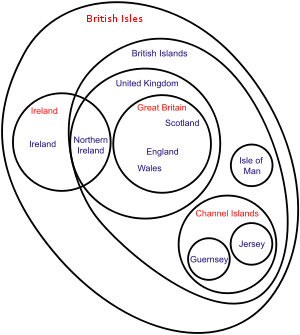
And for a more impressive example, imagine that we have laid out the following diagram instead of a bunch of axioms of the form “Ireland is in the British Isles,” “Ireland is not in the United Kingdom,” etc.:
Then upon hearing someone say, “From the [written] axioms we have mathematically derived the following theorem: Every country that is in Great Britain is in the United Kingdom,” a sufficiently intelligent being (in this case, you or me) would reply, “That was already contained in the [diagrammed] ‘axioms.’ There is no need to ‘deduce’ it! At most you could say you’re just pointing it out.”
So… this suggests that much of what we regard as difficult thinking that has in some cases taken centuries for people to work out might be trivially easy if done in pictures. It’s just that the pictorial representations have not been ambitious enough, probably in part because people would be resistant to learn very complex diagramming schemes.
And also, I think this means we are engaged in the same enterprise: we both want to create better engines for basic communication “language,” but I am emphasizing the visual aspect (or really all sensations, but visual seems the most practical for now).
I think success in this area would mean great strides toward AI, and even if not, it would still mean tremendously much for human communication and hence our understanding of each other.
That is really interesting. It may be better than English at handling voice and the nouns/adjectives.
However, you seem to be saying that we need grammatical voice to give speakers the flexibility to rearrange objects without changing the meaning of the relation. But it strikes me that we only need both “something killed him” and “he was killed” because something doesn’t normally include people. If we had a normal English construction that just said something like “X killed him,” would there be any use for passive voice? And if we could say “I killed X” we wouldn’t need anti-passive, right? From those examples it seems (on my admittedly rudimentary consideration of this so far) that maybe the only reason we need grammatical voice is because we don’t have sufficiently non-specific words like the mathematical “X” - because “something” implies a thing not a person, etc.
And I also suspect voice could be partially or completely done away with in a visual language.
I think that we should just replace the word “idea” with the word “perceptions”, and then define them as everything. Our consciousness is just a series of perceptions. We don’t experience anything not a perception, and we don’t perceive anything not an experience. Our perceptions aren’t in our minds. They are our minds. Our consciousness isn’t anything other than a bundle of perceptions. Feeling, seeing, hearing, hating, and so on, all of them are nothing but perceiving.
With the last section in mind, our simple perceptions are spatial points, the most fundamental spatial relations, the most fundamental temporal relations, our most fundamental feelings, and so on. I can’t enumerate all of our simple perceptions, because I don’t know how, but I am pretty sure that spatial points and temporal disparity are two of them.
(Time is to us two things: (a) temporal disparity, and (b) temporal direction. We don’t only say whether something happened at the same time or at a different time than something else; we also say whether it happened before the present moment or after the present moment. So temporal disparity and temporal direction are two candidates for being simple perceptions. But we distinguish between before our present moment and after our present moment only because our lifecycle is a linear movement from birth to death, and we can see how far we have progressed in that journey at any moment, and because everything else around us is subject to the same sort of thing. If we were to not see a regularity in the growth and deterioration of us and everything around us, we wouldn’t be able to distinguish between before and after. We would see things changing, but we wouldn’t see anything moving forward or backward. If the universe fluctuated chaotically, what justification we have for saying that time is moving forward? So I don’t think that temporal direction is a simple perception. But temporal disparity still stands.)
We can’t observe relations without objects, but we also can’t observe objects without relations. They aren’t logically prior or posterior to each other. They are correlatives. We can’t imagine one without the other. We can’t imagine a relation without two objects, because there would be no relation. But we also can’t imagine an object without a relation, because it would be floating in nothingness. Try to imagine a simple perception such as a spatial point without imagining a relation. It is impossible. It has to be at least related to you. It has to be in front of you, in back of you, in your visual field, or something like that. It can’t just be hanging in nothingness, with no relation to you.
And what the sentence “a chair is in my room” refers to isn’t a simple perception. It is made up of simple perceptions, such as spatial points, the most fundamental relations between those spatial points, and so on, but it isn’t itself a simple perception. So we should expect that a diagram referring to it, but also having other uses, wouldn’t itself be a simple perception either.
I don’t know how to. Do you have any ideas?
I’m not sure what you mean. (Did you explain it in the Mises/Quine thread?)
Can you explain the second one? (Did you explain it in the Mises/Quine thread?)
Our consciousness of the public world is at the most fundamental level a succession of spaces. We see an iteration of space A, which has a ball in the bottom left corner, and then we see an iteration of space B, which has a ball still in the bottom left corner, but further toward the top right corner, and so on. But then we put them together in order to come up with an idea of the change.
Our consciousness of our private world, when we aren’t thinking about the public world, is basically the same, except each iteration doesn’t consist of spatial points arranged in a certain manner, but consists of points with varying meanings and degrees of severity to us. Our emotions aren’t spatially related to each other, but they are related to each other in terms of what they are advising and how severe they are.
Our consciousness is a succession of iterations of spaces, feelings, and so on. So we can compare things in iterations, and we can compare things between iterations. I could compare the ball in the first iteration to the lines making up the perimeter of that iteration, or I could compare the ball in the first iteration to the ball in the second iteration.
So there are different levels of description both in iterations and between iterations.
We can explain things in iterations different ways. We can for example say that a pot of water is boiling, or we can say that the molecules of water in the pot are vibrating in a certain way. Both of those descriptions refer to the same thing, but they are still different. They are different “levels” of description. One is of the macroscopic scale, and the other is of the microscopic scale.
And, if we assume that there is a regularity in the succession of iterations, we assume that the information contained in one iteration is the equal to the information contained in all of the iterations, which means that we see each iteration as a level of description of the entire succession of iterations.
So “2 + 2” and “4” are just two levels of description of the same thing, and they are of course of the first variety, because they don’t have anything to do with a succession in time. But I don’t think that the matter is as simple as you are acting like it is, because see what happens when you go back to the example about the water boiling. A video of the macroscopic scale, which would be of a pot of water boiling, and a video of the microscopic scale, which would be of a bunch of molecules vibrating in certain ways, would of course be different. They wouldn’t lend themselves to being seen as referring to the same thing as pictures any more than they would in writing. Or would they?
So the conclusion is that all of our science has to do with connecting levels of description. But there are two types of doing that. One is staying in iterations, which is what David Hume called “relations of ideas”, and the other is jumping between iterations, which David Hume called “matters of fact”.
And the question is whether visual stuff could work better at doing this. The example that you gave with “2 + 2” and “4”, I don’t know whether mathematics could progress without splitting the visual “…” into the the two levels of description, “2 + 2” and “4”, among others. Aren’t the levels of description important for other things? What your example did was just take the two levels of description and show what they were both referring to. But, with the example with the boiling water, couldn’t we get something from looking at the macroscopic scale that we couldn’t get from the microscopic, and vice versa? Isn’t that the point of different levels of description?
(By the way, while I have you thinking about the two types of levels of description, I want to say something about praxeology. Every science has to do with connecting different levels of description, whether they are the levels of description in iterations or whether they are those between iterations. So where is pure praxeology? Does pure praxeology stay in iterations, or does it jump between iterations? I think that it stays in iterations. Saying that we desire A because we both desire B and think that A leads to B is staying in one iteration. Desiring A, and both desiring B and thinking that A leads to B, are just two different levels of description of the same thing. And they definitely don’t have anything to do with succeeding iterations. The moment we come to the conclusion that A leads to B while desiring B, we start desiring A. So where does jumping between iterations come in? Isn’t that psychology or something? Shouldn’t we combine psychology and praxeology to get the whole picture, just like people combine mathematics and physics to get mathematical physics, which gives the whole picture? I think that pure praxeology doesn’t jump between iterations, but Austrian School economists in practice jump between iterations. Maybe the next step in the theory would be making that explicit? These are just rough, somewhat tangential thoughts.)
I could make a word containing no information, which could go in the space of something which I want to omit. Suppose that “tom-” is the root for that word.
Starting with this:
Djekusi bava deva
I could get these:
Djekusi bava deva
Djekusi toma deva
Djekusi bava toma
Djekusi toma toma
But that might be a bit unwieldy, or we might be able to get a different emphasis by using voice instead of the no information word, or something like that. Either way, the language would have both options, so the speaker could choose whatever he thinks will work the best.
(Also that doesn’t include the inverse or reflexive voice.)
I want to show you what I think would be a good starting point in explaining how languages originate, and you can tell me how your explanation relates to my explanation. (I don’t know whether I understood your explanation very well.)
We so strongly associate the symbols with what they symbolize that the perceptions of the symbols “feel” like they are what they symbolize. When a person says to me for example “table”, a perception of a table appears in my mind whether I want it to or not. This is what underlies the game which children often play in which one of them tells the other to not think of something, such as a purple elephant, and then says that they won because it is clear that the other thought of it. So we barely need to “interpret” the symbols which we hear, because what appears in my mind almost coincidentally with the symbol not of my own will, is what that symbol symbolizes.
So that sheds light on how languages originate. We have the power to choose what to do, we have the power to make a wide range of sounds, and we have this principle of association working in us. So, if somebody makes a certain sound everytime something appears, such as a cat for example, the next time somebody says that sound, the people will perceive a cat whether they want to or not, and then expect that a cat is someplace around them which they haven’t checked yet. So, if somebody says “cat” when you are looking at a cat like 20 times, and then says “cat” when you aren’t looking at one, you will perceive a cat in your mind, and expect that one is around you someplace.
I think that it would be possible to use the principle of association to come up with an explanation of the origin of language analogous to the explanation of the origin of money.
Although I think this is self-evident, you are almost the first to agree with me on this! I notice you didn’t include “thinking” in the list, but the same logic applies: if it’s conscious I must be perceiving it, so conscious thought must happen through sensations/perceptions/ proprioceptions or whatever we shall call them. This of course feels strange because we are generally not aware of experiencing sensations as we think. I only realized this last summer when I was actually able to see my thought process for a brief little while. Since then I’ve been able to access it more regularly, and I’ve seen and talked to many people who have seen much more (including Einstein, who claimed to think in visual and “muscular” sensations). The sensation-based nature of thought is my No. 1 interest.
This part is hard. I would say that at bottom we access all of these consciously through pure sensation, but what our subconscious does with this, how it processes them and how it feeds them up to our conscious awareness get increasingly into unknown and perhaps even unknowable territory. A few things we do know:
We can only focus on a few things at once, because we have a very limited short-term memory (STM). I’d wager that STM figures prominently in how we perceive the flow of time.
We get much faster at tasks with practice. What at first required laborious and careful conscious attention (say, using chopsticks), in time becomes something I can do while devoting nearly all of my attention to a conversation. I recently noticed that I can weave through a dense arrangement of pedestrians on my bike, while on the phone speaking Japanese, with enough mental ticks left over to wonder what people are thinking of me! I think the nature of practice is that, once certain patterns of movement and decision rules for eventualities are set through conscious focus, they eventually “take less and less time” = “slip further and further down into the fuzzy threshold that separates conscious from unconscious.”
My suspicion is that the line between conscious and unconscious is not clean, but in fact is just determined by speed. The faster it happens the more subconscious it is. In some sense I can be conscious of almost any one thing I do when riding a bicycle, if I think to notice, but mostly it just happens way too fast. Rather than say it is below conscious awareness, I would say the sensations are flashing in my mind so fast that I cannot possibly remember them. Since there is a limitation on the number of things we can hold in our STM, it would simply be impossible to hold even a small fraction of all the sensations of the process of riding a bicycle in my STM at any given time. When I am first learning and it takes all my concentration is when I am most aware of those sensations, but I am also most preoccupied with the learning task. So one way or another we hardly ever get to notice the sensations that are our thoughts, racing by.
I also think we can take hints from psychology, even though we of course cannot rely on it for praxeology. I see no reason why it can’t inform our intuition, though, since that is a crucial part of how we actually come up with good ideas.
Time is something I’ve yet to seriously look into, but I will bet it has something to do with STM, as well as a kind of tagging system in the conscious-subconscious interface for labeling a sensation as (a) a memory, (b) a sensation that feels like it’s actually happening to our physical body right now, (c) a future imagined sensation, (d) a past imagined sensation, etc. For example, in NLP they claim that if you ask people to imagine a future event they will look up-left, and for an imagined past event up-right, for a real past even down-right, etc. (I don’t remember if the directions are correct, and I know different people are supposed to have different internal representational systems). [You can probably torrent Using Your Brain for a Change to get one of the classic NLP books that talks about many different people’s specific mental “tagging” systems. Note: My ideas on this are not from NLP, but I’ve noticed that NLP jives with them.]
I can imagine a pain in my hand, or seeing blue, or smelling watermelon. You can say it’s related to me, but then either that’s a statement made from a third party or “objective” point of view, or I’d have to wonder what we really mean by “relation.” It seems you’re saying that anything can be thought us as standing in relation to something else, but that doesn’t necessarily mean that that relation is inherent in the experience of the sensation itself. This perhaps goes back to dots and connected dots, which is what I PMed you about before. Perhaps you are talking about the connected dots (the model), not the dots themselves.
I’m guessing here by simple perception you do mean “dots” (not as in spatial points, but as in “raw sensory data” prior to applying a theory to make sense of it). It depends on at what level I am thinking of “A chair is in my room.” If I am just thinking “X is in Y” and am not at this precise moment concerned about what X and Y refer to, I might just see a diagram.* Even if the diagram could be used for other things it may still be that that is all that is perceptually present for me. Now I think you are making a slightly different point that, say, a picture of a chair in my room would not be simple because it is made up of visual “pixels” (a scientist might say, photons striking my rods and codes). I haven’t pursued that line of analysis, just because there are some messy issues about how much we really access those photons hitting our eye directly, how much the subconscious filters it, how much we really see and how much we think we see and is just being filled in by our imagination, etc.
*This isn’t as strange as it may sound; it’s just when I am turning my attention only to the “something-is-in-something-ness” aspect of the situation. I think this is what deduction feels like - a formless, mechanical process of basically reading off diagrams, just like how you can read off from the British Isles diagram that Scotland is in the U.K. The modeling side of thinking feels more like intiuting, being creative, having flashes of insight, etc. Logical error feels like what most people describe as “thinking” - a confusing, somewhat frustrating feeling of having to cut through semantic soup to get at actual thoughts rather than conventional fuzzy word-thought blobs.
I really have no idea. I’ve never employed the term myself, and I half-suspect it might just be an aspect of language rather than of experience itself. That would be radical, but I would not be too surprised if something like that were the case.
There and in the PM. It’s just the whole business with the bee and flower connect-the-dots example.
Dots are raw sensory data, and I (my subconscious? my conscious? probably the latter first, then eventually - with practice - the former) connect the dots to make useful predictive models. It’s the so-called “inductive” aspect, although I disown the baggage of that term.
For another example, imagine a girl playing Super Mario Bros. for the first time on a really old TV that is cutting off the top part of the screen that would normally be showing how many lives she has left. She doesn’t know how the game works and doesn’t have the manual, so she has to figure things out for herself. Sometimes she hears a particular noise, but doesn’t know what it means. (Spoiler: The noise is the famous 1-UP noise meaning she got an extra life.) She learns from experience that she has to start over if she dies three times, but soon she notices that whenever she has heard that sound, she doesn’t have to start over after she has died three times, but instead four times. And she later notices that if she hears the noise twice she can generally count on being able to die five times before getting Game Over.
From the perspective of attempting to make sense of what use that noise (raw sensory data; “dots”) could be to her, she might “connect the dots” and form a predictive model that she deems useful to act as if, for instance: “Every time I hear that sound that means I have one more extra life.” So if she hears the 1-UP sound many times and she is eager to advance, she may be more cavalier; but if her model predicts she only has one life left, she may exercise particular caution despite her eagerness to advance, or she may adjust her strategy toward trying to harvest more 1-UP mushrooms. She deems it useful to act in accordance with this model, which is constantly being evidenced as being a more and more accurate predictor of her future sensations, hence more useful.
She doesn’t ever really know what the sound means; it could actually mean something like, “You just gained an extra life if there are no pipes on the screen right now; otherwise it means nothing.” It could mean that, but by Occam’s razor - which I think is a natural tendency people generally follow in their modeling unless prompted otherwise by ideology, etc. - it wouldn’t be the most efficient theory to posit until at least one data point contradicted the existing model. Make sense? I hope the context of video games, since praxeology also has to apply in it, can help us throw off some of the biases we might otherwise have in discussing human action.
Actually this a great example, because in referring to the things scaling up, that is, that we should be able to derive the macro-scale results - in principle - from the micro-scale ones, you are positing that the physical world behaves essentially like an idealized mathematical model. (Or at least a theory that is tantamount to the same.) In comprehending the physical reactions that take place, I of course will not be seeing just a video of water boiling. I will be seeing the thought process, however fleetingly, that I must see (and/or feel, hear, smell, taste) in order to consciously be aware of my assumptions about the physical world and my deductions on those assumptions as applied to this particular case. If anything, it would be more like a schematic “video” where the assumptions, laws, and data relevant to whatever I was ratiocinating would be represented in abstract, possibly diagrammatic form.
Just take everything you know about the boiling pot of water. Take all the premises about the physical would, about H20, heat, metals, etc., as the starting premises. I contend these can be put into some kind of sensual representation - probably all visual if necessary - perhaps in the same general fashion as with the British Isle’s diagram above, in which I can hash out the necessary deductions just like mathematical proofs can be done with diagrams. We arrive at the macro-level result as a logically necessary conclusion, although the schematic itself will not produce the normal-view video of boiling water, simply because there is much more going on in that normal view. But we can know just what we know from the verbal description (and probably much more): that the water will do all the macro-scale things we associate with the phenomenon of boiling. See https://forum.freecapitalists.org/t/why-modern-theoretical-physics-is-a-lie/14814/34 and also the follow-up post right below it for more clarification.
If this seems impossible, I reply first that we must do this - it is praxeologically necessary if you agree that all conscious experience is sensations. If we only have five sensations, this thought process has to - one way or another - be available to our conscious minds through sight, sound, taste, touch, and smell. If this seems the ravings of a mad man, here’s at least some support from outside:
From the book The Philosophical Status of Diagrams, by Mark Greaves
The use of diagrams as permissible parts of formal proofs in logic and geometry encountered stiff resistance in the 20th century. Contemporary definitions of validity in logic are stated purely in terms of relationships between strings of a formal language, and it is now commonplace to observe that a valid geometric proof must not be based on any pictorial properties of an accompanying diagram. Yet diagrams have been a constant part of informal proof practice in both logic and geometry since antiquity, and it is a rare mathematician who can execute a formal proof in plane geometry without one. What accounts for the exclusion of diagrammatic methods from modern proof techniques?
This book explores the reasons why structured graphics have been largely excluded from contemporary formal theories of axiomatic systems. In particular, it traces how several systematic forces in the intellectual history of mathematics and logic drove the adoption of sentential representational styles rather than diagrammatic ones. This book shows the progressive effects of these forces on the evolution of diagram-based systems of inference in logic and geometry, stretching from the Greeks to the early twentieth-century work of David Hilbert. This exploration makes clear that the familiar prejudice against diagrammatic inference in logic and geometry owes more to history and philosophical context than to any technical incompatibility with modern theories of axiomatic systems.
In this way, presuming the world does correspond to the mathematical model-like assumptions you seem to be starting with, the macro-scale effects will present themselves exactly according to the micro-level premises and deductions from them. This is really no more striking than saying that the premises of a mathematical system can allow us to derive high-level theorems by pure deduction; in fact it is essentially the same result, just with the starting premises specified by observation of the physical world instead of human choice of axioms. (That’s exactly what a mathematical model is.)
Visually we can do that, too: . . . . Of course, since people understand that “2” is basically something like " . . " we don’t ever need the dots or similar except for teaching young children. My point is that that is how* I at root comprehend numbers. (*Not that this is the only way I do it, nor that other people necessarily do it that way. At times I think of numbers as having colors, maybe even flavors and smells. All for different purposes. My main thrust here is just to show that thinking of numbers in a purely visual/sensual manner is both possible and quite feasible.)
And if you mean for higher than 4, humans can subitize up to 4, and after that we can utilize a base-5 scheme for pretty fast addition and multiplication. I actually see stacks of five blocks in my head when I add, with one or two pieces missing or added on to the top. So when I add 7 to 29, I see the 29 as “ending” with a stack of 4 blocks (25+4) - one block missing from the top - and then slam the stack of 7 blocks (5+2) against it, one block gets caught on the stack of 4 to make a nice round 5 (a 30) then 6 blocks (5+1) are left over to add on top, yielding 36. All the while I am working with subitizable “moving parts” of 4 or less. This is why I think the base-10 system is fairly comfortable for us, because it breaks down into nice 5-block chunks where only 4 pieces added or subtracted ever have to be considered in the final digit.
Above 4, we are of course using Arabic numerals or whatever, although people trained in abacus probably do see it all in pure “pictures,” since many abacus users have learned to do it all in their heads (they still have abacus dojos in Japan).
Anyway, from that point on we are working with symbols and then only our formal rules of math - which can all, I posit, be diagrammed sensually (if they are valid*) - govern how we consider them, along with some eclectic pieces of intuition we have about certain “key” numbers, like a mental picture of a classroom of 40 kids, or the knowledge that a million dollars would be a “heckuva lot” (likely a bodily sensation; I’ve noticed emotional content is all physical - such as in the chest, back, etc. - for me) of money. So I see no problem for math, and certain diagrammatic systems have already been shown to be rigorous, logically sound, and complete methods of mathematical proofs.
*Quine thread has more discussion on this. There is in fact a strain of mathematics that rejects ideas that are supposed to be “unthinkable,” such as Riemann’s point at infinity, existence proofs, proofs by contradiction, etc. See http://en.wikipedia.org/wiki/Intuitionism
For anything, I can’t necessarily tell you how to put it into sensations - that’s my life’s work! for now at least - but I can tell you that it must be arrangeable in sensations, or else it cannot be consciously thinkable.
Yes, that is necessary - that is what thymology is. Praxeology is concerned with what can be deduced. Thymology with the specific models and data. Instead of saying empirico-deductive above I could have said thymo-praxeologic. The role of praxeology, as I see it, is to elucidate those logical deductions that are deductible from premises which are self-evident to everyone, but whose deductive results are nonetheless hidden from view. You might be wondering why the deductions are hidden from view. You have probably heard philosophers say that philosophy is mainly a negative discipline, where the game is to clear away what is preventing us from seeing the obvious. You may have heard of Max Stirner who had a lot of success simply rejecting every other kind of theory.
Mostly what I think happens is people have a pretty good idea of what is going on when they don’t think too much, but it is not perfect. They have myriad assumptions and misconceptions handed down from their parents and society in general, and through the distorting effect of language itself, so they must think to some degree to reach useful conclusions and discard other “spooks” in order to be better than the average if they are to prosper as thinkers. However, these theories they develop to cope with the broken conceptions and the noise they started with (in the case of philosophers, the main source of the noise is probably other philosophers!) can easily just lead them more off track, although they may be better than nothing.
Praxeology basically says to me, “All right, STOP. Just think about what you know is self-evidently true and can be deduced from there while making no assumptions (other than the self-evident, but since it’s self-evident it perhaps doesn’t count as an assumption - depends on your specific starting points). You might learn something! And oh look, you do! Law of diminishing marginal utility. Thought it wouldn’t work, and would only lead to useless tautologies, didn’t ya? What you didn’t realize was that a tautology is no longer worthless when you realize it’s in direct contradiction to some commonly held theory!”
In one sense it’s a mental hygiene issue. You might have a whole complex of conclusions deduced from certain starting assumptions that are less than self-evident (but still reasonable under the circumstances in which you adopted them), but you may also have more self-evident assumptions whose deductions you have not elaborated as far. If you did undertake to elaborate the deductions of the more self-evident assumptions, you might find the results conflict with the results derived from higher level (less self-evident) assumptions. In such cases, you’ll want to seriously think about rejecting those higher level results. Some would say you must reject them if you want to be logical. That is, for example, if some economic theory works pretty well but is overturned by praxeological insights, it would be consistent to reject it, so long as you are sure you did your praxeology right.
About voice, do you think it’s necessary only because language is linear/sequential?
There are several important things I didn’t get to cover, but rather than add to the length of this - and eat into my sleep time any more - I will leave off here, hoping what I left out won’t distort what I have said too much.
I stopped reading you post there, because I want to say something about it. (I will continue reading it when I finish writing this reply.)
I think that you are correct that the distinction between something being conscious and something being unconscious is at least in one sense just one of how proficient or fast you are at doing it. I can drive someplace normal without even thinking of it at all. I can drive all of the way there, and then not be able to remember anything about the trip except for all of the thoughts not about driving which were occupying my mind during the trip, because those thoughts weren’t normal.
I noticed that, the older which I get, the less mundane things which there are which I have to “consciously” do. I don’t need to consciously think at all about what I am doing when I am driving someplace familiar, I don’t need to consciously think at all about what I am doing when I am using a fork, and so on.
But one of my goals, which I can’t really explain, is that I want to “expand” my consciousness. I want to be as conscious as possible. I don’t like feeling like I am on autopilot. I want to observe the world as actively as possible, so I don’t lose control of my mind. I don’t know how to explain this very well, but that is how I feel.
So I try to spend every moment of every single day trying to learn something new. But it is a constant struggle, because everytime I learn something new, it becomes something old, and I have to find something else to learn to keep it going. It is like my entire life is a constant struggle to make sure that I don’t fall unconscious, because it might be impossible to come back after that.
I don’t know whether you will be able to understand what I am talking about. I wasn’t able to explain it very well, so I think that you would have needed to have had the same sorts of experiences as I was talking about to be able to get it.