"prices cannot rise until full employment" - respond

Neo,

Stuff we agree on, based on your agreeing to what Rothbard wrote in Chapter 11, Section 5, subsection F “Hoarding and the Keynesian System”:

  1. Inflexible prices will result in the over priced thing not being bought. If we are talking about goods and services, those goods and services will stop being made, as people go into other lines of business will actually make them some money. If it’s workers ware talking about, and their wages are too high, there will be chronic unemployment, like we see in Europe today. If everything is overpriced by law, well I’m not sure anyone discusses this scenario. Seems a bit remote. The usual discussion is about overpriced labor. [Oddly enough, marx thought this never happens, the worker always getting the shaft].

We disagree about what the solution is according to Keynes. You say his answer is to print money, thus increasing AD with little to no inflation. But Rothbard quotes him much differently. According to him, Keynes claimed that decreasing the purchasing power of the wages, at the same time keeping the dollar amounts the same to fool the workers, will solve the problem. This can be achieved by inflating the money supply, he claims.

Rothbard also says it won’t work, for the reason I mentioned, that unions keep an eye out for the CPI

Is there an alternate solution, given the theoretical situation that prices will be rigid forever? Not if we accept the validity of the law of supply and demand. If the price of labor is too high, there won’t be enough employers. End of story.

“the usual discussion is about overpriced labor.”

That’s what Keynes in particular thought was the problem, specifically sticky wages caused by unions. Since then the more radical Keynesians have become increasingly ardent in the belief that prices in general are not flexible, casting general doubts asto the dynamic nature of the market system in general, which I see as the most dangerous trend in economics today from any number of points of view. I even read somewhere (and don’t quote me on this) that some post-Keynesians support mild inflation as a way to ensure that prices are more nimble and variable.

At any rate, Keynes did indeed feel that unions were a major reason why prices were sticky, this is especially understandable as he came from the European elite where you did have a good deal of labor problems and a much larger labor movement than ever organically existed in the United States. Unions were part of, although not the entire problem here, part of the problem was indeed, as many American Keynesians contend in our day, that people just plain aren’t willing to accept wage cuts.

Also, I include the example of a world of completely inflexible prices as much as to prove a point as to prove a point as to describe a viewpoint, although there are some Keynesians who have generally as radical a viewpoint. The fact is that I’ve never heard a modern mainstream economist talk about price flexibility or a really compelling reason for a free-market economy, all of which necessarily revolve around short term price flexibilty downwards.

“Is there an alternate solution, given the theoretical situation that prices will be rigid forever? Not if we accept the validity of the law of supply and demand. If the price of labor is too high, there won’t be enough employers. End of story.”

Correct, but then you run into the eternal debate over how long it takes for prices to adjust, which was Keynes’ argument. In the long run depressions are self correcting, but in the long run we are all dead, but life is a series of short runs, and it’s about making the best in these short runs. That’s the real debate here, and we must learn to fight it.

What basis is there for the proposition that prices are inherently inflexible?

To sum up, it’s that people don’t like watching their income fall for any number of reasons.

I should rephrase: What basis is there for the proposition, as employed by Keynesian advocates, that prices are inherently inflexible

neodoxy said:

In Keynesian models prices are fixed and cannot adjust, therefore full employment cannot be brought about until aggregate demand starts to drive up prices by increasing the demand for goods in general.

you are saying prices rise. but keynesians are saying employment increases and prices do not rise.

That’s the basic phillips curve. I know of no Keynesian who argues that prices are going to be stagnant until full employment, but the idea that inflation will be relatively mild until that point is widely. Once again:

See how it is relatively, but not perfectly horizontal up until a certain point.

could someone please tell me what’s wrong with this reasoning?

any entrepreneur regulates production so that MC = MR (marginal cost equals marginal revenue). so he would only expand production (and hire the unemployed) if his MC goes down or his MR goes up. So the only way money printing can make him hire an unemployed is if money printing causes his MC to go down or his MR to go up. But printing money does not cause his MC to go down, so we can rule this out. so the only way printing money could decrease unemployment is if it causes his MR to go up. But, in turn, the only way his MR can go up is if the price of his product has increased. So, money printing only decreases unemployment if some prices rise (or are expected to rise). Unemployment will decrese to the extent that prices rise. If prices increase little, unemployment decreses little. If prices do not increase, unemployment does not decrease.

Please help me spot the error, if any.

That’s how I always understood it as well, that the increase in aggregate demand was a backdoor measure of lowering real wages and thus allowing a higher rate of employment.

Also

No, it’s more than that. The Keynesian treatment of capital has no basis in reality. An essential part of liquidating your assets is a recombination or destruction of improperly combined capital.

For example: The Keynesian treatment of capital is that of an accountants’; capital is simply represented by its cash value on the books. More cash-as-capital, the more performative capital there is. This is permitted under the assumption of homogeneous capital.

The Keynesian prescription then is to restore the pre-crash price level by deficit financing. The problem to them is that aggregate demand has fallen beneath aggregate supply, so ‘bumping over’ aggregate demand will even everything back out, right? This does nothing to solve the actual problem, but makes it worse, as those firms whose capital was combined on the premise of expanding credit will not seek to alter their capital structure, but maintain it in the hopes of returning to the old (pre-crash) price level. The Keynesians may be successful in raising the price level to what it was (though it would be impossible to do it to identity), and the problem would still be present: a non-performative capital structure. The market will still be burdened with a capital structure, in certain sectors, which cannot hope to sell enough of its wares to justify its production processes, meanwhile there are sectors entirely neglected.

The issue is more than price flexibility. If capital were homogeneous and investment were merely a matter of dollars, AND prices were inflexible, then maybe the Keynesians are right. But both the schools of price stability (monetarism/keynesianism) seek to disallow capital from reorganizing toward a better chain-of-production, which often means selling off assets at prices which one would not like to consider in common circumstances.

1. But printing money does not cause his MC to go down, so we can rule this out.

A mistake. Because printing money does not magically make all prices go up right away at the same rate. It makes prices of things the govt wants to spend on go up. This may make prices of other things go down, at least for a while. For example, if the govt decides to spend on infrastructure, the workers of that sector will have more money. They may all decide to eat caviar every day in fancy restaurants instead of hamburgers at McDonalds. This will lower the price of hamburgers, at least for a while, until the money moves on.

2. so the only way printing money could decrease unemployment is if it causes his MR to go up. But, in turn, the only way his MR can go up is if the price of his product has increased. So, money printing only decreases unemployment if some prices rise (or are expected to rise).

Notice his big mistake right here. The first two sentences talk about what CAN happen. The third sentence suddenly says that not only CAN printing money raise employment, but that it WILL raise employment. Which is absurd, because maybe printing money will raise MC more than MR, either in aparticular industry or across the board. In the rest of his paragraph, he just runs with it, once again assuming that what CAN happen MUST happen. Notice what he says: Unemployment will decrese to the extent that prices rise. And the next two sentences again assume that what can happen must happen: If prices increase little, unemployment [must] decreses little. If prices do not increase, unemployment does not decrease.

  1. Austrians have pointed out that printing money also often makes the following thing occur. The entrepeneur is fooled into thinking that MC has gone down, because interest rates have dropped down thanks to the money printing. This makes him malinvest, meaning waste his money. Thus printing money will make his MC go up, and his MR go down. In other words, it causes recessions.

  2. In addition, he doesn’t grasp what Kel Kelly writes in Chapter 1 of his book:

Bear in mind that these apparent profits are not real but a monetary illusion. Due to higher costs from inflation companies must at some point replace their plants, equipment, and inventories at much higher prices, which wipes out most of their paper profits, even though this cannot be seen on an income statement (companies often consume capital without even knowing it). Since businesses have their increased profits from inflation taxed, but have to replace inventory, plant, and equipment at higher costs than last time, the profits needed to replace the equipment at higher costs are diminished because a portion of them has been taxed away; companies thus have about the same, or likely less, real purchasing power with which to replace assets. In short, the increased profits that inflation provides companies do not constitute real increased wealth for these companies; at best, companies come out even.

See Chapter One there for more about this.

  1. Even if MR goes up because money is printed, that increase is nominal, but not neccesarily real. In real terms, he may not be making any more, or may even be losing money. If he knows this, he will not hire anyone, and may even fire people. If he doesn’t know it, he is hiring people that will not make him any money, meaning he is hurting his future and will have to lay people off later.

  2. Now it’s true that printing money will help some people for a little while. If the govt prints money and buys GM cars with it, more GM workers will be hired. But they will have to be fired when the printed money is spent. Which is why printing money mat cause a temporary rise in employment in soem sectors, but that will end pretty quickly unless more money is constantly printed, which will mean destruction of the currency like Zimbabwe.

  3. The only way to improve an economy is to increase productivity, meaning make more stuff with the same or less resources. Printing money does not increase the amount of land we have, or of workers, or of machinery, or improve our methods of production. So of course it cannot help an economy. Which is why Mises said anyone who thinks we can improve everyones lot through monetary means is a crank.
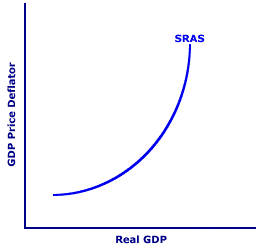
First assess that statement a bit:

  • money is printed (or book money is created), meaning that the money supply is inflated.

  • There isn’t full employment yet. Hence there are still people looking for jobs.

  • Only once everyone is employed price inflation CAN start.

There is more then one problem with that. The money will have to go somewhere. The first recipients will spent this on a specific market segment and you can bet that some of those prices there will go up after a while. Of course this will also stimulate demand for more goods for a while and producers will employ more people. But the price increases DO NOT start only once everybody has got employment. That will definetely start before this.

As a practical example I could give South Africa. Before 2008 there was a boom on the middle and upper class housing marktets. It was easy to get credit, hence to money was entering the economy. Of course more people got work during that time in the housing sector, but the house prices did rise dramatically in this period, too. Later you got price increases in most other sectors as well. Right now prices are at least tripple that what they were in 2003. During all that the unemployment rate remained at an official level of 27%, while many observers estimate it to be far higher at about 40%. It is however quite difficult to say this with certainty, because many people work in the informal sector or are subsistence farmers. It should be noted that full employment is almost never approached in any country.

About all this I can only say that I don’t think that you need full employment for price increases. OK, I guess the wages will go up once full employment is approached, since it will be more difficult to recruit more laborers. But this is actually a good thing, because companies will now look into programs to increase the labor efficiency more seriously (which is also good for people like me ) and this is actually an important motor for progress. Prices could actually go down as result of this.