"prices cannot rise until full employment" - respond

Hi, could you guys please respond to (or give links responding to) the Keynesian claim that printing money cannot cause price inflation until the economy reaches “full employment”?

Aside from the empirical response that stagflation disproves this theory, I am interested in listing the theoretical disprovements — one of which I believe is about capital not being homogeneous. Not necessarily Austrian responses.

External links to blogs, papers, and books are highly appreciated. Thanks

What’s the logic behind his assertion?

Let’s try a thought experiment. Four people form an economy. One of them is homeless and unemployed, living off what he finds in garbage bins and occasional charity. One of them is the govt. The other two make things.

Suddenly the govt guy prints himself a big wad of paper money. He then outbids the other two [not to mention the homeless guy] to get all the stuff he wanted but couldn’t afford until now. Prices have gone up. And the new money in the economy will make sure they stay high.

I guess the Keynesian would respond that the unemployed guy would become employed, production will increase, and prices will not go up (more money but also more stuff).

I am not sure why they believe this will happen (I was hoping for someone to explain it before refuting it).

I’m not following the logic either. Production did not increase but the money supply did, more dollars chasing the same amount of goods. Further, as the value of the money left in the pockets of those furthest from the printing press decreases they have even less purchasing power than before. Not a great recipe for anticipating either investment or hiring.

We know that producers only expand their production if they see that the prices of their products have increased. (this follows from the law of diminishing returns). In other words, only if prices increase would the two producers expand their business and hire the third guy. If they don’t first see the prices of their products increase, they won’t have incentive to hire the guy. But keynesians seem to claim that the guy will be hired and at the same time prices will not increase. This seems inconsistent.

There is a good deal of truth to the assertion. A usual characteristic of economic downturns is, of course, a decrease in consumer spending, this is generally true no matter what school you follow. In Keynesian models prices are fixed and cannot adjust, therefore full employment cannot be brought about until aggregate demand starts to drive up prices by increasing the demand for goods in general. Put another way, during a recession people save more, increasing the demand for money which in turn increases the price of money, meaning more goods must be offered up in relation for the same amount of money, AKA price deflation. Therefore increasing the supply of money, assuming that no changes in the demand for money or the supply of goods, will lead to only mild inflation which will be inherently beneficial if prices are sticky, or if enacted early might keep the price level constant where it would otherwise fall, which is exactly what the economy needs.

Therefore, so long as the inflation isn’t to severe or the recession isn’t too mild, they are perfectly correct in their assertion, although there is a small bit of incorrectness here in that, because of the non-neutrality of money, meaning prices will not rise equally, and therefore some prices might rise while others might not change at all as the result of an increase in the money supply.

To restate this again: The disagreement with Keynesians ultimately results from price inflexibility. If prices are flexible, the Austrians/non interventionists are right. If prices are inflexible, the Keynesians are right.

Forgive the simplicity of my question (I am a layperson in Economics) but would this inflexibility help explain the desire to fix prices, such as under FDR? It would seem that government-mandated inflexibility would help promote a Keynesian position.

My apologies for not addressing all the many errors of reasoning in Neodoxy’s post. The fingers type not as fast as they used to. But here’s some good stuff, if only partial:

A usual characteristic of economic downturns is, of course, a decrease in consumer spending, this is generally true no matter what school you follow.

Let us not confuse cause with effect, stimulus with response, symptom for disease.

Say someone has a disease causing his skin to turn yellow. Surely painting him flesh colored will not help matters, especially if the paint used contains the very toxin that got him sick in the first place. This is generally true no matter what school of medicine you follow.

A decrease in comsumer spending, while as unpleasant as headache and nausea, is a symptom.

In Keynesian models prices are fixed and cannot adjust…

Let us grant this assumption, but once again, let us not slop paint on the patient and say we have cured him. Flexible prices are essential for a functioning economy, I think we can all agree. What has to be done is find what froze them and change that. Of course it will be something artificial, meaning a rule or regulation or law imposed on the market.

But keeping the cause intact, and at the same time whitewashing the symptom by redistribution, is surely not going to help matters, no matter what school you follow.

…full employment cannot be brought about until aggregate demand starts to drive up prices by increasing the demand for goods in general

  1. Have you heard of Say’s Law? You know, the one that explains that aggregate demand can only be increased by increasing purchasing power, which can only be increased by increased production? Or do you think it is wrong in a money economy, or that it has some other absurd flaw people have made up?

If you agree with the Law, do you agree that a consequence of the law is that printing money is absolutely useless in increasing AD, because is it not an act of production?

If you disagree with the Law, why?

  1. Let us introduce the parable of the Martians. Seeing that the economy is in a deep recession, Obama calls up his pals living in outer space.

“Guys, we have us a recession here. How 'bout you help us out?”

“Sure thang. What you want, bro?”

“Come on down here and haul off half of our stuff and take it to Mars.”

“But people will want to be paid. We Martians have a code.”

“No problem. I hereby authorize you to print money and dump it wherever you hauled stuff away.”

Obama sits by happily. “I’ve increased demand, all right. And the money supply. And prices are sure up. People are lined up in front of the stores, in fact fist fights are breaking out cause there’s not enough stuff.”

Now replace “Martians” with “govt” , and you have the absurd solution Keynesians advocate.

So what’s the flaw? Obviously, letting a bunch of parasites loose to gobble things up does not improve anything. Only if increased demand comes from increased production, thereby non-parasitic, is it beneficial to the economy.

Mises put it very well when he defines monetary cranks.

The monetary crank suggests a method for making everybody prosperous by monetary measures.

  1. You realize that there are costs of production, right? If prices go up, the price of making stuff goes up, too. Net result, no increased incentive [aka profits].

OK, fingers need some walking.

ancap,

If by promoting a Keynesian position, you mean giving govts incentive to be Keynesians, rest assured they don’t dont need any. They love Keynes.

If you mean that it govt imposed price fixing creates a situation where Keynes’ ridiculous notions will aplly to reality, then the answer is no. Keynes is wrong in all circs, just as jumping off a tall building without a parachute never improves ones health. I wrote a bit about why in a previous post.

Hi, could you guys please respond to (or give links responding to) the Keynesian claim that printing money cannot cause price inflation until the economy reaches “full employment”?

Who says this exactly?

I’m gonna go on a limb and guess…Keynesians?

Names? Quotes? References?

How about this: Lord John Maynard Keynes, in General Theory on Employment, Interest, and Money! LOL

Who says this exactly?

Esuric, sort of:

Monetary injections do not automatically and necessarily yield inter-temporal disequilibrium and discoordination (i.e., an accumulation of malinvestment). Thus, it logically follows that there is no 1-1 direct relationship between changes in the “TMS” and business cycle volatility. This is due to the fact that monetary injections become inflationary (and therefore arbitrarily reduce the market rate of interest below the natural rate) only when expansions in the supply of money > the demand for money.

Phillips:

https://en.wikipedia.org/wiki/Phillips_curve

"Say someone has a disease causing his skin to turn yellow. Surely painting him flesh colored will not help matters, especially if the paint used contains the very toxin that got him sick in the first place. This is generally true no matter what school of medicine you follow.

A decrease in comsumer spending, while as unpleasant as headache and nausea, is a symptom."

It’s irrelevant how one gets into a depression. To be a broken record, if prices are not flexible then the depression is there to stay unless aggregate demand picks up. The fact that an arm is broken tells us only certain things about how it needs to be treated, but the problem that needs to be delt with is both dealing with the specific way that the arm is broken and the very fact that the arm is broken. The economy cannot recover until demand increases or supply shifts to the right, although of course the persistence of malinvestments would also mean that the economy could not heal properly if they were not liquidated.

“What has to be done is find what froze them and change that. Of course it will be something artificial, meaning a rule or regulation or law imposed on the market.”

Lol not if we’re working in the keynesian dream world. Of course when dealing with the real world prices will be quite flexible under free market conditions, and less so when the government imposes regulations, taxation, subsudies, and stimulus. This is why I say “it all comes down to price flexibility”

“Have you heard of Say’s Law? You know, the one that explains that aggregate demand can only be increased by increasing purchasing power, which can only be increased by increased production? Or do you think it is wrong in a money economy, or that it has some other absurd flaw people have made up?”

I admit that I don’t understand Say’s Law as well as I should (I believe that I have a basic understanding of it but not nearly one that is thorough enough. Could you provide me with a useful link?) but would it be fair to sum it up with “there cannot be a shortfall in aggregate demand, only misallocations of production”? At any rate, from what I understand of the law it once again fails in the face of inflexible prices. Therefore I don’t disagree with it, I merely argue that if prices are inflexible that it does not apply.

“So what’s the flaw? Obviously, letting a bunch of parasites loose to gobble things up does not improve anything. Only if increased demand comes from increased production, thereby non-parasitic, is it beneficial to the economy.”

First of all government spending doesn’t always have to be wasteful, it is certainly conceivable that the government can engage upon projects which are, if not fully productive, at least semi-productive, or at least increase the utility of many people. Secondly and most importantly, you still don’t seem to accept the full consequences of sticky prices. If the economy is in a terrible slump, let’s say with 50 percent unemployment, and somehow (once again, I am going with the Keynesian assumption, not my assumption) prices are just plain stuck in place and cannot adjust, then if these Martians did this money drop then the increase in the money supply and spending would lead to an increase in purchases which, if it restores aggregate demand to the right point at the AS curve then the society is likely better off than they would have been at the lower point in the AS curve, even if a bunch of stuff has been carried up.

“The monetary crank suggests a method for making everybody prosperous by monetary measures”

Mises is right if monetary factors are not retarding progress for an extended period of time. If sticky prices are preventing readjustment then only monetary measures can get the economy out of the monetary rut. Once again, this comes down to differences in models and assumptions. In Mises’ view of the economy real conditions are properly transmitted through flexible prices. In the Keynesian model under certain conditions real factors are not transmitted through prices, and therefore the economy is stuck. They are not monetary cranks, they just make foolish assumptions, they are not the likes of Proudhon who thought that interest could be abolished through monetary means.

“You realize that there are costs of production, right? If prices go up, the price of making stuff goes up, too. Net result, no increased incentive [aka profits].”

… And? I fail to see what that has to do with the situation.

Now, to clarify some things.

Dave, I want to make some things clear:

I AM NOT A KEYNESIAN, I’m trying to show what I believe to be the real difference between the Keynesian and Austrian policy prescription, which is inevitably about price flexibility if you take out all the supplemental liberal crap that’s been thrown in post-Keynes. You’ve read MES, now go back to Rothbard’s last chapter on the free market where he talks about money and read the last few sections where he talks about a fall in the demand for money and the problems with the Keynesian system. Now assume that prices aren’t flexible. This would render the Austrian and Keynesian view essentially the same in terms of what needs to be done, with the exception of the Austrian’s emphasis upon malinvestment and the ignorance of man.
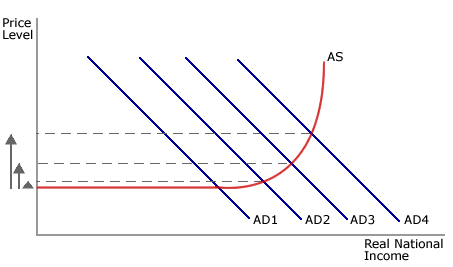
“Who says this exactly?”

Bro, that’s like macroecon 101. Maybe they don’t argue that NO inflation will occur, but merely that it will be very mild

See how the AS curve is horizontal up until about AD2 and then is increasingly upwards sloping? That means that until you hit about the full employment level then the price level will rise relatively slowly. It’s in like every basic macro book.

No Neo. He needs names. Quotes. References.

I’m sure Paul Krugman says this once a week.

Paul Krugman says this (pretty much) exactly: