Because the market for gold and silver is so small, that any additional set of buyers represents a dramatic rise in demand for those two.
neat idea. im not sure if it seems plausible to me. any data on the relative size of these markets?
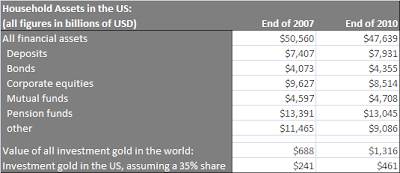
$461 billion of gold in a $48 trillion financial market? If everybody liquidated 0.1% of their financial assets and put it in gold, stock of investment gold in US would more than double. Such a rise in demand MIGHT lead to a dramatic leap in gold prices. 
^ that’s pretty cool. 
From where did you get that table?
Right, kid. What is the size of the derivatives market worldwide? almost 1,000,000,000,000,000,000,000,000,000 (quadrillion)? The point is that those debt instruments are not assured payoffs. In fact, there may even be too much debt floating around as colleteral to function without continual credit expansion. Those gold numbers in NO WAY indicate gold that is not traded. Inconclusive.
So…gold…is …for…insurance…
We all know the elite families own all of the gold and that after them it’s the IMF.
The elite families own all… and the IMF owns the remainder?
shaaadup, you know what i mean.
The IMF is the institution that holds and/or trades the largest amounts of it.
/facepalm
Asserting that the rise in the dollar price of gold doesn’t matter is as silly as asserting that the falling price of homes does not matter. Of course it matters, how could it not matter? (Edited for pretty bad typo…)
As far as gold being a small market, I don’t understand where you’re getting that idea. Wolrdwide, official gold reserves alone are over 30,000 tons. Private holdings are estimated to be roughly equivalent to this. I don’t see how 60,000 tons (almost 2 billion ounces) is a small market. And jewelry accounts for half again the combined total of official and private gold reserves.
Clayton -
-
And how exactly are you confirming it is not a rise in the supply of dollars? Wait. Don’t tell me…
-
Even supposing you have some way to prove your claim and you aren’t just engaging in a propositional fallacy, a dramatic rise in demand for something means “nothing”…because?
(This leads me to wonder if this is even a serious thread. If it weren’t a long time user I would have automatically assumed it was obvious trolling.)
-
I am not trying to undermine or prove whether QE2 and inflation expectations led to a rise in gold prices. I am, however, pointing out that when only 30,000 tons of gold is held for investment purposes, then just about any factor can lead to a jump in gold prices. If all the newly wealthy middle class families in India and China start using their freshly obtained surplus funds for buying gold in 2013, those millions of families could represent a demand for another 6,000 tons of gold. Doesn’t seem much, but that’s a 20% rise in demand for gold. If a trivial thing like that can lead to a sudden jump in gold prices, then there is no point in trying to determine whether the rise in gold prices is due to inflation expectations and QE2 or not. It could be anything, and we don’t know the extent of it.
-
It means nothing, because in this case, you could have a multitude of small reasons for additional demand for gold in a given point of time, and each of those small reasons could lead to a huge spike in gold demand.
Basically, people who try to refer to rising gold prices alone as a sign of rising inflation expectations, business uncertainty, and rise in supply of dollars are not making a strong enough case. To press on rising gold prices alone would be pure confirmation bias.
It’s as futile as trying to attribute oil prices rises to QE2, in a time when the Middle East and North Africa are having supply shocks due to internal turmoil and when oil has a very high price elasticity of demand.
hmmmm.
So basically your argument is that a huge spike in demand (even with an item that has, as you admit, a very limited supply) means nothing because it could be caused by more than one factor. I’d still like to know how the simple fact of something having a possibility of multiple causes means the effect has no implications.
And who exactly has done that?