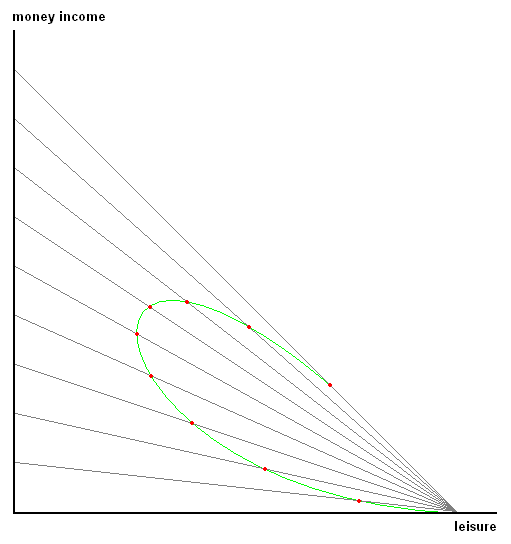
This is a question regarding Rothbard’s claim that higher wage rates will lead to a higher demand for money.
To start off with, some excerpts from MES pages 757-58.
“For labor services, the situation is more complicated. Labor,
as we have seen, does have a reserved use—satisfying leisure.
We have seen that the general supply curve of a labor factor can
be either “forward-sloping” or “backward-sloping,” depending
upon the individuals’ marginal utility of money and marginal
disutility of leisure forgone.”
I have omitted an example he makes.
“In both cases, the man earns more money at the higher wage rate.
This will always be true. In the first case, it is obvious, for the
higher wage rate induces the man to sell more labor. But it is
true in the latter case as well. For the higher money income permits
a man to gratify his desires for more leisure as well, precisely
because he is getting an increased money income. Therefore,
a man’s backward-sloping supply curve will never be “backward”
enough to make him earn less money at higher wage rates.”
To sum up, according to Rothbard, given that an individual chooses to consume more leisure when offered a higher wage, she will only do so to the extent that she doesn’t lower her money income.
Using the graph below to illustrate the above. According to Rothbard, given that the individual chose point ‘a’ at a lower wage, and that a higher wage brings her to consume more leisure, she will only do so at some point on xy (i.e. at some point where her money income is not lower than before).
However, I see no reason why an individual couldn’t prefer a point on yz to xy, and in doing so, lowering her money income and thus her demand for money at a higher wage.