Shock Therapy

Sometime ago, I was reading a criticism page on Libertarianism to ensure that my knowledge of events are as impartial as possible. Here was the page:

Most of it, I was able to refute in my head just as I read it. But I came upon this:

I was curious as to the details regarding Jeffrey Sachs’ economic shock therapy of Chile and why the results were the way they were. In my investigation, what I came across was many unsourced claims of government bailouts (which doesn’t help because it doesn’t explain how they got to the need for a bailout) and an article on the Lew Rockwell website about Milton Friedman:

I was wondering if anyone here had more information on the subject as I feel like I’m missing a few key elements of this particular event in history. It seems most contemporary sources cite Pinochet Chile as a failure and I’m curious as to why this was.

There certainly was come economic turmoil soon after Pinochet implemented these free market measures, and leftists single out this period to make their case. Actually one can say that these economic problems were inevitable, since Allende had completely destroyed Chile’s economy.

But some years later, despite some heavy intervention from the state still present in some areas of the Chilean economy, Chile’s economy recovered fast and continued to grow, today Chile is by far the most developed country in Latin America and even the Chilean left, despite hating everything Pinochet, never criticized Pinochet’s economic policies that much.

Interesting. So, is it fair to say that economic shock therapy is beneficial to a nation then?

With all due respect, I’m kind of a hard data kind of person. And (granted it’s from Wikipedia) the GDP growth in Chile doesn’t really reflect that.

While there was certainly a drop at the inception of Friedman’s policies, which was offset by a sharp rise in the next couple of years, it seems to have sharply declined once again. Can this drop be attributed to the policies of Salvador Allende? And it seems that as the chart comes into more modern times, it seems more or less even with the rest of Latin America.

In addition, do you perhaps have more information on how the following is linked to Allende:

I apologize if my questions are rather basic. I am still learning. But thank you for your response. :slight_smile:

Also, I accidentally clicked the verify answer on your post and I have no idea what that’s for. Does that mean I liked the answer or I can confirm what you’re saying or what? :x

My country went through what I now know to have been among the ‘shockiest’ therapies, with the totalitarian socialist economy being dismantled almost overnight. And let me tell you, it was the best thing we have done in a century. Shock therapy works perfectly, so perfectly that I’d happily go back to the king of free market we had ion 1993.

If you mean by shock therapy a rapidly liberalization of the economy, absolutely.

Regarding GDP, the problem is that GDP is a very misleading piece of data, it counts government spending as economic growth rather than economic vandalism. It classifies imports as ‘bad’ and ‘exports’ as good. I wouldn’t say it’s 100% useless, but it’s not a good number at all to indicate real economic growth.

“Can this drop be attributed to the policies of Salvador Allende?”

No. That was due some stupid monetary policy by the Chilean government combined with an international debt crisis that affected South America a lot.

“universal health care was abandoned (leading to epidemics of typhoid fever and hepatitis), unions were outlawed, military spending rose (for what? who the hell is going to attack Chile?), social security was “privatized” (with predictable results: ever-increasing government bailouts) and the poverty rate doubled, from 20% to 41%. Chile’s growth rate from 1974 to 1982 was 1.5%; the Latin American average was 4.3%.”

Abandoning universal health care, outlawing unions (even though I don’t think unions should be outlawed if they were no economic harm would result, it’s the opposite, actually), privatizing social security are all good things and are in no way or form related to these economic problems.

"From the period 1970-1985, there was little growth in GDP per capita, a decline in real wages by 20% and an (overall) increase unemployment from 6% to 14%.

The percentage of Chileans without adequate housing increased from 27 to 40 percent between 1972 and 1988, real prices increased dramatically, the richest quintile increased their share of income from 44.5% in 1970 to 54.6% in 1989 whilst the poorest decreased from 7.6% to 4.4%"

As I said, this kind of data can be deceiving, a better way to see that the free market measures taken by Pinochet worked is looking at Chile’s social indicators and comparing them to the rest of South America, in pretty much all of them Chile is in the top of the list, and they wouldn’t be that much better than the rest of South America if Chile hadn’t outgrown its neighbors economically by a large margin.

Please do it, compare today’s Chile’s social indicators with the rest of South America and see for yourself if these measures didn’t work.
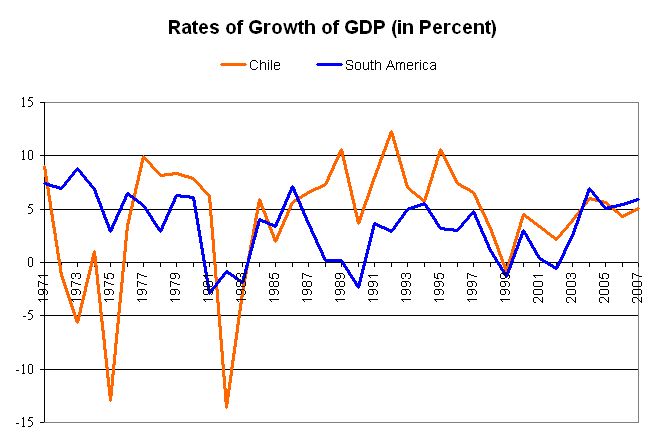
Pinochet was a hyperinflationist. That is probably why GDP was so erratic. The denationalization process continued on long after Pinochet was gone until about 2005. Btw, Chile right now is rated higher than U.S./Canada on economic freedom at #5.

What country are you from?

Really? I honestly did not know that. It does put the Scandinavian model into perspective though. Do you happen to know of any good further reading on the subject?

Interesting. Would you happen to know if there’s a particular name for the monetary policy and international debt crisis, so that I can read more about it?

Yeah, I’m not sure why he bothered to put that in a critique of Libertarianism. Though, I’m curious how he correlates the rise of typhoid fever and hepatitis to the abandonment of universal healthcare.

I’m not really sure if what I found is what you were referring to, but I came across this and this from the Economy of Chile page:

I was hoping the Heritage Foundation website might have what you were saying, but I found nothing. Anyway, looks about right. But how exactly are the other statistics deceiving?

I haven’t come across any information about Chile printing money. In a cursory google search of it, the first result is actually this thread. But from what I was just told about GDP, it seems unlikely that that would be the culprit anyway. I could certainly be mistaken, but it seems to me that printing money could give the illusion of economic success if GDP is measured as a means of government expenditure.

In twenty years, foreign debt quadrupled

Funny claim when Allende’s solution to that was to simply stop paying the foreing debt which turned Chile into a credit pariah

natural resources were wasted

XD

universal health care was abandoned (leading to epidemics of typhoid fever and hepatitis)

Chile never had actual “universal healthcare” in the first place, that was the idea at first by the 70’s the system was broke and in crisis, and that was before Allende.

unions were outlawed

True, so what?

military spending rose (for what? who the hell is going to attack Chile?)

Whoever wrote this should read some history books, Chile almost went to war with Argentina in 1978 over the Beagle Channel.

social security was “privatized” (with predictable results: ever-increasing government bailouts)

There is no relation between the two

and the poverty rate doubled, from 20% to 41%.

Subjective, it totally depends on the way you measure poverty

Chile’s growth rate from 1974 to 1982 was 1.5%; the Latin American average was 4.3%.

This is a distorsion of the truth, Chile first had to clean the mess left by Allende’s regime, real growth didnt begin until 1975-78, then it came the recession of 1982 (it hit all of LA) after that the numbers went up again, the best indicators are from the begining of the 90’s when the military left power and the free market reforms were continued by civil authorities.

I don’t really know anything about Chile and I would like to see someone dig up some data on this, however I can poke some holes in his claims

  1. Emprical evidence cannot definitivly prove a point, all economic claims must stand on their own. How does this man explain the fact that Hong Kong and Singapore are doing wonderfully even though they have amazingly free markets?

  2. What were the exact circumstances of the epidemics? Could a Universal Healthcare service really have prevented that? How is it that nations without such services avoid epidemics?

  3. There is no realistic way that any form of social security system could ever lead to the need for bailouts. Also, Privitized social secuirty is one of those policies where, if you have to have social security (so a just more than minarchist libertarian would propose this) just makes sense. It’s one of those more libertarian policies which are just well constructed and would work well like charter school systesms. It is more stable and profitable than normal social security systems and the social security system there works quite well.

  4. GDP is not an accurate measurment of human satisfaction.

  5. What were conditions like before he came to power? Were similar things going to happen anyway?

Wow, that was a colossally stupid article.

I for one am fed up with the “AUSTRIANISM IS ANTI-SCIENZE” spiel. Absolute tripe. Do they know anything about the scientific method? The acceptence of something like the “scientific method” depends on a “that’s just the way it works” type of argumentation. You have to assume the validity of science before doing science. You have to assume the validity of logic before doing logic.

If you’re going to “use facts” and empirical data, then the point is that when you don’t know most of the variables, you’re probably going to draw faulty causal relationships thanks to the problem of induction (they most likely have not read Hume and don’t even know who he is). All Mises is asking us to do is be in the mindset of “all else being equal, these economic results apply” with “all else being equal” the key phrase.

It is in the EFW index.

That only works when it is counteracting savings as in Keynesian monetary policy. In this case it mostly creates panic.

You would think there’d be more Libertarian articles on this subject. Somalia, for example, is a breeze to find information on, but Chile is quite difficult.
I’m curious what sources a lot of you are using or what method you’re using to find this information because, for the life of me, I can’t find it. :x

Like what?

It’s funny that you bring that up. I’m actually in a debate with someone on another forum about that. Haha.

This?

How so? I apologize for being like a 5 year old asking “why?” But I like to have more than just a cursory knowledge of things.

Well, whatever the institution measuring poverty chooses it to be. The United Nations’ threshold for poverty is less than $1.25 daily wage. The United States’ threshold, on the other hand, is less than an annual income of $22,350. Poverty is not something that can be measured like mass or volume; it’s purely ones own perspective on what level of material wealth is considered “rich” and what level is considered “poor”.

It’s important to note that because the United States’ government periodically raises the poverty threshold, “poverty” will never be eliminated in America.

EFW

Aha. But what makes the method that they used inaccurate?

I came across that, but I didn’t see anything about inflation. :x

I agree that economics is the same regardless of the political system. But funny how the left does the exact same thing. Apparently nothing the Soviet Union or North Korea did applies to modern socialism, because that is “democratic”.

In any criticism of free market reforms we should keep in mind that these countries are poor in the first place because they attempted socialism. It’s kind of hypocritical to blame free markets for not abolishing poverty fast enough when all that socialism does is create poverty. It is also important to note that free market reforms tend to be implemented after the socialist system finally breaks down, which of course doesn’t present the best conditions. I mean, if the pension system is bankrupt and finally breaks down while the country goes through free market reforms, it is easy to say “ha! look what free markets did”. Also, Chile did become the fastest growing economy in Latin America and free markets did bring about a democratic government. Which you can’t claim about socialist countries, they tend to stay poor and oppressive.

I haven’t made up my mind about shock therapy yet. I’m definitely for free any market reforms, but some say that shock therapy is trying to plan free markets, which doesn’t work and does damage. But I understand that in a lot of the cases where it was applied, e.g. in Latin America and Eastern Europe after the fall of communism, things were falling apart and they needed to do something fast.

I recommend watching The Commanding Heights. It goes through shock therapy and the economic effects in Chile in the second episode parts 5 - 7.

Their methodology is inaccurate because what is and is not poverty is purely opinion. Is making $23,350 a year “poor”? From the perspective of an upper-middle class American probably yes, from the perspective of an African in the Congo probably no. All attempts to measure poverty will inevitably fail because, much like utility, its very nature defies scientific measurement.

Aha. I knew there were iffy elements to this. Thank you all for your answers. :slight_smile:

Now to tinker with my WMP to get this Commanding Heights thing to work.

“It’s funny that you bring that up. I’m actually in a debate with someone on another forum about that. Haha.”

Remember that any ideas that are not logically correct in and of themselves, that is any explanations which are not plausible a priori cannot be proven correct simply because “evidence” proves them to be true. There are always different takes on history and knowledge of historical issues, especially ones as broad as whole economies are to numerous to measure without a priori logic. Thusly those who, in a debate, rely totally upon “real life examples” which would, in the absence of these examples be logically disproven, are committing the post hoc fallacy