When dialoguing with non-capitalists about economics, I commonly encounter this story about Pinochet imposing “free markets” on Chile and the entire economy collapsing or something to that effect. I readily admit I don’t really know much of anything about Pinochet or the Chilean economy. I am aware that it was a bunch of Chicago School Friedmanites in charge of the whole thing, but I have little else with which to refute this stuff. Can anyone direct me to some (free) resources that talk about/explain this thing from an Austrian perspective? Thanks.
I will answer in a more theoretical level. If a free market was allowed to reign after a socialist, or otherwise controlled, economy, it does not follow that no businesses/industries, nor that the economy, would not nor is not supposed to suffer. Businesses/industries would go bankrupt, but it does not follow that, therefore, the free market does not work. For example, if the US suddenly became a free market, then US Post Service would most likely go bankrupt and dissolve and so would any business/industry operated, subsidized, or otherwise supported by the government. Furthermore, these bankruptcies/suffering would be necessary to correct the malinvestment that the government created and to allow for capital to go where it is more needed (profitable). To say that the free market does not work because businesses/industries that are supported by the government would go bankrupt is a strawman. The free market does not promise that no one would go bankrupt.
reisman has a lot of articles on pinochet and FYI I’m pretty sure the opposite happened with regard to the economy under that dictator.
Here’s the spiel a lot of anti-capitalists quote at me all the time:
Between 1973 and 1989, a government team of economists trained at the University of Chicago dismantled or decentralized the Chilean state as far as was humanly possible (the so-called miracle of Chile). Their program included privatizing welfare and social programs, deregulating the market, liberalizing trade, rolling back trade unions, and rewriting its constitution and laws… Chile’s economy became more unstable than any other in Latin America… growth during this 16-year period was one of the slowest of any Latin American country. Worse, income inequality grew severe. The majority of workers actually earned less in 1989 than in 1973 (after adjusting for inflation), while the incomes of the rich skyrocketed. In the absence of market regulations, Chile also became one of the most polluted countries in Latin America. And Chile’s lack of democracy was only possible by suppressing political opposition and labor unions under a reign of terror and widespread human rights abuses.
http://en.wikipedia.org/wiki/Criticism_of_libertarianism#Economics
If Chile did not have sound money, then it was not a failure of the free market.
Needless to say, the Chicago school folks don’t place the same importance on freedom when it comes to money, as the Austrians do.
Any one else here notice how out of the control the commies get if you mention the names ‘Pinochet’ or ‘Franco’? I think Rothbard attributed this to the fact that they both acted as reactionary foils to socialist ‘progress’.
Worker intimidation is not a free market policy. Neither is price-fixing the currency, or confiscating land. For that matter, any economic reform foisted upon the populace by force of arms cannot legitimately be called a free-market phenomenon.
Chile had and has by far the most stable economics of Latin America. It didn’t grow a lot during the dictatorship, but because it grew in a sustainable fashion. Unlike Brazil which during the 70s had a big economical boom thanks to massive government money, with a chinese-like rate of growth of 10% in a year.
Needless to say that during the 80s we (Im brazilian) faced a extremely severe recession while Chile was doing quite fine.
Also, I would like to know what happened to all other prices. If their wages went down 30% but their cost of living went down 40%, then they were better off under Pinochet. Also, faster growth is not necessarily a good thing, case in point, the housing bubble where a shit load of houses were built that no could pay for. Lastly, it’s not a free market when you have a central bank, which is what the Chicago Boys had.
Thats a lot of bullshit and they KNOW IT.
There were 3 periods in the military regime
From 1973 to 1975: In this period the main goal was to normalize the chilean economy and society from the TOTAL DISASTER of Salvador Allende corrupt, illegal and unconstitutional socialist government.
Very little changes were done to the chilean economy during this period.
From 1975 to 1982: This was the time were the students from the Chicago school begun the reforms and Chile turned from a heavily regulated and centralized economy to a free market capitalist society with respect for private property and individual rights, as was written in the constitution of 1980.
From 1982 to 1989: This was the period after the international crisis of 1982 that struck ALL of Latin America so Pinochet named the economist Hernan Buchi as minister of finance to fight the crisis, and he saved the chilean economy yet again by aplying some regulations to the central bank and mantaining the spirit of a free market economy, the PIB of Chile more than double in the next ten years and Chile was able to came out of the crisis faster and any other country in Latin America, this time is refered as well as the “second miracle of Chile”
This is true to an extent, however the constitution of 1980 was voted by the people so it wasnt imposed and its greatest achievement was to garantize the respect for private property, the individual rights and liberty of the people against the state, off course the socialists hate it.
Not true
I dont see this as a real argument, some people benefit more than others, so what?
The important thing is that all the people benefit from the free market reforms and the most hard form of poverty was eliminated.
Thats a pretty easy statement since Allende raise the wages by decree, I would also like to know if they actually made the adjusting for the 1000% inflation of Allende socialist government in 1973.
Please
I found very funny that a socialist have the balls to talk about democracy when they bow down their heads for Castro.
I would take the chilean constitutional republic over “Castro`s democracy” any day.
Besides the only people with “terror” were the marxist terrorists that violated the law and the chilean constitution, planted bombs, robbed banks and commited political assesinations, often killingg police oficers and inocent civilians in the process.
Felipe, got any sources/links?
Most information comes from books and personal experience (Im from Chile)
Cristian Gazmuri, “La Persistencia de la Memoria”
Joaquin Fernanodois, “Chile en la Politica Mundial”
However for numbers and figures I would recommend
Any question is welcomed.
Wasn’t Allende also deposed by the national assembly and refused to comply?
None of this passes the so-what test.
Okay, so Pinochet was pro-capitalist.
So what?
When agoraphobic people bring up Pinochet, they are using guilt-by-association to condemn capitalism. But why? Hasn’t every nation, every religion, every ideology had its fair share of villains? If anything, capitalism has had far fewer fascists than other causes.
It would be one thing if Stalin, Hitler, Mussolini, Castro, and Saddam Hussein had all come to power through free-market policies and rhetoric. But they didn’t.
All they have is one horrible dictator to shove in our faces. Just one, which they use over and over and over again, as if that somehow proves that fascism and capitalism are joined at the hip.
Wikipedia has an article on what is called “reducio ad Hitlerem”. It is classified as a logical fallacy, for good reason. I see no reason why reductio ad Pinochet should be given a free pass.
Yes, that is correct.
Allende`s socialist government was denounced by the Supreme Court of Justice and by the Chamber of Deputies of having violated the constitution and the laws of the chilean republic by refusing to acknowledge the authority of the parliament, supporting marxist terrorist groups, violating the property and the rights of millions, breaking the laws of the country and ultimately by endangering the lives of the chilean people by smuggling weapons from Cuba to arm his supporters in anticipation to an armed socialist revolution.
Now we know in addition to that, thanks to the declassified soviet documents in the last years, that Allende was also a KGB puppet.
The left is obsessed with Pinochet because he’s basically the only example of a “free market” dictator they can find. It’s an act of desperation, really. All of history’s tyrants were on their side of the aisle, so it’s understandable that they’re ecstatic to find one who wasn’t.
According to the left, he was the most brutal dictator in all of history (try not to laugh yourself into a coma when reading that).
Pinochet’s problem is that he wore his silly uniform all the time, and uniform translates to fascist.
The biggest myth behind Pinochet is that he came in with the intention of overthrowing the socialists and imposing free market capitalism. It was a complete coincidence that the Chicago Boys were there after the coup. Pinochet preferred state control. Essentially what happened was he had his little coup, sat around for over a year not knowing what the **** to do about the economy… then the Chicago boys came up and said “Well… we have some ideas.”
Here are some good things to read:
The economic policies of Pinochet were largely kept and expanded upon by the democratic regimes that followed him.
The first economic slump really was not all that surprising. There was runaway inflation and the process of “taming” that inflation is almost certainly going to lead to an economic slump. The late 70s recession was inevitable and necessary. The early 80s crash was not due to free market policies, but a combination of a debt crisis that hit all of latin America as well as a drop in the price of copper which was/is one of Chile’s main exports.
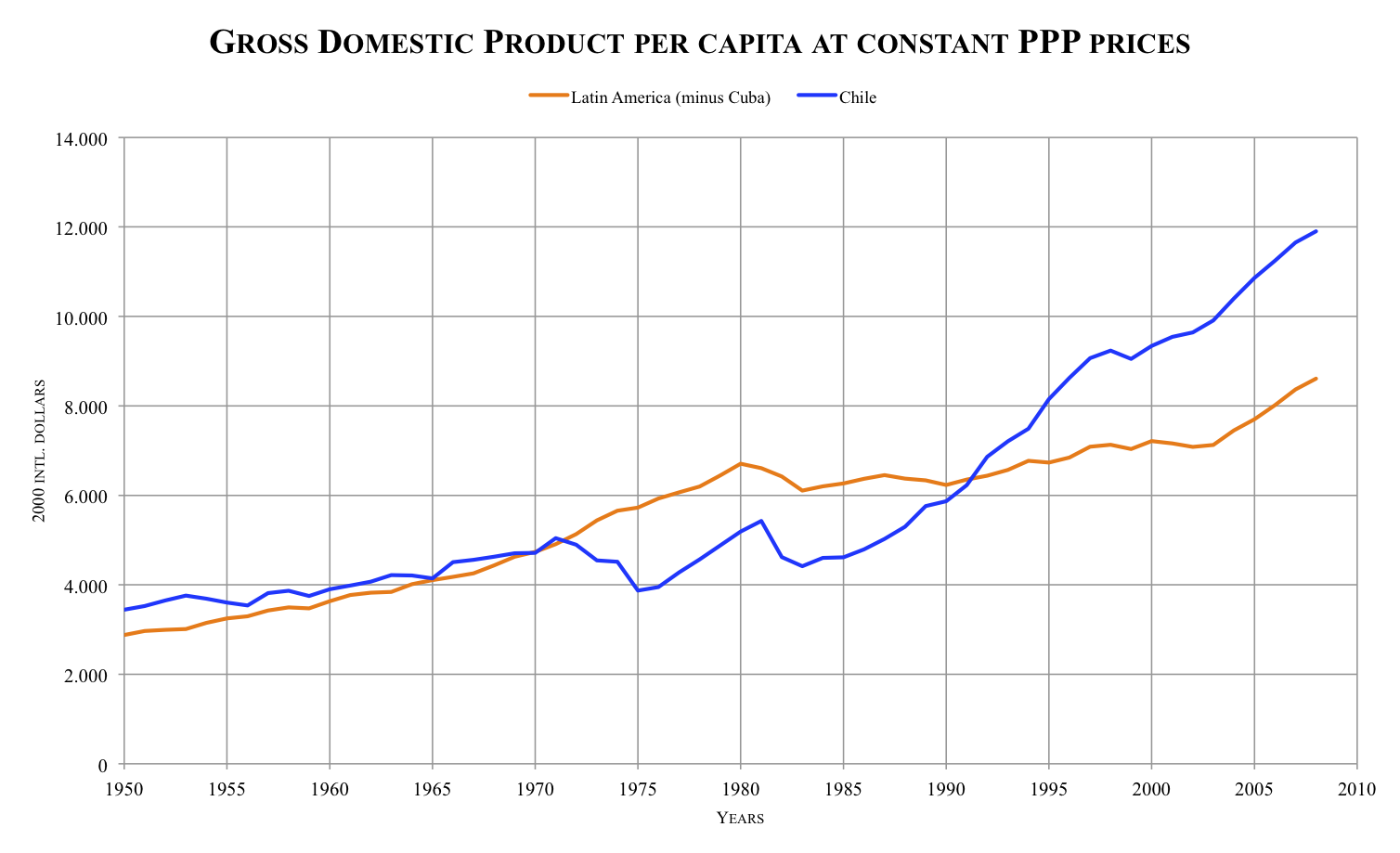
Really this graph is pretty telling…
Exactly.