What was it that Von Mises said about “Middle of the road”?
The best is the last paragraph - that should have been the first.
I think the Heart and Stroke Foundation probably gets government grants to write this sort of stuff - please write a study showing how more taxes can help society.
Read below
An expert panel commissioned by the Heart and Stroke Foundation is urging governments to slap a tax on sugared soft drinks, subsidize the poor to eat fruit and vegetables and give farmers incentives to grow more fresh produce, in a novel new take on Canada’s obesity epidemic.
The price of food has a proven impact on weight, and economic sticks and carrots should be invoked to combat the growing weight crisis, the panel concludes in a 79-page report.
The group’s fiscal-policy approach to the obesity issue is bound to generate controversy. Its lead author insists, however, that the soda-tax and other proposals do not represent nanny-state intervention into diet and behaviour.
“We’re not banning these items. It is trying to signal to the consumer that you should try to consume less of it,” said Guy Faulkner, a University of Toronto professor of health and exercise psychology. “If we think that obesity is a serious public-health issue … then ultimately economic measures will have to be part of the arsenal.”
While other health groups and experts have advocated a tax on soda pop, the new report takes a wide-ranging look at the economic aspects of obesity — and how to address them. The falling cost of food over recent decades has “reduced the price of calories,” while higher wages, long work hours and sedentary jobs have “made physical activity more expensive.”
“Standard economic theory predicts that these price changes would rationally lead individuals to increase caloric intake and reduce caloric expenditure,” says the report, presented this week at the Canadian Cardiovascular Society conference in Montreal.
Dr. Marco Di Buono, the Heart and Stroke Foundation’s Ontario research director, said the charity is considering the recommendations as part of a broader anti-obesity strategy it is developing.
New approaches are needed to getting Canadians to eat less and more healthily, he said.
“The days of preaching to individuals to change their behaviour: ‘You need to eat more fruit and vegetables …’ We simply know that is not effective.”
The head of the soft-drinks industry association was dismissive of the soda-tax idea, saying it is unlikely to work and unfairly singles out a small part of the problem. A 2004 federal survey suggests that sugared pop accounts for just 2.5% of Canadians’ caloric intake, said Justin Sherwood of Refreshments Canada.
Meanwhile, sales of full-calorie drinks have dropped about 20% in the past decade — replaced largely with diet beverages — while at the same time the prevalence of weight problems has only increased, he said.
“Everyone recognizes obesity is a complex issue and is a difficult issue to tackle … but simply targeting one product category is nothing more than a tax grab,” said Mr. Sherwood. “Our products fulfil a niche, fulfil a function. People enjoy our products.”
The Heart and Stroke report acknowledges the evidence shows only a “modest” impact on weight as a result of boosting soft-drink prices, but suggested that a real effect requires more substantial tax hikes than have been tried in some jurisdictions. Prof. Faulkner pointed to tobacco, where the majority of the cost of cigarettes now is made up by levies, and evidence suggests that price hikes have helped curb smoking rates.
A reasonable soft-drink tax would probably be about 10 cents per ounce of sweetener, he said, likely boosting the price of a can of pop by about 15 cents.
There is better evidence that eating more fruits and vegetables actually translates into lower weight, said Prof. Faulkner.
The report suggests that lower-income families be subsidized to buy fruit and vegetables, perhaps through special credit or debit cards that could be used in supermarkets, but would avoid the stigma of food stamps. It also calls for providing free produce to at least some children in schools, as is done in Europe.
It recommends research and development subsides and other help for farmers to encourage increased production of fruit and vegetables, while lowering tariffs to boost the supply of imported produce.
“Farmers should be engaged as ‘anti-obesity’ partners,” the panel says.
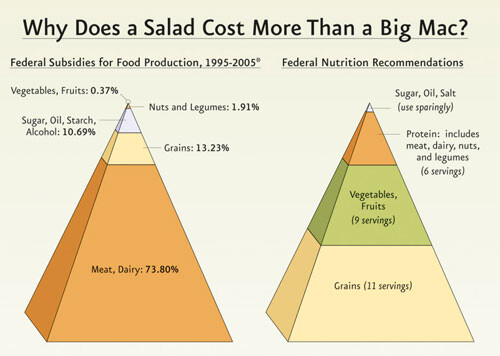
On the other hand, the report says research from the United States suggests that some agricultural policies — such as subsidies for certain types of farmers — will lead to cheaper, more plentiful high-calorie food and higher weight. It suggests that governments consider health issues first when developing farm policies.