How the state, via welfare and taxes, creates a nigh-inescapable poverty trap out of perverse incentives.
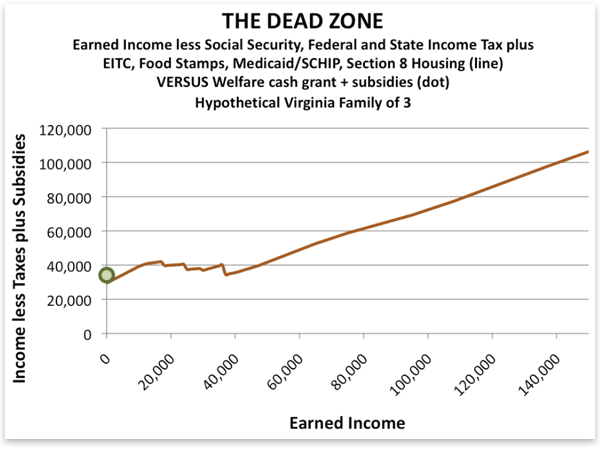
Here’s the explanation of the person who created this graph as to his method:
"Taxes Social Security Social Security tax is 7.65 percent of income up to a maximum of $108,000. I ignore the amounts paid by employers and the self-employed.
Federal Income Tax The federal income tax ranges from 10 percent on taxable income up to $11,950 to 35 percent on taxable income above $372,950.
Taxable income is calculated as income less personal exemptions ($3,650 per person, phased out for households with incomes ranging from $208,500 to $331,500) and the standard deduction ($8,350).
The household is assumed to qualify for the child tax credit of up to $1,000 for each of its two children. (This credit phases out for households with incomes ranging from $75,000 to $95,000.)
State Income Tax The Virginia state income tax is simply calculated as 5 percent of income. This ignores the minor effects of the Virginia personal deduction, the standard deduction, and the initial brackets in which one pays less than 5 percent tax.
Subsidies Earned Income Tax Credit (EITC) The EITC provides a maximum annual benefit of $5,028. For qualifying households, the amount rises (“phases in”) with earned income up to $12,570, is level (“plateaus”) from there to $16,420, and falls (“phases out”) from there to $40,295.
Food Stamps Food stamps provide a maximum monthly benefit of $526. For qualifying households, the amount phases out between a monthly income of about $850 and a monthly income of about $2,450.
Medicaid/SCHIP Medicaid eligibility varies by state. I assume households are eligible if their income is less than 133 percent of the federal poverty line. If one is eligible, this program covers all medical expenses. I assume the value of Medicaid coverage is $9,000.
If a household is not eligible for Medicaid, members of it may still be eligible for SCHIP. I assume that the children are eligible if household income is less than 200 percent of the federal poverty line, and that the value of this coverage is $6,000.
$15 $12
"How stupid and evil must our elected representatives be to do this to the working poor!"For low-income families, being covered by Medicaid or SCHIP means workers can look for employment that emphasizes cash wages at the expense of employer-subsidized health insurance.
Section 8 Housing Section 8 housing subsidies cover qualifying rent and utility expenses in excess of 30 percent of household income.
For low-income families, qualifying for section 8 housing means the household can look for housing comparable to what moderate-income families can afford.
Cash Assistance Temporary Aid to Needy Families (TANF), the successor to AFDC, is assumed to provide qualifying households with a cash grant of $395 per month."