Yeah, my Dad recommends to get one of those sturdy desk mics in order to give the voice more “presence”. But this happens to me sometimes, I don’t know if I just didn’t sleep well or what but sometimes I get this annoying lisp on my S’s and this happened to be one of those days. Oh, well.
Oh, and to expand on the contributions of liberalism to astrology - I’ll just quote Lew Rockwell at length:
Astrological metaphysics, physics, psychology, medicine, etc. is so beautiful and compelling yet there is this huge, gaping hole surrounding the science of commerce, trade, exchange, markets, prices, etc. This is because there simply was no economic science to speak of before about 400-500 years ago. So, these are new insights, genuine insights, beautiful and compelling insights into human nature and the structure and harmoniousness of the social order. These insights are closely related to moral philosophy, as well, since what it means for something to be good or bad (think of economic “goods” and economic “bads”) is integrally related to valuation, which is one of the foundation stones of economic science about which there reigned a great deal of confusion in all the ancient writings and was not really cleared up until a few centuries ago.
A couple more things that are missing from astrology are some basic ideas in liberal philosophy: in particular, scarcity and the mutual benefits of trade. In astrology, it’s not clear whether the resources available to man are finite/scarce or infinite/abundant. A lot of religious language is plagued with this problem and I think this is symptomatic of its cerebral nature, unconnected with practical concerns. It’s like the old debate over how many angels can dance on the head of a pin. As soon as you unshackle yourself from the limits of physical causality, you are faced with the slippery-slope into infinitudes.
Another problem is that balance is key to astrological metaphysics… light is balanced by dark, good with evil, and so on. While this is beautiful and I think deeply reflective of the underlying of structure of the physical and psychological worlds, it leads to problems when applied to voluntary exchange. Voluntary exchange is rarely zero sum and theories of give-and-take based on the idea of “balance” lead immediately to grave economic fallacies.
This astrotheology stuff is not as crazy as it sounds. Here’s a clear proof that at least some portions of the Bible - even portions that are believed to be very old - are astrological allegories. This is Joseph’s dream foreshadowing the famine of Canaan when Joseph’s family (including his parents, Jacob and Rachel) would be forced to go to Egypt where he would later be a vizier overseeing the sale of Egypt’s grain stores.
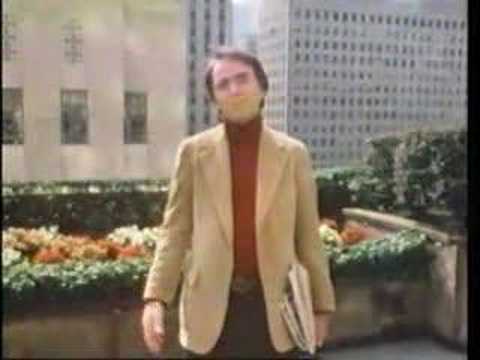
This is a great place to start - I think Sagan captures the essential problem with popular astrology, the idea that the planets “care” about you or that your life was “mapped out” by their positions, etc.
However, I think this view misses the subtlety of serious astrological metaphysics. It goes back to systematic versus unsystematic knowledge, as I described in an earlier post. Astrology is a way of coping with unsystematic knowledge - not so that you don’t have to find a way to systematize it into rigorous, scientific knowledge but, rather, so that it does not lie completely neglected and unconnected from the rest of human life and experience. We see the effects of the materialistic/reductionistic view of the soul, for example. We’re just “gears and levers all the way down”. Even if true - a methodological dualist might take materialism as his default hypothesis - it misses the point that there’s no meaningful distinction between a system of gears and levers as fantastically complex as the human brain … and an intangible soul (immortality is a separate question). Ideas, thoughts, motives, feelings, moods, plans, values, possessions, friendships, etc. etc. these are all intangible entities that exist only in our minds, only in our souls, so to speak. But the modernist view is that this is all the stuff of fairy tales until they can measure it on an oscilloscope or image it in an MRI machine. How ridiculous!
And the view of a universe that is mostly cold and distant, here promulgated by Sagan, is far from a settled question. This is a cosmological question, not a question of astrophysics, at least, it is an astrophysical question that has lain nearly dormant for going on a century since Kristian Birkelund first trekked to the Arctic Circle to observe the Aurora. We know that space is filled with plasma. We know that plasma is highly conductive. We know that the Sun sets off an enormous magnetic disturbance through the entire solar system on its 33-day rotational cycle. We know that any magnetic disturbance will cause charge separation in plasma (thus setting off electrical currents which set up magnetic fields as a result of charge flows). We know that plasma phenomena are scale invariant so that any plasma phenomena we create in the lab (e.g. “filaments” etc.) can scale up to arbitrarily large phenomena (e.g. galaxies, clusters, super-clusters, etc.) If the plasma cosmology view of the Universe is correct, then we are connected to everything much more deeply than Sagan acknowledges - and the influence of the planets may not be relegated simply to their gravitational influence.
Also, going back to the idea of culture as a repository of experimental knowledge regarding human nature, I think it is generally unwise to reject out-of-hand the human need for religious ritual, such as worship, prayer, etc. But without some kind of mystical context into which to place one’s worship or prayers, where do you direct it? I think that sifting out the aspects of your knowledge and experience that simply escape systematization - what can be called the Absolute - provides a context for a proper sense of awe, that is, a sense of awe that does not interfere with a causal view of the world.
One of the practical uses I can immediately see in astrology is as a kind of “mnemonic map” of all human knowledge and the art of living. Extending this idea, astronomical events - including the regular phases of the moon, the equinoxes and solstices and the apsides, as well as eclipses, conjunctions and planetary transits through signs - are a universal mnemonic for the events in one’s own life. I remember the Venus transit in early June of this year… the news headlines were blaring some crap about the Republican primary and some tax increase in California. I had to look up those headlines to even remember what they were. But I remembered thinking ot myself at the time, “That’s not the news. The news is that Venus is transiting the Sun, something that happens only once in 240 years, you idiots. THAT is the news.” And I’ll remember the transit of Venus for the rest of my life so long as my memory is working. I’ve already forgotten the trifling political headlines of June 5, not even two months ago.
But going even further - the more that people pay attention to these events and mark them in their own lives, the more these events created a “shared mnemonic framework” by which we can correlate events in each other’s lives and compare what was happening at this time or that time in our lives. “What were you doing when Venus transited the Sun?” These are historical events that smart people can’t fiddle unlike, oh, I don’t know, JFK’s assassination, 9/11, at least some of the Moon missions, etc. etc.
But seriously, I think that liberal philosophy suffers from excessive left-brainedness. I’m certainly open to other ideas than astrology to accomplish the goals I set out in the opening of this thread. It’s just that the more I read and study about astrology, the more I realize that there’s no need to reinvent the wheel… we already have an ancient tradition that fits the bill perfectly once you incorporate a few of the recent (compared to astrology) insights regarding the subjective nature of value, mutual benefits from trade, comparative/absolute advantage, division-of-labor, self-regulation, self-enforcing contracts, etc. etc.
Well, all I can say is that I probably don’t much agree with anything on this thread- and leave it at that.
The good thing is your probably being intellectually honest and put a lot of thought into this. If someone wants to offer a legit critique, to your thoughts it demands a lot of work and honest attention, otherwise it’s just haterade from a lazy bones wanna be to someone who actually made an intellectual effort. So that’s good.
oh,
unless you just ate brownies from some strange patchoulie smelling person - in which case everything you wrote ought be ignored by non “mind expanded” people.
I just want to make sure I’m reading you correctly. Are you saying that astrology should be used as a way to remember important events, history, and culture? This would be opposed to predicting the future. It seems that this is what you have been saying, but as vive pointed out, you use a lot of words , so I just want to make sure that I’m reading you accurately.
I think the non-rational element of liberalism has been staring us in the face: spontaneous order (what Hayek, coincidentally, referred to as cosmos): order that exists as a result of human action but not of human design, which also appears to have been designed. This process of cultural evolution was the origin of liberal morality and morality in general. Obviously spontaneous order can be discussed in relation to the market, but the concept can also be extended beyond human action to those things in nature which appear to be designed but are actually not: life in general (via biological evolution), groups of organisms (bee/ant hives, schools of fish, flocks of birds), and then still further to non-living things - the astronomical order you were discussing in your videos and the atoms which form the entire universe. This concept is not only the basis of the respect for property, but is also awe inspiring and counter-intuitive (like economics).
Perhaps some elements of Taoism can be drawn upon also (see Zhuangzi and Laozi).
But I think the reverance for spontaneous order strikes back to the heart of what we’ve been discussing in this thread. As I see it, the problem of modern morality is that people adhere to the dictates of the state in the same way that in former times people adhered to emergent norms. That is, the norms that arose out of a spontaneous, evolutionary process have been largely replaced with rules that have been designed (necessarily in a poor fashion) but which are treated as if they were spontaneous norms. This has led to a situation where people hold to a kind of designed justice, which to the jurist of old is an oxymoronic concept. To him, law emerged naturally - he was its discoverer, but not designer.
If you haven’t read Hayek’s The Fatal Conceit, I suggest you drop everything and turn your attention towards it!
Clayton, I’ve mentioned it once before, you should really read into Joseph Campbell (and further expand in Guenon, etc.) I’m pretty sure you’d enjoy his works. It’ll shed some light on primordial wisdom in regards to religious themes, knowledge, and metaphysics while cutting out any Newage bullshit.
Though I don’t know much on astrology in regards to my own religious reconstruction, 6th century Anglo-Saxons had no use for it…
@vive: Thanks for the respect - I don’t expect everyone to agree with the direction I want to go with this. I understand there’s a lot of danger of falling into irrationalism but I sincerely believe there is a lot that the classical liberal philosophy can benefit from a more holistic approach to the individual.
@gotlucky: No, I don’t just mean explaining the past, I mean everything that is intangible, fuzzy, squishy, hunchy about the past, present or future. Let’s take the oncoming “Aquarian Age”, for example. Should a person feel good, bad or indifferent about it? Well, (Vedic) astrology suggests you should feel good about it because we are leaving the lowest Age, the Iron Age. Does it really matter whether this is factually true or false? I don’t think it really does. How you choose to feel about an oncoming astrological future is a matter of personal taste but it still fits within that same mnemonic framework I’ve talked about before. It still provides a holistic framework for you to hang the progression of your life onto.
In a more literal sense, we can say that the night is evil, that winter is evil and that they are predictably so. See the arguments given above. So, the cycles that affect human life predictably bring conditions which are to man either evil or good depending on how he values them.
@Aristippus: I’ve read bits and pieces of it. I’ll take another look as I definitely have respect for your perspective and input.
As an aside, are you concerned that, perhaps, astrological philosophy is incompatible with or antagonistic to the ideas of emergent order?
I want to underscore that what I have in mind is to capture the truly intangible aspects of human experience that lie outside of economic or any rigorous science - what I was calling the “mystical” which must necessarily always reside back of scientific/structured knowledge.
For example, what is the medical explanation for that body-enveloping good sensation that you get from stepping out the door in the early morning when the air ist still cold? Who knows. Who really cares? I can’t imagine how explaining the mechanics of this sensation actually matters to any real world problems that need to be solved. Nevertheless, it’s a very real part of the human experience.
The economist’s view of these kinds of trivia is that they are just part of the value of something else. For example, you might value a house because it has a nice view. From the point-of-view of economic science, it really doesn’t matter why you or anyone else values the property, all that matters is that you (and other) do value it, and that creates the potential for price-bidding which - as a result of bidding vis-a-vis similar or substitutable goods - causes a “market price” to emerge. But this rides roughshod over the subjective view of life where the little things really do often count the most. You can have a great vacation in Venice with expensive airfare, long flights, and so on… or you can just travel somewhere nearby and enjoy the same satisfaction you would have had from a trip to Venice, perhaps more. In other words, since the final end of all action is the individual’s satisfaction (cessation of suffering), it really doesn’t matter how you get that satisfaction. Getting it from little things like the fresh breeze in the morning or the feeling of grass under your feet can sometimes be just as effective as paying to have a nice dinner at a restaurant or some other sort of exchange-based luxury.
And I think this is where a lot of people balk at the “materialistic” view of economics. Bastiat says in Economic Harmonies, ch. 2:
The whole enterprise of building capital, working hard, being industrious… it’s not for everyone. Some people are content with the “small lot” in life, that is, to simply take the pleasures that can be had without taking so many pains in terms of labor. This is why I think that a “class society” is, actually, inevitable and that the abolition of classes is always a consequence of welfare society and a sure sign of egalitarianism. A healthy social order permits the individual to choose how much pains he wants to take in the search for greater material prosperity. A lot of people - rightly or wrongly - will choose less over more.
@Bert: I’ve looked the book over on Amazon and in my local bookstore a few times. My concern with this concept of a “hero with a thousand faces” is that it sounds like he’s trying to say that the Christ narrative is universal, something that I am pretty sure is actually false. Perhaps you can allay my doubts on this point?
have given me somewhat of an insight into what an afterlife might really be like and it’s just got me interested. I’ve never tried psychedelics or read the Scripture in its entirety but I think just the way it’s presented makes me intriqued.
Sorry if it doesn’t really relate at all to the topic per say but I’ve just been intriqued by this lately as someone who doesn’t see himself as spiritual.
Yes/no. He’s not saying that the Christ narrative is universal, but the “hero’s quest” (or monomyth) is universal. In the beginning of the book he acknowledges the differences and contrasts of the worlds religions and myths, and that the point of the book is geared towards the similiarities. I watched some lectures on Netflix and he explains this from a psychological perspective (highly influenced by Jung) that the function and projection of mythology/religion builds up and it’s social structure starts with the individual and expands to family, community, and eventually outwards to government/state.* The Hero with a Thousand Faces contrasts with more historical based works of his like The Masks of God series. The Wiki page does a good job at explaining the monomyth, function of myth, and evolution of myth.
If you’ve ever read Jung you’ll know Jung placed heavy emphasis on an understanding of comparitive mythology, religion, and folk culture for an understanding of dreams and one’s psyche, as to where Jung used this to understanding dreams and expanding to problems like neurosis I think this is where Campbell picks up and instead uses the same idea to understand society as a whole, just not individuals on a pyschological basis.
*Edit: The projections are from the unconscious part of ourselves or psyche and expands on the individual outwards. Religion and mythology would be projections of the collective unconscious (there’s a quote either by Campbell or Jung along the lines of “myths are public dreams”), just as one could view classic literature representing the culture and views of it’s time (Beowulf, Faust, Huckleberry Finn, etc.)
Now, of course the Christian narrative being universal is false (even though Christianity finds itself to be a universalist religion), because even if one may find similiarities in myths, that does not find them in those worldviews of said religions. For example, in many myths there’s tales of serpents. In some cultures good, and in some bad. The perception and view of the myth in regards to the worldview of those people can be drastically opposed to one another. Worldview is the key and core to any religion, but this would begin to lead into the metaphysics of religion of which is just more depth to a topic I don’t want to carry that far in (something the likes of Rene Guenon focused on such as Eastern metaphysics). Campbell won’t go much into worldview as much as he’ll break down the psychological understanding and projection of various myths and rituals giving the “this is what it means, this is how your unconcsious reads it, this is how you personify it, and this is the final product” - sort of laying out a blueprint for religion. Though Campbell is not alone, he’s just the most popular and damn amazing. Georges Dumézil, Mircea Eliade, René Guénon, Frithjof Schuon, and many others all have their own approach around the same topic of religion, mythology, and metaphysics (Hilda Davidson being my favorite in regards to northern European mythology).
No, not necessarily: I haven’t said much on the topic mostly out of igorance of it. The introspective element of what you’ve said about it is intriguing, however.
On the topic of spontaneous order, I mostly brought it up as a non-rational element of liberal philosophy, which could serve as a basis for ritual - since I thought this was something you wanted to incorporate into the ‘First Church’. The concept of an unplanned order is an important part of Taoism, for example - a belief system with much ritual. From Wikipedia:
See also the Three Treasures, which one scholar has described as “abstention from aggressive war and capital punishment”, “absolute simplicity of living”, and “refusal to assert active authority”. This brings me back to a link between the concept of spontaneous order and the Epicurean understanding of the good life that you described in your last post (and which I wholeheartedly endorse). Many people are preoccupied with the state of the world and at any juncture have a knee-jerk reaction of there being a need for some grand plan to save it, without the sense of order existing without such design. This also links back to Epicurus’ exhortation to ‘live unknown’ instead of engaging in grand schemes that are ultimately fruitless.
I think that liberal philosophy suffers from excessive left-brainedness.
I can say with some confidence and even third rate expertise, this left/right brain, use only10% of brains type stuff is a myth. Unless you are using it as a metaphore for personality types - in which case it has its uses.
Also could you please clarify by what you mean on “irrationality”? Idon’t know if I’m a big fan of the term - I don’t like dichotomies all too much. Anyway, in some sense the radical subjectivism, the market process, etc could very well be seen as “irrational consequentialism” -and how the world functions in a “Dionysian” way.
If I had to guess, the right / left thing may have come about with a severe treatment for very severe cases of epilipsey where the corpus callosum (a bundle of fibers), which is what the brain uses for sending messages across hemispheres in the brain, is severed. Due tothe nature of the seizures, and the operation itself-it can produce some rather interesting side effects.
EDIT:
My hunch is probably wrong. According to a quick google search, the myth came from the 1800’s due to symptom correlations with location of brain trauma
@vive: That’s what I learned in Psych 101. However, astrology also associates a “left” and “right” with the mind, in the astrological sense of right as the “stronger, more preferable” and left as the “weaker, less preferable.” For example, the Sun is right, the Moon is left, male is right, female is left, etc. etc. The discursive part of the mind is considered the left mind. The speculative, intangible aspect of the mind is considered the right mind.
Some more comments on an astrological versus “scientific” way of looking at one’s life.
a) The character of your life is almost completely determined by when and where you were born (and to whom). So time, place and family are the 3 most important things in determining who you are and what your life will be. The idea of astrological “signs” is at least a useful metaphor in this regard. The configuration of the planets and the orientation of the Earth with respect to the Sun in the tropical year (including the ascendant sign) is a way to organize these facts into a mnemonic map.
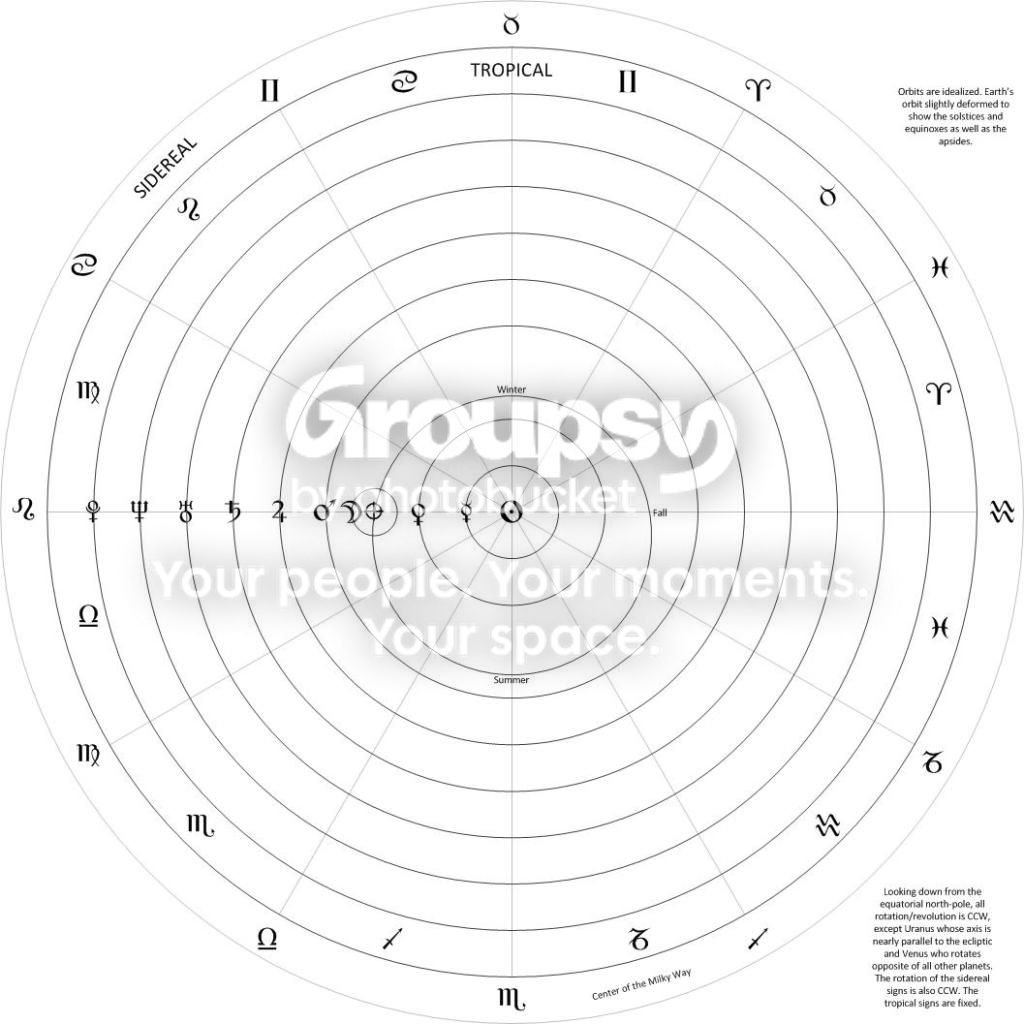
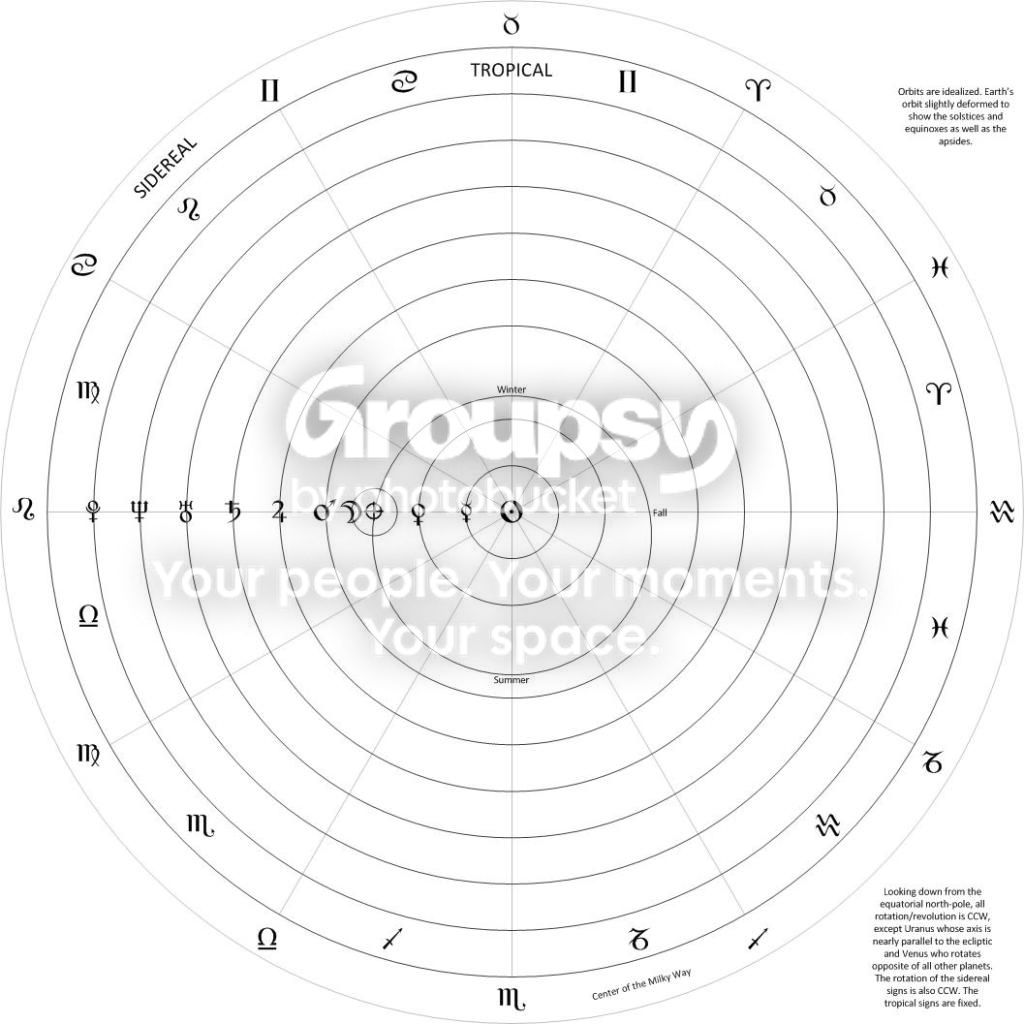
And just like a book that has plot without setting will leave the reader lost and disoriented, so a life lived without being placed in its context is meandering, aimless. Every person with enough good fortune to afford even a rudimentary education should know where and when he is in the Universe and that starts not only with understanding his geography, the facts of the Earth itself but also where the Earth fits in the Solar System. Here is a chart I drew up depicting all the basic facts of the Solar System that I think should be known at a glance:
b) This is related to the second point which is that non-generalizable particulars constitute the vast majority of the “stuff of life.” We can separate facts into “particulars” and “universals”. Universals are generalizations of particulars, they are the “laws” or “rules” by which particulars are thought to be arranged/unfolding. And Universals are definitely a big part of your life - the laws of physics (or even the laws of economics), for example, constrain your every action at every moment. Nevertheless, most of the knowledge that you need about universals is already built-in and requires no further introspection on your part, whether you acquired it through innate knowledge, early development, or cultural habit.
But life is also a series of essentially “random” particulars. We can see this when thinking about business opportunities, for example. They arise mostly unpredictably and often the greatest opportunities a person stumbles across in his life will be things he would never have dreamed he would bumped into. But the “left mind” mentioned above looks down on these “mere random accidents” as trifling factors not worthy of a well-developed, structured, rigorous, scientific mind. They don’t fit the left-mind’s pre-planned layout of one’s life. The right-mind, on the other hand, is the pattern-seeker, the superstitious, it sees significance in every detail no matter how trivial.
Of course, life requires a balance of these factors, not merely one or the other, but I think astrology provides an “interpretive context” or “mnemonic framework” within which to relate to the particulars in one’s life in such a way as to be able to maintain that left-right balance. Without an interpretive framework to operate in, the right-mind is dangerous… it leads to neurosis and schizophrenia. I think this is why moderns are afraid of the right-mind. Science, at least, is safe. It will not lead to insantiy. An overly scientific approach to life might make you dull and rote but at least it won’t make you crazy.