The Myth That Is Falling Real Wages

Commies and other wacko leftists often like to claim that real wages are falling in the United States, and that this fall is due to “free markets.” Theoretically, of course, this claim is bunk (if firms are profit-maximizing, then they will continually seek to expand production through greater investment, which will in turn increase real wages). Here is the empirical data to whack such pinko Marxist claims on the head with:

The above shows total real compensation per hour. In other words, it’s compensation (wages + benefits) that workers receive per hour, not just wages.

This one could be a good one to throw at unions such as the UAW. Real compensation for the manufacturing sector has increased by 25% since the mid 90s.
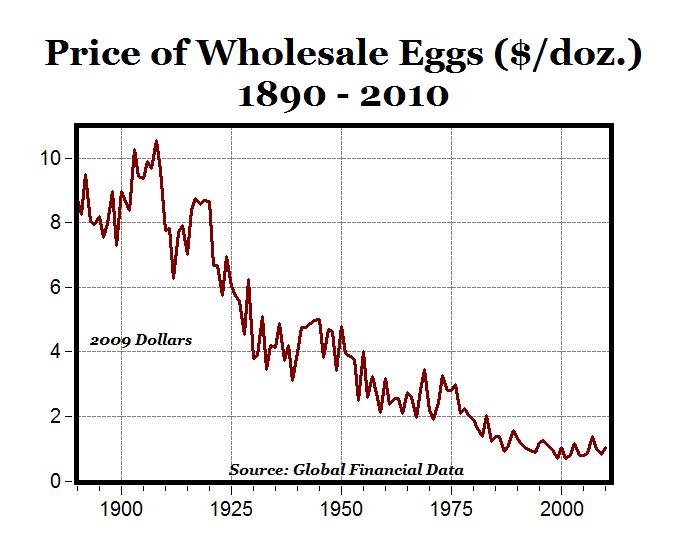
Although the price of eggs doesn’t tell us much by itself, it does indicate that productivity increases have made life-necessities like food much more affordable to the average person.
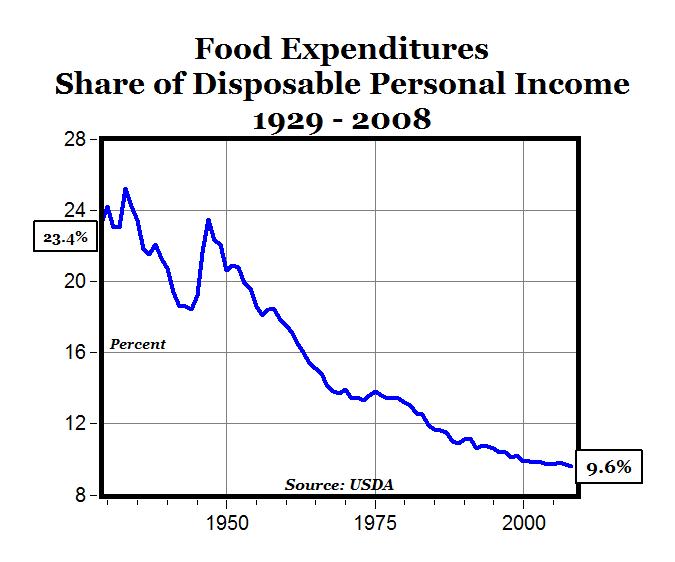
Few people will argue that Americans ate more per capita in 1929 than today. This graph shows that the food has become progressively cheaper to the American worker as a result of capitalism.
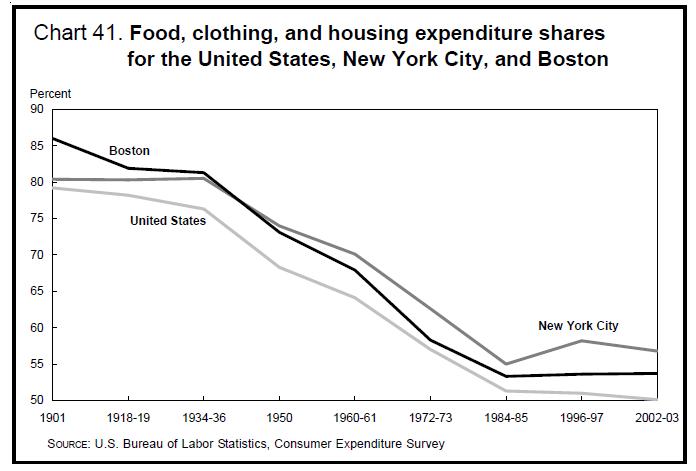
Further proof that the necessities of life have become cheaper in the United States as a result of productivity increases and capitalism.
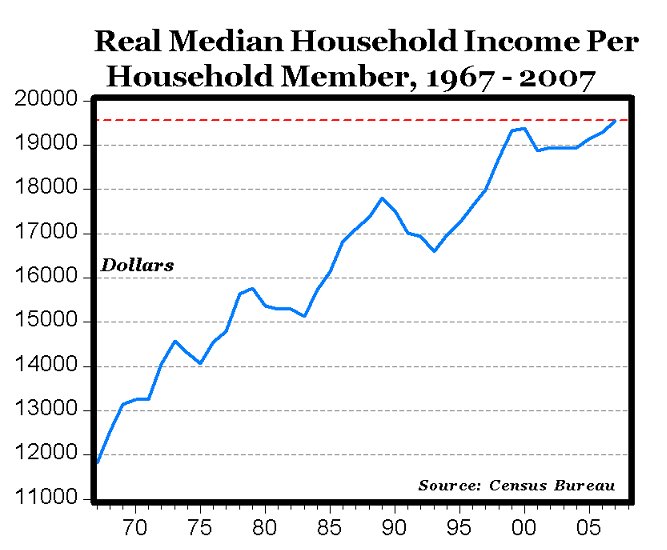
The above is fun to throw at people who post the now infamous “falling real wages” graph.
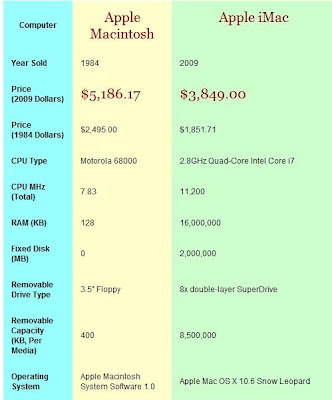
Though not very useful by itself, this data is a pertinent reminder of how new technology has not only vastly increased living standards in a way that’s immeasurable, but also how new technology has become increasingly affordable over the decades.
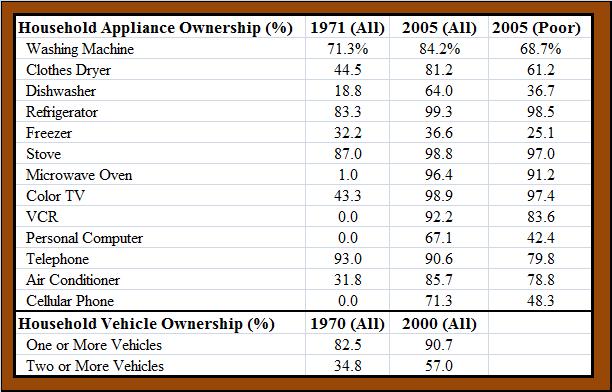
If Americans are becoming poorer, then why are they better able to afford day-to-day products?
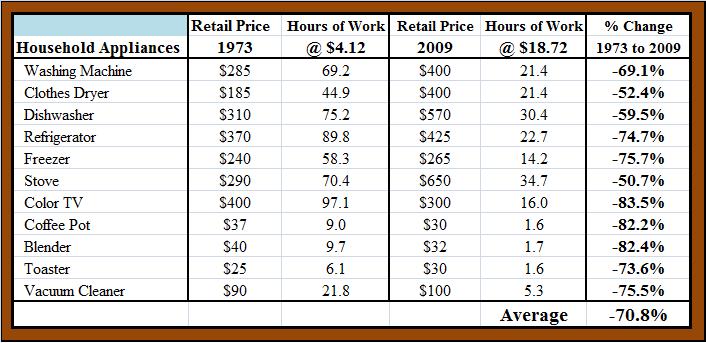
This puts the “falling real wages” argument in perspective.

All of these graphs have been culled from Dr. Perry’s blog at http://mjperry.blogspot.com.

More like your run-of-the-mill Economics illiterates.

That’s basically a tautology.

So this means that capitalism is out-competing inflation.

Fix’d

awesome thread. Bookmarked :slight_smile:

This was worthy of a Facebook repost.

i dont know about pinkos claiming such. unless you use the pinko to have various meanings.

a mises video claimed that living standards were falling and savers were harmed by the current money system.

maybe they were lying?

would living standards be greater with a different type of money…wages and compensation in gold and silver??? i havent been able to find that yet.

though often in my experience, compensation in benefit form seemed to decline in quality.

I have heard Stefan Molyneux make a similar argument in video. He points out falling standards of living in the U.S. since the 50-60’s and blames it on the Fed’s massive increasing of the money supply. I have been meaning to make a thread about this argument in order to get thoughts from people better versed in economics than Stef.

OP: Couldn’t a statist simply counter that those improvements in the standard of living occurred under a mixed economy, and so one should praise the mixed economy, not necessarily freedom? For example, there are farm subsidies, housing subsidies, etc. While we may understand that these gains are made despite government interference, people who are more ignorant of economics may see it as the opposite.

Here’s what you do: first ask them whether or not we’re a (mostly) free economy. If they say yes, show them the above post. If they say no ask them if they think things could be better, if they say no show them the graph demonstrating an increased standard of living. If they say no, we’re not a free economy and that things could be better hand them a copy of Man, Economy and State.

Food prices spike when FDR is in office. Wonder what could have done that…

If the prosperity theory of government is true, there ought to be more prosperity with more government.

You can see that prices fall their fastest up until 1940.

Even if they think government can bring prosperity, they have to at least admit that the free market does too.

Thanks for the compliments. (:

Trust me, they do. If you don’t believe me, come to Detroit and we’ll confront some of the Trotskyites (yes, that was purposeful) around here.

I remember watching that Mises video on youtube. Real wages have fallen and savers are harmed by the current monetary system. But if you look at things like real compensation and how many hours one must work to purchase basic necessities of life as well as household appliances, you’ll find that living standards on the whole have risen. The reason for this is that the monetary system itself is just one factor in the whole economy. Our markets here in America are stronger than the inflationary forces the Fed creates.

If a statist makes such a claim, then ask him/her how he/she thinks housing subsidies have lowered the price of household appliances relative to real wages.

Basically, you’re saying that the statist claims:

  1. Government subsidizes x, y, and z.
  2. ???
  3. Goods a-z become more affordable.

Ultimately, like almost every argument made regarding economics, you have to fall back on theory. And theoretically speaking, there’s no way that the statist could show that food subsidies (which mostly restrict food supply and subsidize only a small percentage of food crops) could consistently increase the affordability of food over the decades. On the other hand, there is a clear theoretical reason why capitalism can achieve increased affordability of goods and services: each business is profit motivated, so it invests in new capital equipment and technology in order to increase productivity (and thereby increase profits), which increases the amount of goods and services produced per capita, which makes said goods and services more affordable per person.

Great analysis. Thank you. Very illuminating.

nice[Y]

You know that says a lot! I mean a lot! That’s packed full of information. No lie.[:D]

Finally a decent answer to the “stagnating wages” conundrum. I’ve been waiting for someone to address this one for a long time.

Marxists pwned, yet again. Good job!

How does this fit in with Hoppe saying in the Democracy TGTFailed that the U.S. has been degenerating economically ever since WW1 with only one upspike in the 1950’s? I don’t have my book as somebody is borrowing it but I can’t remember what word he used exactly to described the economic degeneration. Whether the word was wealth or standard of living or something else. Anybody remember that part in the book or could it explain what he was getting at in light of the OP here?

anybody? ^^^^^