Mises says in ‘Human Action’:
“The entrepreneurs embarking upon the utilization
of the newly accumulated capital goods and the improved technological
methods of production are in need of complementary factors of
production. Their demand for these factors is a new additional demand
which must raise their prices. Only as far as this rise in prices and wage
rates occurs, are the consumers in a position to buy the new products
without curtailing the purchase of other goods. Only so far can a surplus
of the total sum of all entrepreneurial profits over all entrepreneurial
losses come into existence.”
I don’t understand how, when there is bidding up of the price of labor employed in newly formed capital industries, “the consumers [are] in a position to buy the new products
without curtailing the purchase of other goods”?
Why wouldn’t the goods be sold without a bidding up of price of labor? I am not sure if you people understand my question. But still, could you at least explain to me the meaning of the quote para from Mises?
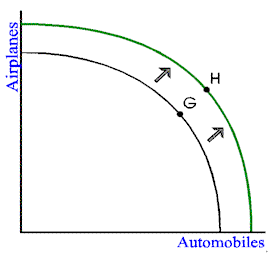
The answer is the same as your other question, and is demonstrated by the productions possibilities curve. There is an increase in wages, and so the PPF shifts to the right.
Do you mean the lowering of price, caused by increased capital base, leaves surplus money in the hands of consumers which they could spend in other goods?
An increase in productivity usually leads to an increase in wages; there is an increase in wealth. An increase in wages leads to a rightwards shift in the PPF.
OK, take into consideration the above graph. The black curve is the original PPF. Only taking that curve into consideration, an increase in the supply/demand for Airplanes leads to a proportional decrease in the supply/demand for automobiles, in this theoretical economy. An increase in wages and technology leads to a rightwards shift of the curve. Now, the consumer can buy more of one without necessarily reducing the other.
Let’s add numbers to the graph. Let’s say that the point G on the graph (black curve) is 50 airplanes and 50 automobiles. That rightward shift allows the consumer to purchase 100 airplanes and 100 automobiles (it’s still in the middle, so the demand/supply for both is the same). But, there was an increase in one, without a decrease in the other.
The simple explanation is that an increase in wages, due to an increase in productivity, just allows consumers to buy more. Or, the alternate, an increase in productivity allows suppliers to supply more.
Got it, Jonathan! Thanks!