I thought it was government insurance of bank mortgages that created the environment where banks had little to no risk and would offer mortgages to everyone. Because everyone could get a mortgage this pushed up the prices of houses and this created the bubble in house prices. When no one can get mortgage, houses do not sell and house prices fall, that is unless the estate agenies refuse to value the houses lower and people owning the houses refuse to sell them at a lower price.
Recently the UK government has created a scheme called FirstBuy which is going to cause the same distortions in the UK market that happened in the US housing market. UK housing is already well over priced and the houses are all very poor quality, due to most of them being built by the government at the lowest possible price possible.
Abstract:
Considerable debate rages about whether Federal Reserve policy was too lax in the early part of the 2000s, thereby fueling the home-price bubble that was the proximate cause of the global financial crisis.
So far so good.
We present evidence that the view that modest alterations to monetary policy have vast consequences is inconsistent with theory and not supported by evidence.
MODEST? Did you say modest?
Here’s a few items from Wikipedia on money supply:
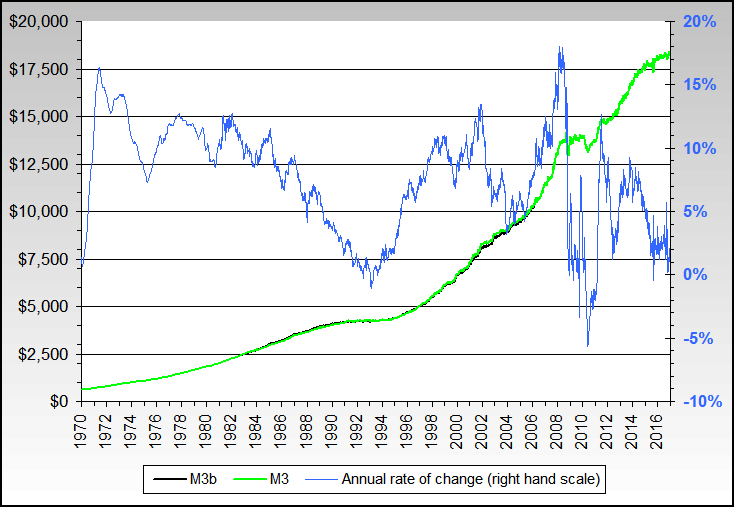
I can’t show the graph, but it has M2 rising from 5 trillion to 8 trillion from 2000 till the recession.
Oddly enough, "The Federal Reserve previously published data on three monetary aggregates, but on 10 November 2005 announced that as of 23 March 2006, it would cease publication of M3." Makes you wonder why such a modest little number isn’t going to be publicized anymore.
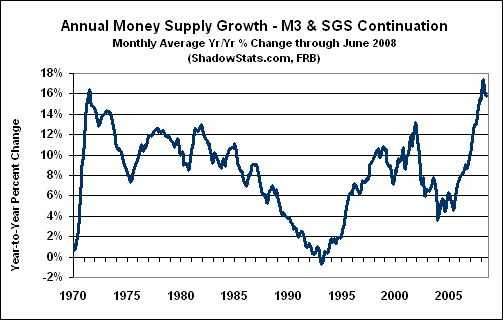
Shadowstats.com on M3 as of Dec 2, 2009: "Separately, as reported by the Fed in its second-quarter 2009 flow-of-funds analysis, foreign holders of U.S. assets have something in excess of $10 trillion in liquid dollar-denominated assets that could be dumped at will into the global and U.S. markets. In perspective, U.S. M3 is somewhat over $14 trillion."
[In fairness, the Austrian estimate of shown there estimating money supply growth seems modest]
A quote from there:Separately, as reported by the Fed in its second-quarter 2009 flow-of-funds analysis, foreign holders of U.S. assets have something in excess of $10 trillion in liquid dollar-denominated assets that could be dumped at will into the global and U.S. markets. In perspective, U.S. M3 is somewhat over $14 trillion.
We take a close look at the responses of asset markets to changes in the short-term policy interest rate since the founding of the Fed in 1914. Changes in the federal funds rate have no systematic effect on either long-term interest rates or housing prices over nearly a century.
When the Fed prints money, there will be inflation and a bubble. Where the bubble will be depends on the circs. In the 20’s stocks were ripe for a bubble. In the 40’s the bubble was in war. In the 90’s it was dot.com companies. In the 2000’s housing was the preferred place to throw away money, for reasons explained in many places.
Indeed, since the mid-1990s the policy rate had a negative relationship with long-term interest rates.
Very understandable. A low interest rate set by the Fed creates inflation. Long term interest rates are set by the fears people have of inflation.
The real q here is: What relevance does their statement have to the topic at hand? Especially since a huge chunk [a majority?] of housing loans were ARM’s, not long term.
This is consistent with a global view of capital markets where massive cross-border flows shape the availability of domestic credit and asset prices.
Irrelevant verbiage.
The evidence casts doubts on arguments that a moderately different monetary policy path might have mattered.
Oh, I agree. A moderate [=piddling] change would not have done much. Drastic change is what we needed.
Note that every single person involved in that paper works for the Fed. Let’s try and guess what their conclusion will be. Will they say the Fed is responsible, or is some boogey man, say, lack of “macroprudential regulation”, is to blame?
What caused the housing boom of the 2000s? A number of researchers have suggested that loose monetary policy during the first half of the 2000s was a primary cause of the substantial run-up in house prices in many countries.
You got that right.
However, using a common statistical approach, we find that monetary policy was not the main factor.
Shame the abstract doesn’t go into detail, and the 51 page paper costs money to dowload. What are they hiding?
That should not be surprising: Although low interest rates raise house prices, the increase in prices during the mid-2000s was much larger than the historical relationship between the two variables would suggest.
Aha! A clue as to what that “common statistical approach” is. Historical relationship. As if the situation in the housing market in the 2000s was the same as before, when it fact it was completely different, as explained in detail on this site. 'Twas a disaster waiting to happen, needing but a match [=plenty of cheap money] to blow everything up.
With the kind of thinking the Feds are using here we can deduce that Japan was not damaged by the recent tsunami, earthquake, and nuclear disasters. After all, the ground under their feet, the ocean next to them, and the power plants, all existed before 2010 and did not cause much damage over the years. What really caused the recent disasters must be, by process of elimination, lack of “macroprudential regulation”.
Instead,
We shift the blame on anybody else we can.
we investigate further the link between the marked loosening in terms and standards for mortgage credit and the most rapid increases in house prices.
Double aha! So they admit that things were completely different. The "common statistical approach of historical relationship is, by their own admission, ridiculous.
This link provides some evidence for a story where credit provision and the demand for housing fed on each other and helped spur the housing boom.
How can a demand for housing “feed” low interest rates? Has someone, in their eagerness to pass the buck [excuse the pun], forgetten about the laws of supply and demand?
And BTW, what exactly is “credit provision”? It means ridiculously low interest rates. Meaning money printing. Both provided to us by the Fed. So you have passed the buck of blame to yourselves, guys.
Our work suggests a greater role for macroprudential regulation rather than monetary policy in managing asset price booms.
No surprise here. The conclusion is always that we need more govt meddling. Although one wonders what exactly “macroprudential” means.
Think about it this way, to have an asset bubble you really need new money. If the increase in new money is zero, consumers will do two things:
Reallocate more of their scarce resources to the bubble area in the short term.
Reduce purchases of things in the bubble area ain the longer term.
So as one asset increases in price the others will decrease. This is true for individuals and banks as well. Even with government incentives and regulations, without new money this is still a reality.
Enter a central bank with the ability to create money not backed by savings. With this new money in the form of below market price credit, consumers can buy the assets increasing in price without doing either 1 or 2 above. This is how the bubble inflates.
Now this new credit is not backed by real savings. So at some point this unravels or the currency becomes worthless and there is a crackup boom. With all the government intervention prior to 2008 you saw a complete unravelling of the system.
So by logic the central banks have had a huge affect on the creation of the Housing Bubble and its unravelling.
They cite loosening standards for lending, this is a one sided analysis. Policy may make it ‘profitable’ to manufacture square wheels. What idiot is going to buy them? Their analysis is common and it only deals with sellers, not buyers. So policy made the creation of bad debt easy and atractive. So what? Who would buy it unless: they had money to burn; they needed yield and were willing to take risk thanks to supressed interest rates; they knew that when the **** hit the fan, they would be bailed out? Answer: no one. Just like no one would buy square wheels no matter how much the government pays someone to make them.
Business cycles are always a mix of monetary and social policy. Think of it as a hose with a nozzle. The water traveling through the hose is the monetary policy, the nozzle is the social policy and regulatory structure and directs the flow. In this most recent case when the Fed flooded the market the nozzle was pointing the deluge toward housing.
Gee. A former Federal Reserve employee of almost 2 decades and his Neo-Keynesian wife, and a team of 7 members of the Federal Reserve Board found that the Federal Reserve was not the cause of the housing bubble. Go figure.
Just judging by the abstracts, it actually looks like the Fed’s own paper is more honest than the husband/wife duo. The Fed says “monetary policy was not the main factor” and points to “marked loosening in terms and standards for mortgage credit”…which of course was a huge proponent in inflating the bubble. (Throughout the bubble FNMA and FHLMC owned on average roughly half of all mortgages in the U.S. ).
The other paper tries to claim “Changes in the federal funds rate have no systematic effect on either long-term interest rates or housing prices over nearly a century.” Please.