There’s nothing novel about teleological language, but there is something novel about a field where such terms are only considered proper when they are strictly teleological. The everyday sense allows for both teleological and non-teleological senses:
Why does it matter? Whatever my purpose for the loan, I still need to apply teleology to understand whether or not the person is lending to me when “lending to me” might be associated with any one of trillions of different sensation-bundles which, considered only as sensation-bundles, have no topographical or spectographical rhyme or reason. However, introducing my purpose for the loan would only require even more teleological understanding. I wouldn’t want a loan so that the sensation bundle associated with a rectangular prism manifests before my eyes; I want it to acquire goods and services.
You really like your MS Paint don’t you? I have to admit, the pictures are a nice change to the usual walls of text that describe the same topic as a picture could.
I couldn’t figure out why it mattered that you wouldn’t care about a bunch of stuff.
There’s an ambiguity to deal with here:
your purposeful behavior vs. our purposeful behavior
Your purpose for the loan is an observable for you, but the purpose of the person lending you the money is just how you model their behavior.
So why does it matter? What AJ said. He’s only concerned with the money showing up in his account (seeing numbers on a screen, knowing that pressing a certain key would cause something else, etc). So what are you concerned with? I’m not sure what it would mean to be concerned with “the action”. Isn’t it the money showing up in your account that you’re worried about?
I am concerned with both: the former as a means to the end of the latter. But I can only comprehend the means by viewing it teleologically, because the means I’m looking for, again, might come in any one of trillions of different sensation-bundles which have no topographical or spectographical rhymre or reason.
And furthermore, I can only undestand money in the terms in which I’m interested in it in the first place (as near-universal medium of exchange) teleologically.
Yet someone watching Ben Bernanke make his pronouncement will indeed perceive that the interest rate has dropped, whether he thinks Ben is really a robot or whatever.
This is a dumb example, but what if all you knew was that saying “lend me the money or die” would get you the money in your account? Maybe you don’t know English or anything; all you know is that sequence of sounds seems to make the numbers appear on your screen later.
It would be clearer if I had said, “There is an everyday sense that doesn’t distinguish between teleological and non-teleological cases.”
Just like the everyday sense of the word “kill” does not distinguish between intentional and unintentional killing. It would be as if there is a special field where kill always means murder, but in the everyday sense it covers both murder and accidental killing.
If I didn’t think the sounds was influencing the purposive action of another person, then I would be getting the resource by, for all I know in the situation, non-interhuman means, like if I was digging up gold. What’s your point?
Yes, money described by that definition is what I’m interested in.
So you would not be happy to get more money in your account even if you couldn’t tell how anyone decided to give it to you? Besides, the “visuals” thing is not the same as “predicting movements.” I believe StrangeLoop is saying there may be other ways to predict what someone will do. That doesn’t mean a specific movement or a specific visual necessarily. It could be something like, “They will do something that gets money put in my account.”
The practical applications of this are myriad and daily: I can predict that a female will come home with me with high accuracy if I hear certain noises from her. I need not - and don’t - predict specific concrete visuals of her walking with me to a certain station and doing a certain thing, nor specific movements, other than the general change in location to my room. Yet I can predict this entirely through statistics: it has worked every time so far, so I am pretty confident it will work again. I don’t need to know or ever consider the process teleologically. I can entirely comprehend the means without any teleological consideration at all. All I need is, “It worked before many times, so it will probably work this time.”
Or because his coworkers and boss told him that when the robot “says” the interest rate has dropped, that means it has dropped. To make it even easier, we could imagine someone who has a little interest rate widget on his desktop, and all he knows is that when the number changes the interest rate has changed. For all he knows it is set by computer, weather patterns, etc.
But the everday sense of “drop in the interest rate” is not…
the mere fact that a bald bearded man flapping his lips, or maybe
the mere sounds that happen to be associated with any of the billions of ways it could be phrased on the radio or maybe
the mere patterns of black and white that happen to be associated with any of the billions of ways it could appear in newsprint or maybe
any of the other sensation-bundles through which the news might appear
The everyday sense is “the persons who have the power to make borrowing cheaper for me have done so, and now I can expect to be able to acquire money (media of exchange) in exchange for granting a claim for less money than I would have had to before.”
The everyday sense need only include what is left after crossing out the part I did. I don’t know where you’re getting the bullet points from (besides the first one).
I think you’re missing the fundamental point, which is that it is only how a given actor perceives the action that matters. Even if he perceives what he receives as money (medium of exchange), he need not perceive the steps that led to him receiving that money as teleological actions per se.
As you noted above, he could have mined it (or thought he did, when he was really swinging his pick and the people that lived in the cave were getting scared and throwing gold at him). He could have noticed that people drop their wallets when he points a gun at them. If he were normal and reasonable, he would probably immediately get a good teleological theory of why, so he could better predict that, say, a guy with a bigger gun would not necessarily drop his wallet. But it is conceivable - far fetched, yes, but we are arguing whether it is possible in principle - that he will only think in terms of simple statistical results, treating everyone, effectively, as if they were money trees and as if pointing a gun at them is the magic switch that makes their fruit drop to the ground. If he does so, indeed, he is not treating the people as humans or as teleological agents, but that does not mean he is not considering the money as a medium of exchange that he can later use to get stuff he wants.
It is as if you are saying here that since you can only understand money teleologically (for your purchases), you can therefore only understand the obtaining of money teleologically. But of course you could have just picked it up off the ground, etc. Or you yell into a well and a gold dubloon pops out. Every time! So you think maybe someone is down there. But at other times it seems so mechanical you wonder if your voice isn’t just triggering some automatic device that’s shooting the gold up to you. You go back and forth, thinking it might be one or the other. You vacillate between analyzing the well phenomenon as mechanical or purposeful. Later you find out it really just a weird gold-dispensing machine. Does that mean the gold isn’t money anymore? Could you still only comprehend the means by viewing it teleologically?
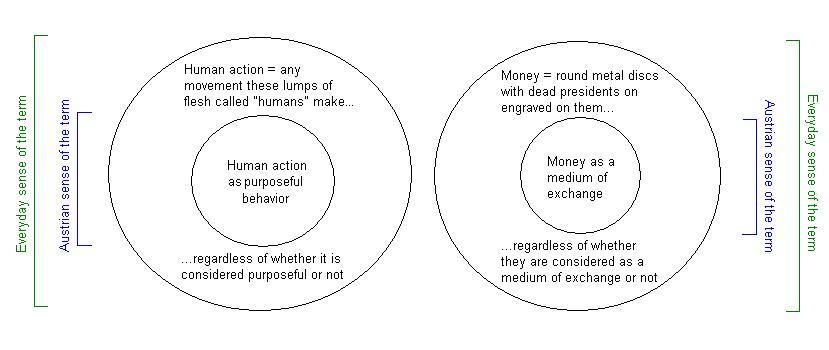
 I have to admit, the pictures are a nice change to the usual walls of text that describe the same topic as a picture could.