Omega, I have a question for you: What do you expect to learn from this forum? Or, are you here to teach? I am skeptical you are here to learn. It doesn’t matter why you’re here or why I think you’re here. You are certainly welcome. I would just like to know your motivation.
chloe732,
The truth is, I am here to learn more about AE after being introduced to some of its major proponents; Mises, Rothbard, Rockwell, etc. There is alot of wisdom and common sense that is contained in AE’s system of thought and I find this very appealing, liberating and productive for a number of reasons.
I’m sorry that you are skeptical but it is not at all clear to me why my asking questions, attempting to understand AND standing my own ground would make one skeptical.
That is it in a nutshell.
By the way, I’m not sure of what I expect to learn on this forum. I’m hoping that it’s more than I have thus far.
yeap, i did say that. Nothing perplexing about that to me.[:)]
That’s what you think. I don’t.
ok
Why do you think you haven’t learned very much at this forum?
chloe732,
Are you asking a rhetorical question or do you really want to know my answer?
wilderness,
-
It is to me.
-
You are free to choose not to think that. I do think that.
-
Yes, it is o.k.
I don’t pretend to think I know or am God, thus, I don’t know. But I do have faith in a Creator. Does that help?
Would someone please tell me how to isolate particular statements or paragraphs as I see many of you doing. If it isn’t necessary I don’t want to continue to have entire quotes posted. Thanks, I appreciate the help.
Just highlight the text you want to quote. Then click the quote link.
I do that like I’m using Word or something. I use my mouse to highlight what I want to delete or hit the delete button directly. Make sure there is one ‘quote block’ for each name with what you are actually quoting in-between.
for instance:
that might not make sense but that’s the best i know how to say it at the moment
My question was not meant to be rhetorical. But don’t bother answering. Judging from your past replies, I’m not equipped for philosophical and logical battles. I’ll step aside now.
I don’t think you even understood what I said… Of course I don’t think the government is doing a single thing well! I never said that the government protects us from the infringement on our rights. Maybe you read a rhetorical question in a non-rhetorical way. I don’t think for one second that our society is better off with more government in ANY circumstance (save complete anarchy, but that’s another debate).
You are in a sense preaching to the choir…
Now, is creating a government as a response to those ills counter productive? Yes, of course! Are people stupid? Eh, maybe ignorant is a better word. But think about it… Would the government be around if nobody were out for power, pleasure, wealth without regard for others? That is the key! Sure people can have wants, desires, etc. etc. etc. But people are only willing to infringe on the rights of others when they have no regard for others’ well-being (they are selfish!), etc. If people cared about the person next to them then why would they infringe on their neighbor’s rights… That is where we see that it is in human nature to be selfish. That is, to care about themselves more than they care about others.
Doesn’t the government always have to do something? I’m being sarcastic… After all, this is what everybody says when a problem arises. In fact, it is the government that causes all the problems! But why do they cause problems in the first place? Because everybody wants more for themselves without doing the work (because they are selfish!). “I want free healthcare!” “I want to be paid for nothing!” “I want free housing!” Blah Blah Blah… Not only that, but they think they are entitled to these things… And here comes socialism!
Then you have the government’s perspective… “How can we get more power?” “What else can we tax?” “What else can we sensor so as to keep our power?” Blah Blah Blah… Again, here comes socialism! They are all in it for themselves.
Anyways, I could come at it from more angles, but I am still convinced. The only thing that I might add as a reason that ‘society always chooses government’ is ignorance, but it seems to me that if they weren’t so selfish they would do what was best for their neighbor in the first place… That is, treat them the way they would want to be treated and let them keep their rights!
-Daniel
The sequence, you might say, is: Selfishness -->crime and trampling of rights–>government–>government commits crimes and tramples rights–>ignorance–>government grows until it becomes an empire and collapses–>repeat the process. The key step, then, was “ignorance”. If ignorance could have been replaced with its opposite (knowledge of liberty?), then perhaps the next step would have been “liberty” instead of “government grows bigger”.
From earlier posts on this thread I concluded: 1) humans communicate, 2) the internet is a revolution in human communication, 3) the internet is new (15 years old). This explains why we have had ignorance (in regards to choosing liberty) up until this time. Centuries ago, people knew of liberty, they talked about liberty, but they have never actually chosen liberty. Until now? I don’t know, it’s just a guess.
That may be true, but has any other revolution in communication ever led to more liberty? If this were true than we should technically be freer now than ever before. From what I’ve heard, we are taxed more today than medieval serfs were so…
And I like how you tried to make a timeline, but this is more like what I mean:
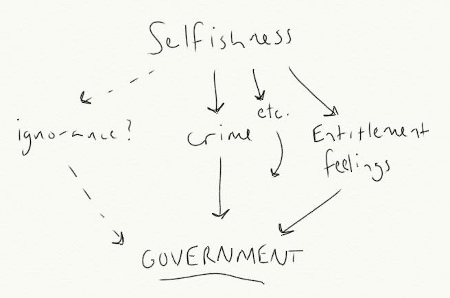
(I hope you can read my handwriting…)
Edit: I wanted to try and show selfishness as the heart of the problem, not just the starting point, if that makes sense. You could stem several things off of selfishness including maybe the quest for power (from the politicians’ selfishness). Another thing is that the only ‘problems’ for government to solve without selfishness (crime, etc.) would be random natural disasters, and frankly, if people were treating people the way they would like to be treated (i.e. no selfishness) they wouldn’t need government to solve that problem anyways; they would help their stricken neighbors out!
And I wanted to also add one more thing… As I was drawing this wonderful diagram (haha…) I may have thought of a fallacy to my argument. Because I believe we can agree on peoples’ selfishness (maybe not in it’s role in the cause of government), one might ask: “If people are selfish, they should be able to tell after a short amount of research that liberty is the best thing for not only others, but also themselves! So if people are selfish, why aren’t they all libertarians?” Does this make sense? Maybe not…
-Daniel
Government is not a reflection of people; it’s just a reflection of government. Of course, government is made of people, but it is not easy to say that the junior officer of the environmental preservation department is an embodiment of government, or the vice secretary of the treasury department is the government. It’s thousands of people with thousands of different and independent agendas. And what they do is what they do as people from inside looking out, and it is not easy to simply go and say that they are the necessarilly the result of those on the outside looking in.
You don’t “choose” liberty. You have it. It refers nothing more than to your claim on your actions and what you do. You are not GIVEN liberty; it just exists.
The truth is - all society is libertarian society. We are a world of people acting according to incentives and constraints, while weighing between costs and benefits. What we people here normally just object to is the intrusion of coercion into this process. This coercion - that may come from either government intervention or by intrusions on natural rights by just about your typical person on the street - is a disruption of already existing natural liberty which has allowed resources to be allocated in such a manner that allows human society to exist. All simple individual human action of weighing between costs and benefits and working by incentives and constraints has helped build society, but the entry of external decision makers is what leads to a momentary disruption of this process, the cost of which is continuously borne by free society.
Of course, whether or not we choose government is irrelevant. People choose a lot of bad decisions. Or are at least inclined towards them. Bad decisions always have a cost. But incentives and constraints still push away the effect of bad decisions, and you can make a bad investment once, but you can’t keep doing it forever once your money runs out. Mistakes are a part of free society, and errors of government are one of those mistakes, but ultimately, we somehow absorb those mistakes and move on ever further. Amazon kept making losses for several years before it came a hugely successful business. Losses are a part of the resource allocation process. So are the faults of government. It will exist; it will burden society; but our human race will still continue on. Only war can destroy it, and that’s one area where we must really watch government.
Irony.
lol
I don’t pretend to think I know (fathom the ways of God and have the knowledge that God has)* or am God, thus, I don’t know. But I do have faith in a Creator. Does that help?
*edited
Thanks filc.
Thanks you also.