Yeah, you’re right. No way he got escape velocity on the golfballs.
Well, to be blunt, how strong are your maths and chemistry? >_> 80,000 molecuels in a cubic-centimeter is essentially a vacuum compared to the earth equivalent:
"Avogadro constant = 6.022 × 10^23 molecules per mole
The density of air at sea level is about 1.2 kg/m^3 (or 1.2 g/L).
Assuming you are asking about how many molecules are there in 1 cubic centimeter or 1 cm^3 of air, then
mass of one mole = 29 grams
the density of air tells us that there are 1.2 grams of mass within 1 cm^3 of air
1.2 g/29 g = 0.04 moles of air in 1 cm^3
Therefore the number of molecules = (0.04) x (6.022 × 10^23) = 2.49 x 10^22 molecules"
2.49 x 10^22 molecules is a gigantic f*ing number. To put your number in equivalent terms, 80,000 is 8.0 x 10^4. Each number past 10^4 is a power of ten >_> And that’s of difference of 18 powers of ten.
That’s almost the different between the size of an atom and the size of a human being. I suppose that analogy fails if you don’t grasp the true size of an atom tho… as most people don’t. I probably don’t fully grasp it myself <_<
You can understand it in reverse tho more easily, since we are familiar with large things and not familiar with very small things.
So then, the size of an atom compared to that of a human being is a lot like the size of a human being compared to the size of the sun. (or was that person to the size of the entire universe? Been a long time since I’ve seen Powers of Ten.)
How many ‘yous’ could fit in the area of the sun? Possibly many trillions.
So, if there’s 80,000 ‘yous’ contained in an area the size of the sun, that should give you an idea of just how sparse 80,000 molecules per cubic centimeter there would be on the moon, and why it’s perfectly reasonable that only a few of these would likely touch each other before escaping into space
Here’s the Powers of Ten movie if you haven’t seen it, enjoy
I was thinking about this today and I figured you might say something like this. I agree that 80,000 molecules isnt very many when you spread them out over a cc, as you have ably demonstrated. My argument isnt the contrary position. When I envision solar wind sweeping all those molecules away, I dont envision there being 80,000 molecules left, but as you alluded, when we get out of observational physics these things have a tendency to become less intuitive. So perhaps solar wind does the job and only these few molecules are left.
My problem is actually more to do with trust and the way “facts” are reported. Instead of doing what you just did, for years people were taught “the moon has no atmosphere.” nowadays theres more information, just like theyre willing to admit that theres water on the moon. After your science review it seems like lunar atmospherics is an excellent example for teaching people how to work in moles. But I think I lost my point because I am now bitching about what they taught in school a million aeons ago when I was a student, and popular “science” publications which we already know are full of misinformation. So lets just say that the normal nasa explanation passes, and I wish people used words like “minimal” and “negligible” instead of “no[ne]” for the sake of accuracy. When someone tells me there is no atmosphere, then I find out there actually is one, its just “not important enough to mention” I get suspicious.
We read you the first time, thats not very informative. You could at least post a picture of the moon where the terrain looks like the nevada picture. Surely there must be one of those somewhere, right? Or do we have more pictures of the moon than we have of nevada and so I could flip it around, and question whether anyone had ever been to nevada, as the landscape looks awfully lunar…
I’ve had a thought for a long time now that we should create a digital textbook that allows you to drill-down into detail and out of abstractions.
At it’s top level, it would be science at a first grade level. The text might only be 20 pages long, with incredibly basic explanations of basic science.
But, with a click you could have it expand into say a 5th grade level, or a 12th or graduate level, almost like zooming in for more detail in Google Maps.
What might be a page on the 1st grade level could turn into an entire book by the graduate level. The mere introduction of a concept on the st grade level could turn into a reference library at the graduate level primarily concerned with that one aspect of the field! All with a single click.
This would allow students to drill down and pursue self-study as desired. How I’ve wanted to do such a thing in the past.
Anyway, back to our discussion. I think that the science writers, in saying the moon has no atmosphere, mean that there is no ring of gases which are held in place by gravity. Pretty much the only air that earth loses are the incredibly light gases like helium and hydrogen. The rest are held in place despite exposure to the vacuum.
In that sense, it’s not misleading.
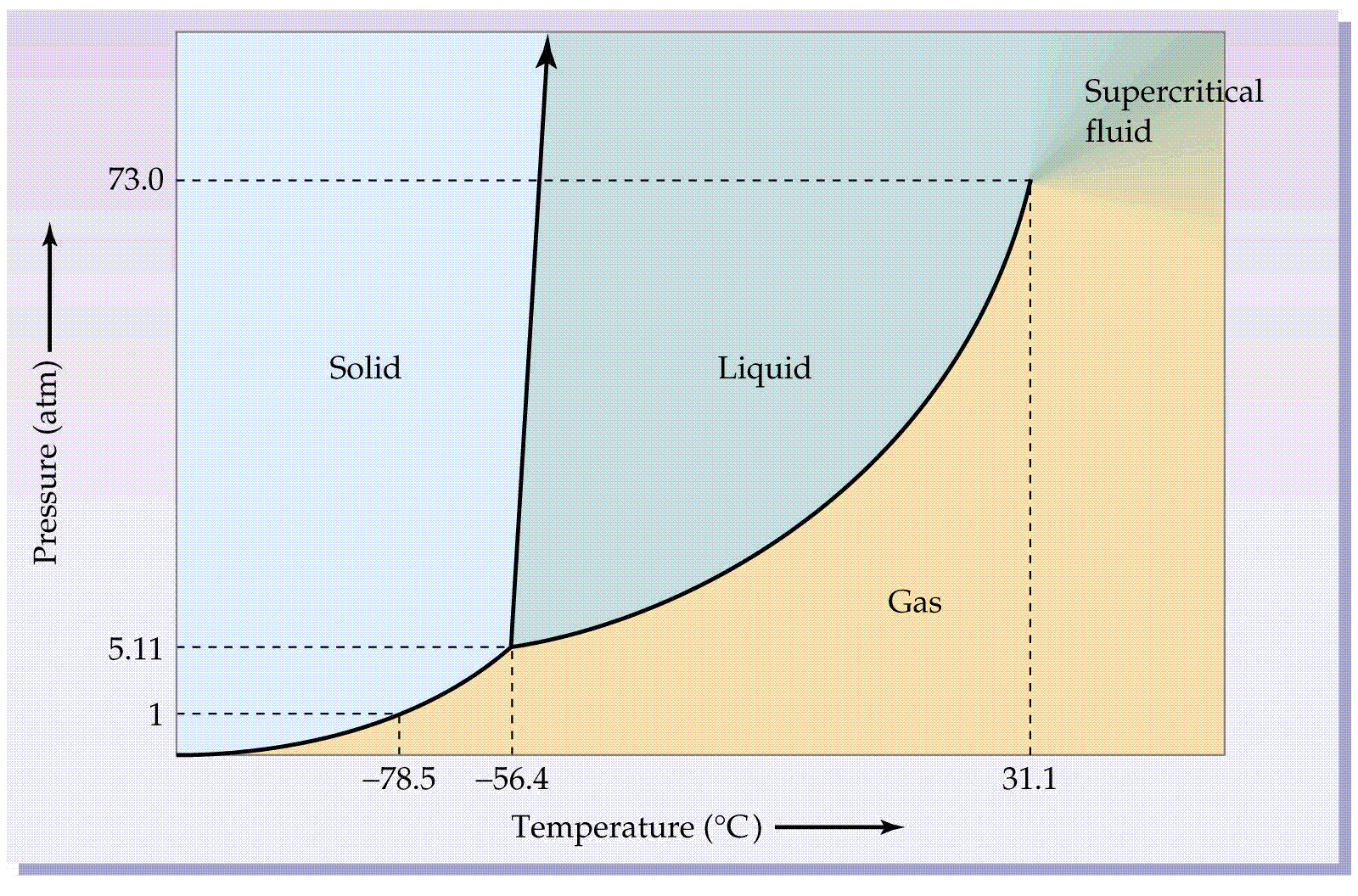
As for water on the moon, I’ve always been deeply suspicious of the claim, for the simple reason that any water thus on the moon would be exposed to extreme of cold and heat and vacuum, and the phase-change diagram of ice show that cold + vacuum = sublimation, meaning ice turns directly to a gas, skipping the liquid phase, which means any existing ice would simply turn to gas and be lost to space in no time. Not to mention being boiled if the sun hit it.
I finally understood that they meant that water is trapped in the form of chemical hydrates on the moon, chemical compounds with water which cannot simply boil away as a gas.
I’d like to think libertarians are a breed apart, able to take the correct approach to things like this :\ Anyway, some rebuttal:
“- No stars appear in any of the pictures that were allegedly taken from the moon nor were any mentioned by the astronauts. Because the moon has no atmosphere to diffuse their light, the stars should have looked spectacular.”
The moon is bright. Because the sun is bright. To take a picture on the moon is not quite like taking a picture on earth. The ISO value would be quite low to compensate for brightness. Depending on the luminosity of the stars then, which wouldn’t be significantly different from that of seen from earth, if you block really bright light (the sun) to get a photo, then it’s perfectly obvious that you do so at the expense of dim lights. Thus why the moon photos had no visible stars. This actually ends up being exactly what you’d expect, and evidence for the moon landing rather than against it. Could you see stars, we’d know it had been faked. And since photoshop didn’t exist back then it would’ve long since been detected.
NASA has never released any photos in which the moon can be seen in relationship to planets other than Earth, because those relationships would be almost impossible to fake, said Kaysing.
This assumes its conclusion, and thus is ridiculous. It also casts aspersions on motives, a weak rhetorical move if any.
Pictures of Earth that were allegedly taken from the lunar surface are patent fakes, he added, because the Earth appears much too small in relationship to the lunar horizon.
To know that you’d need to be able to accurately measure the distance, in the pictures, to the perceived horizon. However, they landed in a crater, didn’t they? Therefore we’re not seeing the actualy horizon, just the like of the crater, I believe.
Lunar landers should have kicked up tons of dust and debris as they landed on the moon but photos show that the areas directly under the modules’ rocket engines are undisturbed. If powerful rockets didn’t affect the lunar surface as the module landed, asked Kaysing, why are the astronaut’s bootprints clearly visible in the dust?
Really relies on an argument from analogy, the analogy being to how thrust works on earth. On earth, wind and thrust create large vortices because it’s pushing against an existing atmosphere. But thrust on the moon works primarily by mass-expelling. The mass being expelled isn’t going to hit very much stuff, much less rile them up. The logic simply fails a basic science-literacy test.
Pictures taken with the sun behind the astronauts show bright detail on helmet visors and the front of their suits. This could only be done with artificial lighting of the type that is used on movie sets.
I assume this is referring to the old canard that only an atmosphere can scatter light, shouldn’t all the shadows be perfectly black? A moment’s thought will show you that, even without an atmosphere, light can reflect just fine in a vacuum and hit things with their back to the sun, no atmosphere needed at all.
It would have been a simple matter for astronauts to signal Earth and all mankind with silver foil or a laser device after they reached the moon but they didn’t. It’s hard to imagine how NASA could have overlooked such a public relations stunt.
It’s also a (fairly) simple thing to send a cheap satellite to the moon with a hi-rez camera and film the landing sight. And you’re going to find all the bootprints still there, in perfect correlation with the photos we have now. That would be essentially unfakeable. Then you’ll know for sure. If the Russians had doubted us, they could’ve verified the landing. I don’t doubt they did in fact, because if the US had faked it, the revelation would’ve been a tremendous propaganda victory.
If Apollo astronauts had really flown to the moon they would have passed through radiation belts that would have burned them to crisps. Astronauts who merely orbit Earth don’t encounter these belts and return unharmed.
Ridiculous on so many levels. I’m done here. Not worth the effort.
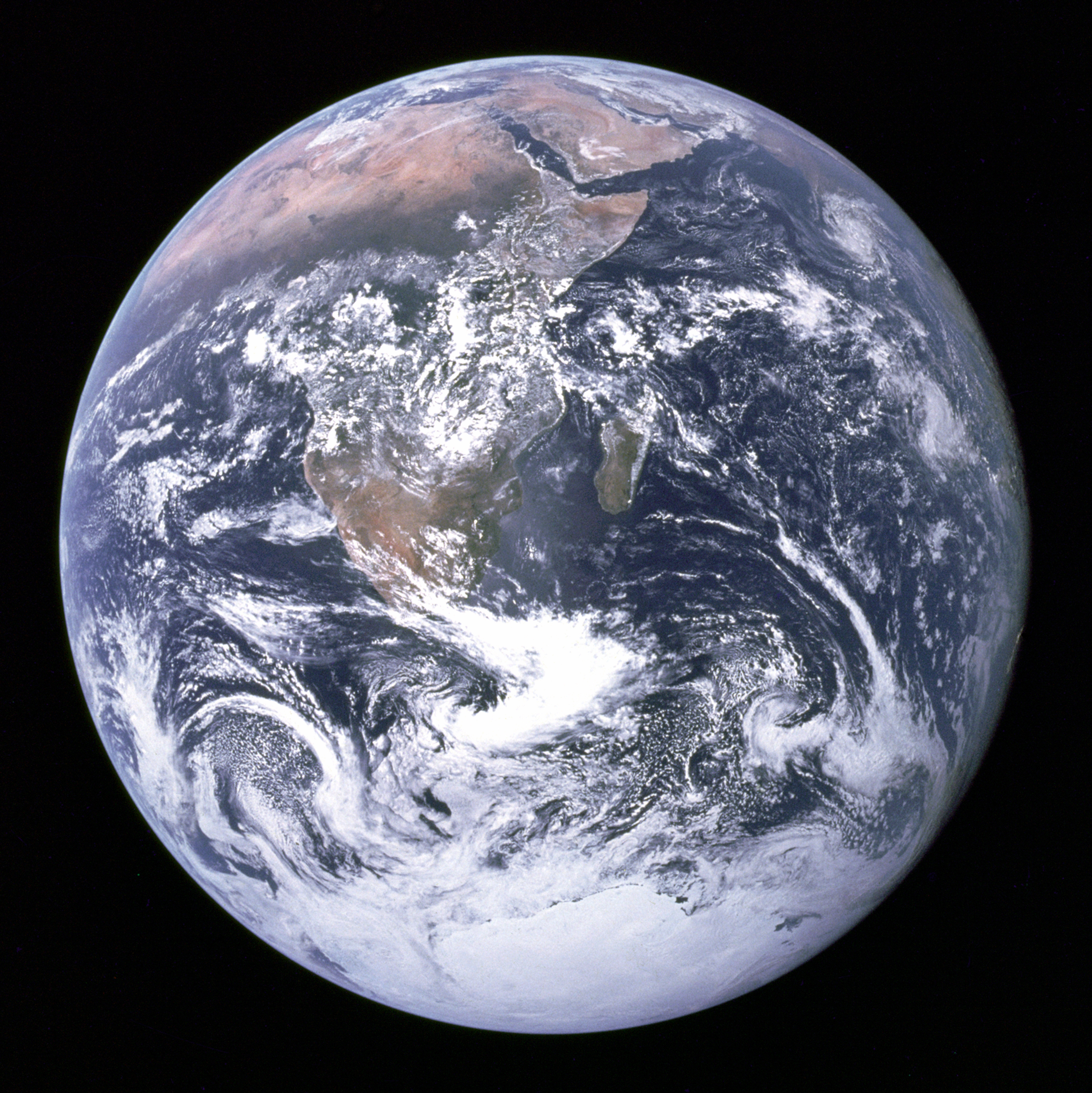
So, you’re basically claiming that the cameras could not resolve any stars? Consider this photo taken of Earth on the way to the Moon during Apollo 17:
There is no moon surface here, no Sun in the frame. What bright object is responsible for the blacking out of all the stars? Since the path of the moon rocket would have had to be nearly in the ecliptic plane (the Moon is tilted just 5 degrees from the ecliptic, there should be any number of planets visible in these shots. Venus is the brightest astronomical object beside the Sun and Moon (and, in this case, Earth itself) with an apparent magnitude of around -4.9 from the Earth’s surface on a clear night - sans Earth’s atmosphere, its apparent magnitude would be even greater.
I’ll do some more digging on this because it seems too obvious a point to have been overlooked. The conspiracy-theoretic explanations for simply blacking out the stars that I’ve seen given is that the astronomers could not have been fooled. But then it seems like this is an even more incredible story. “Our cameras were too insensitive to pick up any stars.” Seriously?
God, are -you- a conspiracist too? …I suppose I should’ve realized with your musings on the Catholic church and Blavatsky.
I believe you’ve quoted here a picture of the famous photo known as The Blue Marble.
Brightness is certainly a factor even here. The sun in reflection is just as bright as the sun in reflection on the moon. In both cases there is no atmosphere to scatter.
But, in reality, this picture does have stars showing in it, despite the adjustment for exposure, as can be seen in a hi-res copy of the original, enjoy:
Again, view the larger image. The human eye is so good at adjusting for luminosity disparities that I think you’re being tricked by your own human experience.
Yes. I’ll admit Lew Rockwell got me started on this but the more I’ve looked into it, the more I realize that it really, really just does not add up.
Motive issues. Praxeologically, the Moon missions serve the same function the Pyramids did for the Egyptian Pharaohs. They are big, impressive monuments to the massive swinging balls and unsurpassed excellence and “can-do” of the USG. Superlatives like “heroic” “superhuman” “titanic” are regularly invoked both in respect to the operational achievements of the lunar astronauts and in respect to the technological achievements of NASA.
Also, in terms of basic risk analysis, the lunar plunge just doesn’t make any sense. Going to orbit the Moon is insanely impressive and the risk of just going and orbiting the Moon is many, many orders of magnitude less risky than descending to the lunar surface. While descending to the lunar surface is more impressive than merely orbiting, it is not nearly as much more impressive as it is more risky. Cost-benefit wise, it’s just not worth it. The final moments of a beloved American hero being broadcast across live TV as he burns up and suffocates to death, stranded on the Lunar surface is just beyond unthinkable and USG would be 100% to blame for it.
Technical issues. The biggest hang-up for me is the blatantly insufficient testing of the lunar landing. They should have gone back after Apollo 10 at least three or four more times before even dreaming of taking the final plunge. If the program really was so reckless as to move straight from Apollo 10 to Apollo 11, then the flawless* record of success from there on out is simply unbelievable. The risks in getting down to and back up off the lunar surface are almost incalculable.
There are other, less glaring - but still fatal - technical issues. How the modules were kept cool, how the astronauts survived the radiation, and so on.
Evidentiary issues. Look at the footage in the videos I linked above. It’s simply not believable. They must have faked those portions of the footage. This leads me to want to dig further in terms of evidence. I’m generally uninterested in evidence unless I suspect somebody’s lying. Then I want to find the proof they are lying. And you only need one piece of evidence. You do not need to build a “preponderance” of evidence. This isn’t a court case.
Clayton -
*Sans 13, but you know what I mean… zero deaths above LEO.
as for ice in space, are you suggesting that whenever (or most times) scientists mention it, they are referring to hydrates? That seems like another pesky detail that the reader would like to know. Because astronomical literature contains many references to ice in what is typically considered a vaccuum. On the moon, from what I have been reading, the story is that there is solid water in the bottom of craters that are deep enough to escape direct solar radiation. Theres also supposed to be millions of tons of it.
first of all, you cant say that apollo served the same function as the pyramids since the function of the pyramids is still an open question. That question is beyond the scope of this thread, so lets just leave it there. Secondly, I argue that the apollo program was a reconnaissance campaign. Dont confuse the propaganda that surrounds the program and uses it for other purposes with the actual program. Humans have recorded transient lunar phenomena for over a thousand years, when ballistic missile tech got to a point where people believed it was feasible to explore luna, they did.
This is built upon the paragraph before it, and so I contend that only a manned reconnaissance mission (or series of missions, i.e. a campaign) could have returned the data that they wanted. As for the risk, the planners and powers that be were not astronauts, they operated through intermediaries and used regular folk to do the dangerous work. I also contend that if the lethal accident on apollo 1 where three americans died in a training/test sequence, and the public reaction to that incident, reveals that the risk of dead, dying, or marooned astronauts was not so bad as you suppose. The public accepted the risk because of many reasons, the astronauts were largely active-duty military pilots, they were volunteers, and people identified with them.
I tend to agree that the risks are incalculable, but that causes me to reject this argument. I dont understand what further testing you would have done between the flyover and the landing. And I dont believe that repeating apollo 10 three or four times wold have been worth the cost, when those missions could have gathered data from the lunar surface. Theres also precedent for nasa deleting what they considered to be superfluous tests from the schedule.
I dont think that lethal amounts of radiation are a given.
EDITED TO ADD: I’m sorry, Clayton, I saw that bare url and got to thinking how much time and effort you put into your posts and thought it might seem kind of disrespectful to just bleh with the bare url. So I will explain, I did a search and found out they used space radiators, the thing is that space is actually very cold in that it doesnt have much thermal energy, indeed there isnt much of anything. So they convert the heat into infrared radiation and beam it out into space. This works inside an atmosphere, but the inbound thermal radiation is almost as bad, so its not worth the trouble.
I agree with you that nasa lies, and has lied countless times about the moon and the space program. The existence of a lie does not mean that any story that contradicts it is true. In fact, you cold prove that every image that nasa had released was fake, and that still would not resolve the issue at hand. Fake pictures dont prove that someone didnt do something.
No, not always. Comets, for instance, certainly have actual ice on them. But they must have come from recent explosions of planets or something, 'cause it seems like the ice would have sublimated off eons ago.
Or maybe the rate of sublimation drops very much as ice gets colder. That seems more likely to me. Since space is very, very cold, unless sun hits it of course, but more importantly it’s always very low pressure.
We’d be talking about the extreme lower left of this diagram, and moving right, but not up, when sunlight hits it:
So, ice is quite reflective, it’s a question then of how hot ice gets when sunlight hits it when it’s already near absolute zero. It’s certainly imaginable that the rate of sublimation could be extremely low still, dunno for sure. Would be a good question to ask a NASA scientist.
It’s all theory till someone lands a mining bot in there. Water on the moon could make a settlement viable, be it in hydrates or ice or some combination. We do know that water is everywhere in space. I only wondered specifically if there’s actual ice on the moon in large quantities.
Well, your question prompted me to look up the phase change diagram and consider if maybe the coldness and vacuum might mean incredibly low sublimation rates that would make such a thing possible. Having done skimmed that info, I think now that it may be possible for ice to live a long time in space after all.
Comet’s tails are probably sublimated ice, and they last quite long after all.
"So, you’re basically claiming that the cameras could not resolve any stars? Consider this photo taken of Earth on the way to the Moon during Apollo 17:
There is no moon surface here, no Sun in the frame. What bright object is responsible for the blacking out of all the stars? Since the path of the moon rocket would have had to be nearly in the ecliptic plane (the Moon is tilted just 5 degrees from the ecliptic, there should be any number of planets visible in these shots. Venus is the brightest astronomical object beside the Sun and Moon (and, in this case, Earth itself) with an apparent magnitude of around -4.9 from the Earth’s surface on a clear night - sans Earth’s atmosphere, its apparent magnitude would be even greater.
I’ll do some more digging on this because it seems too obvious a point to have been overlooked. The conspiracy-theoretic explanations for simply blacking out the stars that I’ve seen given is that the astronomers could not have been fooled. But then it seems like this is an even more incredible story. “Our cameras were too insensitive to pick up any stars.” Seriously?"
I might have explained it wrong. The problem with the pictures has to do with shutter speed. To make the pictures look good, as opposed to taking pictures of the stars, they used a really low shutter speed that could make the lit objects look good. However, because the shutter speed was so fast, the stars did not appear, because not enough light from the stars got onto the camera. Reducing the shutter speed would overexpose the image, unfortunately, due to the relative brightness of everything but the stars. This is a realistic limitation of photography.