I was recently informed on another forum that Austrians are not taken seriously in academia and they have not given any reasonable explanation for the recent financial crisis. Is that because mathematical modeling is not core? I was also told that starting from first principles or behavioral analysis to understand or describe a market is useless since there are a great number of consumers, markets, governments, etc. You use statistical tools to make inferences on the largest portions of data. What is the Austrian reason for the financial crisis? The thread was about getting a master’s in economics and what the job entails in industry. From the impression I was given, Austrianism and economic philosophizing in general is purely academic and not taken seriously. I’m curious what you guys think here.
I’ve never known an Austrian to ever reject modeling in toto, only poorly-constructed models on an individual basis.
Marginal analysis, the cornerstore of modern economics, is based on axiomatic logical deduction. If we can’t have a priori knowledge, then we can’t have economics, or philosophy, or any science.
If your statistical tools are broken then you’re going to get flawed results.
To simplify a rather complex issue, the manipulation of the money rate of interest via credit expansion on the part of the Federal Reserve.
You’ll be a minority if you’re in an economics program and you’re an Austrian. You’ll most likely be a minority if you’re anything on than a neoclassical, to be honest.
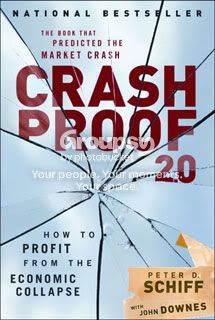
Many Austrian economists predicted the housing bubble. Likely the best known Austrian warning of the crisis was Peter Schiff who was scoffed at.
Read this Mises Daily by Daniel James Sanchez analyzing the stunning wrongness of Federal Reserve Chairman Ben Bernanke. The YouTube video he cited is no longer available because the YouTube account associated with the video was terminated due to multiple third-party notifications of copyright infringement from A&E. You can watch it here.
There is a good explanation of the crisis from the Cato Institute.
Oh, I understand the reasoning completely. It only makes sense to use propositional logic to deduce economic theory. I’m a math major, physics minor senior. How are the statistical tools broken?
I thought poor government policy, legislation, and regulation led to a great number of mortgages being given to those who could not afford it. Combined with the securitization of mortgages, when the incredible number of loans defaulted, the insurer of those loans could not pay the claims thus having a massive ripple effect in the economy. I certainly understand how the Fed has been introducing artificiality in the market for a long time. I asserted that you want the most natural market as possible. I was told that’s not possible and that large markets only exist with massive government intervention. To this person, it was a good thing.
I would characterize myself as free market/Austrian. How much of a difference is there between the two? I say free market because I like a lot of Milton Friedman’s principles or positions on market dynamics. However, if I’m not mistaken, I think he views the Fed as having a legitimate function.
You’re kidding, right? As opposed to the reasonable mainstream view, which is, “Capitalism did it!” Like a little kid crying that his bicycle bit him when he fell off…
The financial crisis was precipitated by a gigantic bubble in housing, caused by artificially depressed interest rates making credit artificially easy. Real consumer preferences became desynchronised from expressed consumer preferences. Without the essential price of a free interest rate available to lenders, they can only miscalculate on a grand scale.
The real ‘problem’ with Austrian economics is that it concludes that there’s nothing for a central planner to do. That’s why pompous annointed experts in the position of central planner aren’t inclined to mention it with respect in polite company. Do you really find it surprising that they prefer dull-eyed econometricians who will look at a single arbitrary data point and inevitably conclude that there is something to be done - some legitimate purpose the omniscient central planner can fulfill?
Pretending that you’re quantifying something fundamentally unquantifiable, such as human desire, is just wishful thinking. It doesn’t make it so.
How is trying to simplify the billions of ever-changing wants of millions of people in some graphs and small equations not a silly, broken and doomed concept?
I am not kidding. I could post a link to the thread, but this person may actually post on here. I doubt it, but I’m not sure. Personally, I think this person is full of crap. I disagree with virtually everything we discussed. I was not versed in the Austrian line of thought, but I understand that you do not want artificiality in the markets. Government is practically soley responsible for such matters. Also, according to this person, centralized planning worked in the Soviet Union in the 1950s, but it didn’t work in the 1970s. I said then it didn’t work. It could for a limited amount of time, but it was unsustinable and simply took a few decades to not work.
Having this philosophical bent, is there a job for us out there? I’m considering a master’s in economics, but I’m trying to determine if this is simply a serious hobby for me.
I agree. I was told the opposite should work. We look at the market activity and make our assumptions from that.
“I’m a math major, physics minor senior. How are the statistical tools broken?”
in physics and math you deal with fixed resources. But humans are not fixed. They are not numbers. Their values are always changes because they are never going to be satisfied with what they have.
“I would characterize myself as free market/Austrian. How much of a difference is there between the two? I say free market because I like a lot of Milton Friedman’s principles or positions on market dynamics. However, if I’m not mistaken, I think he views the Fed as having a legitimate function.”
well, Friedman’s methodology was positvism and he was known for his infamous book, "Essays in Positive Economics "… I cannot find the source of the quote at the moment, but I think this is the book where Hayek said that this is the 2nd most dangerous book in Economics after Keynes’ General Theory.
Right. It is silly to expect or apply such explicit and deterministic laws with human action.
I have not read any of Friedman’s books, just listened to some interviews and discussions on Youtube. I liked his free market ideals. I downloaded Human Action; Man, State, and Economy; and Individualism and Economic Order, but I have yet to read a lot. I may buy the books, though.
Friedman is awesome…his methodology shouldnt keep one away from studying him
I like his free to choose concept. His exchange on youtube with “Michael Moore” is fantastic, in my opinion. I always break things down into principle and philosophy. Practicality can always sort itself out once you have a correct foundation. I guess I should study his laissez faire approach.
Business cycle theory is like the most important aspect of Austrian economics, lol. Austrian theory explains the crisis, mainstream and Keynesian theory does not quite square with the data.
Well, clearly, I have a lot to learn about Austrian economics. I watched the video with Peter Schiff. Those other jackasses were completely wrong and constantly ridiculed him. Why? It’s almost like they had an agenda to support the house of cards.
It also appears that the biggest purported contribution from Keynes is the effectiveness of a direct fiscal stimulus in a depressed economy. We were told this in my macro class. I always suspected this is utter nonsense, as the federal government is the most inefficient and cumbersome entity in the U.S.
Welcome to the world of Austrian economics. 
Your suspicions are correct. If you’re interested in learning more, I suggest you start with these three vids. Watch them in this order. They will blow you away…
One### Two### Three
(Bear in mind, these are full lectures…roughly an hour each…so be sure you have the time available to finish one before you start it. I realize it can be tough to watch something on a computer that long (especially a lecture), but you may be surprised. Grab a snack and get comfortable. These will give you the best foundation you can get in this amount of time.)
(If it would be easier to listen to them on an mp3 player, you can download the audios…here, here, and here.)
“Oh, I understand the reasoning completely. It only makes sense to use propositional logic to deduce economic theory. I’m a math major, physics minor senior. How are the statistical tools broken?”
The tools are fine, but their use is improper. To explain, in economics there are many things that can be known by deduction as you pointed out, but there are some things which one cannot guarantee like predicting the exact desirable output for a factory in some unknown future based on collected consumer data in the present. The present collection of data tells us what’s happening now or more properly what has happened in the recent past, but it doesn’t give us indicators of the exact magnitude or nature of the next turn of events. Econometrics are okay for sketching out the history of an economy, but it doesn’t reveal any new relationships to construct theories upon.
I watched the first video. It was pretty good. I’ll try to watch the first in a little bit. I’m at work, and it’s kind of slow right now.
Someone linked the Krugman-second-coming-of-Keynes article. I forget the Austrian response to why fiscal stimulus is a failure in a recession/depression. It seems to me that another reason why is on the aggregate the funds are taken from a large number of consumers and investors. This would certainly have a multiplier effect in an economy where products are mostly interdependent. The effect would more limited if the fiscal stimulus were taken solely from one entity.
Yeah, the statistical tools are okay. It’s simply mathematics. The mathematical models and data are descriptive, not prescriptive, or at best just a guess of future trends.
I picked up Applied Economics by Thomas Sowell. I’m reading that right now. It’s a fairly easy read.
You’ll get an indirect answer for that in the second video, as well as the third. But if you’d like even more, I highly recommend this article (in fact, everyone should read it anyway. And then there was an entire Mises Circle event focused on the failure of the Keynesian state.)
Excellent. For the next step I might recommend Economics for Real People and/or Common Sense Economics (both of which you will find links to free downloads there). (Or you might go back to Sowell’s Basic Economics and/or Lessons for the Young Economist. Both of those are more introductory books, whereas the former two might be considered more intermediate. Either way How an Economy Grows and Why it Crashes is one anyone can and should read, anytime.)
I don’t think it’s true to say that Austrian-school economists weren’t able to predict the housing bubble/bust. There were plenty of people trying to sound the alarm, but times were so good, nobody wanted to hear it. Even the Bush administration tried to fix it twice in the years preceding the meltdown, which was ultimately unsuccessful mostly because congress wouldn’t allow it. A few friends of mine are econ-guys, and they saw it coming at least a year in advance, and they were sounding the alarms to anyone who would listen… and most people would just look at them funny, as if to say, “why are you guys such downers?”
Now, I do think the Keynesians will have some splainin’ to do, since they were all convinced that they could fix all this by printing and spending money. When it didn’t work, their only defense is epitomized by Krugman, who believes it’s not working because we didn’t print and spend enough. This depression-recession-whatever-you-want-to-call-it will be known by most rationally-minded economists as the end of the Great Keynesian Experiment. Of course, Keynesians will continue as usual - their plan didn’t work because of all the greedy, low-brow banks and consumers who refused to spend their money like they were supposed to.