On the subject of inheritance, I take Ayn Rand’s position: in a market economy, wealth tends to change hands to those who are most capable of wielding it, and so no matter how much you inherit, if you don’t use it wisely in the long run you will lose it. It might be useful to consult some data on the United States.
Inheritance hasn’t formed a very large percentage of the net wealth of the rich historically. According to the Fed, from 1989 to 2001, there “was a precipitous drop in the share of recipients [of wealth transfers] among the highest income group, from 48 to 36 percent, and for the top one percent of the wealth distribution, from 57 to 44 percent”. Surprisingly, “wealth transfers as a share of household net worth tends to decline with both income and wealth.” In 1998, the present value of wealth transfers amounted to 17 percent of the net worth for the highest income class.
We might note, as Thomas Sowell writes in Economic Facts and Fallacies, that many of those in the top quintile of income earners do, in fact, work more.
The US Treasury has done a number of studies on historical income mobility. Many of them have reached the same conclusion: as long as you were not in the extreme top or extreme bottom, your chances of moving between income brackets remained fairly good (though obviously not ideal).
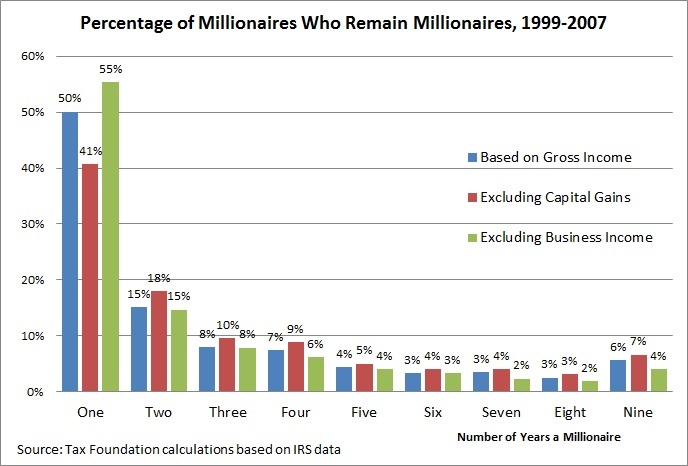
The gyrations of income mobility seem to apply to millionares as well. According to the Tax Foundation, only 15% of millionaires remain so for more than a year.
I’m not trying to defend the rich here or say every single one of them deserves to be where they’re currently at; I’m just saying reality is always a little bit more complicated than the “RICH GET RICHER POOR GET POORER HURRR” caricature you get all the time from the media and from left-wing propagandists.