I though this deserved its own thread.
http://www.youtube.com/watch?v=qzNcY-gZdiA&feature=related
I though this deserved its own thread.
http://www.youtube.com/watch?v=qzNcY-gZdiA&feature=related
Wow, what a pile of propaganda. The narrative is this - game theory has equations that rest on the assumption that humans are self-interested and this assumption leads to the belief that society can self-organize (you don’t need government) but only at the cost of becoming paranoid. The assumption that humans are selfish, avaricious, etc. becomes a self-fulfilling prophecy as the structures for social assistance (government bureaucracies) are dismantled by the ideologues of this self-organized - yet paranoid - social order.
The last segment takes on psychiatry. Here’s the wonderful Dr. Szasz taking on psychiatry:
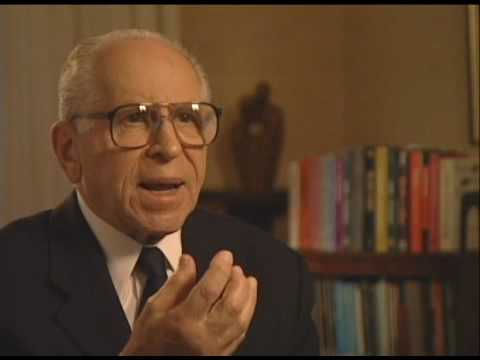
Clayton -
I took something different from it, although I not sure it was the intended conclusion. I thought of it as: humans have goals, these goals are strived after in order to have personal gain, this striving after goals benefits everyone.
Even things like charities can be thought of as self-interested because they are the personal goals of some individuals, people feel good by giving.
I also thought that it was a more scientific way of looking at problems. They took, what I thought to be, a approach very similar to praxeology. They used the assumption that people are self-interested and behave likewise.
As for Szasz, watch all 6 parts of this http://www.youtube.com/watch?v=hk691rHIrkE&feature=relmfu
The film seems to ignore or at least fails to emphasise cooperative equilibria that arise from selfish action. On this and its relation to economics and ordered anarchy, see in particular Anthony de Jasay, Social Contract, Free Ride and Political Philosophy, Clearly. He draws upon game theory to demonstrate that activities in these cooperative equilibria lead to the creation of self-enforcing customs.
As for the supposed ‘paranoia’, I suppose this is nothing more than the old comment that ‘the price of freedom is eternal vigilence’.
Yeah, it’s the consequence of self-ownership. Sure, a slaveowner has an interest in protecting you so that you will not need to protect yourself. He may not even mistreat you even though he is able to. But you’re still a slave. It is true that if you own yourself, you are completely responsible for your own life. I think that’s a fair trade and I think almost everyone in history who’s ever been given this choice has agreed.
Clayton -
He makes a clearly false comparison near the end by claiming that scientology coerces treatment despite explaining that there is a consent form in advance. Psychiatry requires no consent for forced treatment under any circumstance whatsoever. As terrible as scientology is, psychiatry is a far greater threat.
He completely skips addressing the main issue despite noting it at the beginning. There is no theoretical limit to the range of behaviour that psychiatry can use as excuse for forced treatment. Given that the World Federation for Mental Health still claims to be based on its original principles, there is no reason to suspect that a limit is intended. Steve Wiseman may not subscribe to that doctrine; but, he is not an important person compared to those at the top in the psychiatric associations.
If the cost of freedom is paranoia, the cost of pronoia is servitude.
Pronoia: The delusional belief that a grand, benevolent conspiracy exists to aid you.
He makes a clearly false comparison near the end by claiming that scientology coerces treatment despite explaining that there is a consent form in advance. Psychiatry requires no consent for forced treatment under any circumstance whatsoever. As terrible as scientology is, psychiatry is a far greater threat.
I don’t think scientology was the main point of his argument. Although I agree with you on one level, rather than being pedantic and calling out every single one of his errors, look at his mmain argument and try to critique that. As he showed by Szasz’s definition of mental illness makes it impossible to have mental illness, and Szazs’s argument is circular. As for scientology I don’t see it as being any better or worse than any other religion.
He completely skips addressing the main issue despite noting it at the beginning. There is no theoretical limit to the range of behaviour that psychiatry can use as excuse for forced treatment. Given that the World Federation for Mental Health still claims to be based on its original principles, there is no reason to suspect that a limit is intended. Steve Wiseman may not subscribe to that doctrine; but, he is not an important person compared to those at the top in the psychiatric associations.
As for forced treatment, I do not agree with it, but it is not a very common thing, and pretty much everything that can be done to prevent it is. Also, you must be deemed an imminent danger to your own life, or the life of others. But this was not really the main point of his argument. The main point he was trying to get across was that mental health is not a myth.
I don’t have a criticism of that.
That is the boundary of current law, not a principle of psychiatry. The WMFH concerns itself with all social behaviour.
I don’t know much about Szasz’ views. Wiseman’s argument here reduces simply to that Szasz is committing a continuum fallacy. In making that case, he appeals to pure situational sense as the basis for defining mental illness. That begs the question of what makes psychiatry justified as a separately defined branch of medicine, or what makes a psychiatrist better than a surgeon or a bum on the street in that regard. My dad worked in Canada’s biggest hospital for 10 years. I know what goes on in those wards in hilarious detail. I can see how psychiatry could be considered a specialization. But, what goes on in a hospital and the general arc of psychiatry are different. The general arc of psychiatry is to arrogate to itself the final word on acceptable social behaviour and inculcate that into everyone.
Aside from cases of coercion, psychiatry tries to circumvent having to directly coerce people by (a) elevating its sheer opinion on what is healthy behaviour to persuade adoption of its “treatment” and (b) surreptitiously controlling general government policy* under the auspices of “mental health”. In government programs in previous decades, they used appeal to authority to convince masses of people to volunteer for sterilization. In other programs, all over the west, not just Germany, people were forcibly surgically sterilized. As I said in your previous thread, the elephant in the room with Wiseman is that psychiatry acts like a proselytizing religion, imposing its doctrine about what is healthy on everyone else, rather than only responding to people that seek help.
As you can see above, Wiseman’s examples of mental illness don’t quite capture the essence of mental health to psychiatry as a whole.
That is the boundary of current law, not a principle of psychiatry.
It might be the current law, but, as far as I know, it is also a rule among psychiatrist.
That begs the question of what makes psychiatry justified as a separately defined branch of medicine, or what makes a psychiatrist better than a surgeon or a bum on the street in that regard.
What justifies neurology being defined as a seperate branch of medicine? It deals with different problems than gynocology, etc.
psychiatry tries to circumvent having to directly coerce people by (a) elevating its sheer opinion on what is healthy behaviour to persuade adoption of its “treatment” and (b) surreptitiously controlling general government policy* under the auspices of “mental health”.
This is not true. Psychiatrists are often reluctant to ‘‘treat’’ people. They don’t merely have a set of behaviours which they classify as abnormal. They will only treat someone if people meet a certain criteria and claim that the ‘‘illness’’ is preventing the from functioning. If someone complains to a psychiatrist about having hallucinations they will not necessarily be treated for it. they may be made aware that the problem could escalate and begin to affect the functioning but would not be forced if they were indeed telling the truth. The psychiatrist may ask to see a friend or family member with the patients permission. Now, if the friend or family member claims that the person has been seen conversing with hallucinations and committing acts under the order of hallucinations, and their level of efficiency has deteriorated; well then it is obvious that the person is not functioning and need help.
Finally, I don’t believe that psychiatrists are part of some conspiracy to subdue the population. I think maybe in North America doctors are much quicker to hand out medicine and diagnose, but this should be considered mal-practice, rather than believing psychiatry is a pseudo science.
Wiseman leaves open the question of whether treatment should be prescribed without any specific physiological understanding of symptoms such as in his example. A psychiatrist should only act as a researcher in such cases until there is a physiological understanding upon which to base treatment, unless we understand it as common sense treatment rather than esoteric voodoo. He doesn’t say whether the advancements over the past 50 years involved that change in principle, which is rather important given the history. I don’t buy ye olde psychiatrist’s couch therapy. I don’t know enough about neurology to know what that leaves remaining.
That is only in cases where someone goes to a psychiatrist on his own initiative. 10% of kids don’t claim dysfunction. They are indoctrinated into thinking they are dysfunctional by schools and their psychiatric lapdogs.
It’s a systematic mal-practice based on a principle unifying a class of psychiatrists everywhere. If the international and national psychiatric associations were honest, they would admit that much of what they do is not specialized and requires a medical education no more than a junky requires one to know that snorting cocaine will get him high. “Getting an education and a good job will improve my mental health. Hurr Hurr.”
Wiseman leaves open the question of whether treatment should be prescribed without any specific physiological understanding of symptoms such as in his example. A psychiatrist should only act as a researcher in such cases until there is a physiological understanding upon which to base treatment, unless we understand it as common sense treatment rather than esoteric voodoo.
Well doctors don’t know what the cause of migraines is, yet they treat them. Do you think that medication for migraines should be taken off the market.
I don’t buy ye olde psychiatrist’s couch therapy. I don’t know enough about neurology to know what that leaves remaining.
CBT some of the best results for certain disorders. Why don’t you buy it?
That is only in cases where someone goes to a psychiatrist on his own initiative. 10% of kids don’t claim dysfunction. They are indoctrinated into thinking they are dysfunctional by schools and their psychiatric lapdogs.
No they aren’t.
It’s a systematic mal-practice based on a principle unifying a class of psychiatrists everywhere. If the international and national psychiatric associations were honest, they would admit that much of what they do is not specialized and requires a medical education no more than a junky requires one to know that snorting cocaine will get him high. “Getting an education and a good job will improve my mental health. Hurr Hurr.”
Are you actually serious? Do you know how much training psychiatrists need? The need to have an indepth knowledge of mental disorders aswell as all the various medications. The are often well over a dozen medications for one disorder aswell a several therapies to help them.
Migraine medication is based on changes in blood vessel tone. It would be impossible to create a medication without that starting point unless they threw random chemicals into a beaker. There’s really no excuse for medication without physiological basis these days.
If you can’t point to anything physiological you are essentially engaging in heuristics and anyone can do that. If there is substantial difference between the control group and treatment group for a particular tchnique, that speaks for itself. Until then that technique should be advertised as research.
Shrug I go by the enormous amount of people that report otherwise, including people that I’ve known.
I’m as serious as WFMH is serious. I can only hope that their crankery does not feed into the training in schools.
Mon. 12/06/18 20:24 EDT
.post #172
[url=Game Theory, self interest, and praxeology - #4 by Vladimir_Ulyanov]
Transcript of Dr. Wiseman’s talk about Dr. Thomas Szasz
Up until 2:50 of part 1, Wiseman does a tolerable job of representing some of Szasz’s ideas.
But then, at 3:20, Wiseman says this:
Wiseman’s vista doesn’t extend very far, then. Wiseman’s ignorant statement suggests to me that he hasn’t even read one of Szasz’s books, let alone all thirty-five of them. By trying to trivialize something he hasn’t even taken the time or trouble to understand, he tells us more about his own lack of knowledge than he does about Szasz’s ideas.
Szasz neither denies nor affirms “psychiatric symptoms.”
Szasz doesn’t couch discussion of behavior in medical terminology.
What Szasz denies is that behaviors labelled “psychiatric symptoms” are, in fact, symptoms. Psychiatrists (like Wiseman) use medical-sounding language (“diagnose,” “symptom,” “disorder,” “treat,” “medicate”) to create the impression that behavior is illness/disease or somehow the province of medicine/doctoring.
Not only does Wiseman misunderstand what Szasz says, he mispronounces Szasz’s name (and also Descartes’s name). It underscores a fundamental lack of scholarship concerning the subject on which he pontificates.
[url=Game Theory, self interest, and praxeology - #9 by Vladimir_Ulyanov]
Vladimir, there is no “Szasz’s definition of mental illness.”
Szasz does not attempt to define “mental illness.”
Szasz recognizes that some people have strange ways of behaving, but rejects the idea that such behavior is illness, “mental” or otherwise. Behavior can never be illness (or, for that matter, health); the two things are entirely and categorically different.
Wiseman’s actual words are “It’s an entirely circular logic.” But has Wiseman “showed” this, or merely asserted it? And has Wiseman “showed” that the behavior he calls “mental illness” is, in fact, illness, or has he merely assumed it? Has he questioned this assumption? Can Wiseman tell me how “the mind,” which is just a concept, an abstraction, can possibly be “ill”?
Illness is an affliction of the body; illness does not, indeed can not, “afflict” concepts and abstractions like “the mind.”
Tues. 12/06/19 17:20 EDT
.post #174
[url=http://www.suppressiveperson.org/sp/archives/1371]
[url=http://www.abc.net.au/radionational/programs/allinthemind/thomas-szasz-speaks-part-1-of-2/3142206]
Wiseman is clearly flat-out wrong here. As this easy-to-find quote makes manifest, Szasz most assuredly does consider hypertension to be illness. But I knew that before even looking up the quote. Why? Because, unlike Wiseman, I understand the difference between a literal disease and a metaphor.
[url=http://www.suppressiveperson.org/sp/archives/1371]
“Nothing to say”? Szasz wrote an entire book on pain, in 1957: Pain And Pleasure.
Wiseman didn’t have to read the book to know this; all he had to do was look at Szasz’s bibliography.
Did he even do that much? Evidently not.
[url=http://www.suppressiveperson.org/sp/archives/1371]
Wiseman is really reaching here. He wants us to think Szasz, who Wiseman admits “is not a Scientologist,” has nevertheless “… given his support, legitimacy and sustenance to this organization for over forty years.” Maybe Wiseman knows something about Szasz the rest of us don’t? What “support, legitimacy and sustenance” is Wiseman talking about? He doesn’t say.
Wiseman also “… challenge(s) Dr. Thomas Szasz right now to identify any meaningful way that the Introspection Rundown of Scientology differs morally from traditional coercive psychiatric practice.” I think the difference between something that’s voluntary (religion) and something that’s coercive and non-voluntary (psychiatry) is pretty “meaningful.”
[url=http://www.suppressiveperson.org/sp/archives/1371]
This is rich. Wiseman, the tax-funded advocate of psychiatric/state coercion and aggression against innocent persons, calls on Szasz to “renounce” some voluntary Scientological practice. But how can Szasz “renounce” a policy he’s never in the first place embraced? Szasz has already stated he’s not a Scientologist, so there is nothing to “renounce.” Does Wiseman mean denounce? I would call on Wiseman to renounce his love of psychiatric coercion.
I love how Wiseman throws in the gratuitous, superfluous “before his death.”
Does Wiseman think this “renunciation” could occur after Szasz dies?
There are two separate issues which are getting confused.
The first issue is competency. This is not a medical issue, it is a legal issue. Is a person competent to speak on their own behalf in a legal dispute? Children, advanced Alzheimer’s patients, mental handicaps and psychotics are all examples of incompetents. Decision-making power over such individuals must be assigned to another, competent individual, who is then a trustee, advocate, guardian ad litem, etc.
The second issue is disease. Szasz’s quote is like a punch to the face: behavior is not a disease. You don’t go to the doctor and say “I have this tennis problem, I keep playing tennis and then I get tennis elbow”, you go to the doctor and say, “I’m having this pain in my elbow” and he then diagnoses that pain and may ask if you play sports and may suggest that your sports-playing is causing the sore elbow.
Mental disease is no different. It’s not something that you “get diagnosed” with. Dis-ease is something that puts you out of ease. If nothing’s bothering you, you don’t have a disease. Not one of the children diagnosed with ADD/ADHD would ever go to a doctor and seek relief from his “hyperactivity issues”. But he will ask his parents for headache medicine or stomachache medicine.
The entire concept of behavioral diseases is a contradiction of terms. “He’s not acting right. He must have a disease.” No, you have parenting problem and you are either too lazy or ignorant or both to apply elementary principles of parenting and instruct and correct your child’s misbehavior. But your laziness and ignorance are more precious to you than caring for the interests of your child, so you reach for the one thing that will allow you to remain lazy and ignorant: drugs. And the doctors and Big Pharma are waiting for you with wide-open embrace. “Lazy parent? Ignorant parent? We have just the cure! It’s methamphetamine but we called it something different so you don’t have to feel guilty for drugging your child and it’s all conveniently packaged under the rubric of behavior disease. Just come in to one of our doctors who will quickly and conveniently diagnose your child with ADD/ADHD and prescribe high doses of powerful drugs that leave your child in a drug-induced stupor that his teachers will appluad as ‘good behavior’. And the best part is that you get to remain lazy and ignorant!”
Clayton -
I don’t think I agree with that at all, Clayton. Behavior is a product of the brain, and while it might not be classified as a ‘disease’ strictly speaking, it can easily be the product of an illness. Blaming the parent or environment is easy, but often wrong. For example, read ‘Phantoms in the Brain’ or any neuroscience book about how different brains (including damaged ones) influence behavior.
Sun. 12/08/05 22:59 EDT
.post #231
[url=Game Theory, self interest, and praxeology - #18 by zefreak]
Well I obviously think he is wrong, and his conclusion doesn’t really make since in the context of modern cognitive science and psychology. Decades of research has pretty strongly shown that materialism - 1, Szasz - 0