Just for good order adding this critique called “Phenomenology and argumentation ethics” by Xavier Meulders. Browsing it briefly (24 pages… cmon…), despite the fancy phenomenological decor it seems to be the usual points of misunderstanding. If someone requires a more detailed response, he can ask.
My response to Meulers paper having read it.
The main issue with the paper is argument that everyone must assert they have rights based upon their rationality. I could argue my rights depend upon my superior style and aesthetic taste. Now it is the case can only argue this in language but my existence does not depend on language. Consequently the universalisability criterion does not necessarily apply in this case.
A note on Husserl, although his analysis seems interesting imbibing the essence of an object without interpreting it seems at least odd- I hold that man has imagination as well as reason where the former is the epistemology of the aesthetic and is more intuitive I wouldn’t deny that kind of intuition is devoid of analgous presuppostions.
The problem with all the argumentation ethics is that they need a broader moral philosophic base which implies an overall framework of everything- metaphysics (Truth), ethics (Goodness) and aesthetics (Beauty (I count epistemology as a method of discovering these irreducible essences (used in a loose sense)
Arguing over argumentation ethics? Like you guys don’t have any more pressing concerns? This is worse than Maoists versus Leninists.
Another (neo-classical) critique by one Ilja Schmelzer. Skimming the article (another 50 pages critique… how can someone read those?) I see very familiar “objections” such as:
He may only pretend to participate seriously,
but really, in fact, this participation is only a joke.
and a general equivocation of the formal concept of performative contradiction with just standard issue hypocrisy…
misunderstanding the difference between a-priori statements and their categorical application:
Indisputable? I disagree. I can dispute the claim “humans are capable of argumentation” without contradicting myself. I can, for example, claim that some
humans are not capable of argumentation.
ext. ext.
The part of AE I think is strongest is the concept of performative contradictions.
Self Ownership - To deny this requires ownership of one’s body / mind
Objective Truths do exist - To deny this affirms its negation to be true
Conciousness does exist (Randian type arguement) - To deny this requires use of conciousness
These type of propositions are to me axiomatic and indisputable norms. Where I think the chain gets wobbly is making the leap from self-ownership to homesteading and private property rights. Hoppe makes a good attempt but it does not seem as strong as the first principles.
But Hoppe does say that after all, argumentation (and following that our physical existance) is a ‘practical’ affair. Requiring food, shelter and the use of scarce resources in order to continue the discourse and survive in the physical world. And it is a fact there will always be rivalrous conflict over the use of scarce resources, because mans wants are unlimited but the means to achieve them are scarce.
But according to AE, one of the axiomatic norms is a ‘conflict free’ or ‘less conflict’ method of resolving disputes. This proposition is supported by a performative contradiction (again) - the very act of engaging in argumentative discourse means you prefer less conflict, otherwise you would just kill, beat, take or steal from the person on the other side of the dispute.
So this ties together - on the one hand scarce resources are rivalrous and the source of conflict, and on the other hand your actions presuppose a preference for less conflict. Hoppe then declares the only possible way of using scarce resources with the least conflict is via a first-use/homesteading system of private property rights. Property rights based on latecomer-use and universal ownership are praxeologically shown to increase conflict, not reduce it, and thus rejected.
So therefore, the very act of argumentation and rational discourse implies a preference for the libertarian system of self-ownership and homesteading. Hence this system is the only one that can be universally justified.
I can see why AE would infuriate a lot of people, but within the confines of this logic, the theory is all deduced without oughts, ethical interjection or major missteps. It is all praxeological and deduced from the action axiom, but this time starting from the action of discourse.
My biggest complaint is Hoppe has not done the best job in writing it clearly for people to follow. Considering his amazing clarity in most of his other work, this is disappointing considering it is his most known intellectual theory.
Self Ownership - To deny this requires ownership of one’s body / mind
No, it doesn’t. Obama can easily own my body and merely be allowing me to use it. Just a counterexample.
Its the most common objection I have seen, and those using it misunderstand the point of the theory (im not saying you are in this category Wheylous), that AE is about what can be justificatively derived from a praxeological analysis of action and discourse.
Slavery of ones body involves the use of force or threat thereof, and thus the actors involved prefer to resolve conflict via force and violence. The fact that there is slavery, that someone can force you to use your body or engage in ‘fake’ discourse does not invalidate the concept of AE. In reality the common man prefers to resolve issues via the least conflict. Praxeology is a ‘stereotype’ or ‘average’ of mans preference. We do not single out minor cases of criminals and sociopaths, and claim that the existance of them somehow overturns the reality of this ‘average’.
As it actually is formulated:
“Second, there is the logical gap between “is-” and “ought-statements” which natural rights proponents have failed to bridge successfully—except for advancing some general critical remarks regarding the ultimate validity of the fact-value dichotomy. Here the praxeological proof of libertarianism has the advantage of offering a completely value-free justification of private property. It remains entirely in the realm of is-statements and never tries to derive an “ought” from an “is.”
The structure of the argument is this:
-
(a) justification is propositional justification—a priori true is-statement;
-
(b) argumentation presupposes property in one’s body and the homesteading principle—a priori true is-statement; and
-
(c) then, no deviation from this ethic can be argumentatively justified—a priori true is-statement.
The proof also offers a key to an understanding of the nature of the fact-value dichotomy: Ought-statements cannot be derived from is-statements. They belong to different logical realms. It is also clear, however, that one cannot even state that there are facts and values if no propositional exchanges exist, and that this practice of propositional exchanges in turn presupposes the acceptance of the private property ethic as valid. In other words, cognition and truth-seeking as such have a normative foundation, and the normative foundation on which cognition and truth rest is the recognition of private property rights.”
— Hans-Hermann Hoppe, Economics and Ethics of Private Property
Never the less, the issue Roderik takes is with the premises themselves given he considers the deductions logically sound.
- "Any truth claim, the claim connected with any proposition that it is true, objective or valid (all terms used synonymously here), is and must be raised and settled in the course of an argumentation. Since it cannot be disputed that this is so (one cannot communicate and argue that one cannot communicate and argue), and since it must be assumed that everyone knows what it means to claim something to be true (one cannot deny this statement without claiming its negation to be true), this very fact has been aptly called “the a priori of communication and argumentation.” — Hoppe, EEPP, p. 314
- Argumentation is a conflict-free way of interacting. Not in the sense that there is always agreement on the things said, but in the sense that as long as argumentation is in progress it is always possible to agree at least on the fact that there is disagreement about the validity of what has been said. And this is to say nothing else than that a mutual recognition of each person’s exclusive control over his own body must be presupposed as long as there is argumentation (note again, that it is impossible to deny this and claim this denial to be true without implicitly having to admit its truth). — Hoppe, TSC, p. 158
- “[T]he claim of having produced an a priori true proposition does not imply a claim of being infallible. No one is, and rationalism has never said anything to the contrary. Rationalism merely argues that the process of validating or falsifying a statement claiming to be true a priori is categorically different from that of validating or falsifying what is commonly referred to as an empirical proposition. … Revisions of mathematical arguments are themselves a priori. They only show that an argument thought to be a priori true is not.” — Hoppe, Defense of Extreme Rationalism, p. 208.
- “I will begin with some abstract but fundamental theoretical considerations concerning the sources of conflicts and the purpose of social norms. If there were no interpersonal conflicts, there would be no need for norms. It is the purpose of norms to help avoid otherwise unavoidable conflicts. A norm that generates conflict, rather than helps avoid it, is contrary to the purpose of norms, i.e., it is a dysfunctional norm or a perversion.” — Hoppe, The Rational For Total Privatization
- “Alone on his island, Robinson Crusoe can do whatever he pleases. For him, the question concerning rules of orderly human conduct - social cooperation - simply does not arise. This question can only arise once a second person, Friday, arrives on the island. Yet even then, the question remains largely irrelevant so long as no scarcity exists…” — Hoppe, Idea of Private Law Society
- “Yet scarcity, and the possibility of conflicts, is not sufficient for the emergence of ethical problems. Obviously, one could have conflicts regarding scarce resources with an animal, yet one would not consider it possible to resolve these conflicts by means of proposing property norms. In such cases, the avoidance of conflicts is merely a technical, not an ethical, problem. For it to become an ethical problem, it is also necessary that the conflicting actors be capable, in principle, of argumentation.” — HHH, Economics and ethics of private property, p411
Of the exact same vein as one of Bob Murphy’s and Callahans arguments… which get laid to waste on page 15-18 here (trying to keep this concise).
Same as Lomasky’s response..
- “Arguing is an activity and requires a person’s exclusive control over scarce resources (one’s brain, vocal cords, etc.). More specifically, as long as there is argumentation, there is a mutual recognition of each other’s exclusive control over such resources. It is this which explains the unique feature of communication: that while one may disagree about what has been said, it is still possible to independently agree at least on the fact that there is disagreement. (Lomasky does not seem to dispute this. He claims, however, that it merely proves the fact of mutually exclusive domains of control, not the right of self-ownership. He errs. Whatever [the law of contradiction, for instance] must be presupposed insofar as one argues cannot be meaningfully disputed because it is the very precondition of meaningful doubt; hence, it must be regarded as indisputable or a priori valid. In the same vein, the fact of self-ownership is a praxeological precondition of argumentation. Anyone trying to prove or disprove anything must be a self-owner. It is a self-contradictory absurdity to ask for any further-reaching justification for this fact. Required, of necessity, by all meaningful argumentation, self-ownership is an absolutely and ultimately justified fact.” — Hoppe, EEPP, Appendix: Four Critical Replies
- “To say that this principle [underlying capitalism] is just also does not preclude the possibility of people proposing or even enforcing rules that are incompatible with it. As a matter of fact, with respect to norms the situation is very similar to that in other disciplines of scientific inquiry. The fact, for instance, that certain empirical statements are justified or justifiable and others are not does not imply that everyone only defends objective, valid statements. Rather, people can be wrong, even intentionally. But the distinction between objective and subjective, between true and false, does not lose any of its significance because of this. Rather, people who are wrong would have to be classified as either uninformed or intentionally lying. The case is similar with respect ton orms. Of course there are many people who do not propagate or enforce norms which can be classified as valid according to the meaning of justification which I have given above. But the distinction between justifiable and nonjustifiable norms does not dissolve because of this, just as that between objective and subjective statements does not crumble because of the existence of uninformed or lying people. Rather, and accordingly, those people who would propagate and enforce such different, invalid norms would again have to be classified as uninformed or dishonest, insofar as one had explained to them and indeed made it clear that their alternative norm proposals or enforcements could not and never would be justifiable in argumentation.” — Hoppe, TSC, Chapter 7
-
The answer to the question what makes my body “mine” lies in the obvious fact that this is not merely an assertion but that, for everyone to see, this is indeed the case. Why do we say “this is my body”? For this a twofold requirement exists. On the one hand it must be the case that the body called “mine” must indeed (in an intersubjectively ascertainable way) express or “objectify” my will. Proof of this, as far as my body is concerned, is easy enough to demonstrate: When I announce that I will now lift my arm, turn my head, relax in my chair (or whatever else) and these announcements then become true (are fulfilled), then this shows that the body which does this has been indeed appropriated by my will. If, to the contrary, my announcements showed no systematic relation to my body’s actual behavior, then the proposition “this is my body” would have to be considered as an empty, objectively unfounded assertion; and likewise this proposition would be rejected as incorrect if following my announcement not my arm would rise but always that of Müller, Meier, or Schulze (in which case one would more likely be inclined to consider Müller’s, Meier’s, or Schulze’s body “mine”). On the other hand, apart from demonstrating that my will has been “objectified” in the body called “mine,” it must be demonstrated that my appropriation has priority as compared to the possible appropriation of the same body by another person.
As far as bodies are concerned, it is also easy to prove this. We demonstrate it by showing that it is under my direct control, while every other person can objectify (express) itself in my body only indirectly, i.e., by means of their own bodies, and direct control must obviously have logical-temporal priority (precedence) as compared to any indirect control. The latter simply follows from the fact that any indirect control of a good by a person presupposes the direct control of this person regarding his own body; thus, in order for a scarce good to become justifiably appropriated, the appropriation of one’s directly controlled “own” body must already be presupposed as justified. It thus follows: If the justice of an appropriation by means of direct control must be presupposed by any further-reaching indirect appropriation, and if only I have direct control of my body, then no one except me can ever justifiably own my body (or, put differently, then property in/of my body cannot be transferred onto another person), and every attempt of an indirect control of my body by another person must, unless I have explicitly agreed to it, be regarded as unjust(ified).[7]
[7]Informal translation from Hans-Hermann Hoppe, Eigentum, Anarchie und Staat (Manuscriptum Verlag, 2005, pp. 98-100; originally published in 1985).
Action-based jurisprudence… most advanced thing out there. Chill, you can still keep your Aristotelean ways (as I’m also rather inclined).
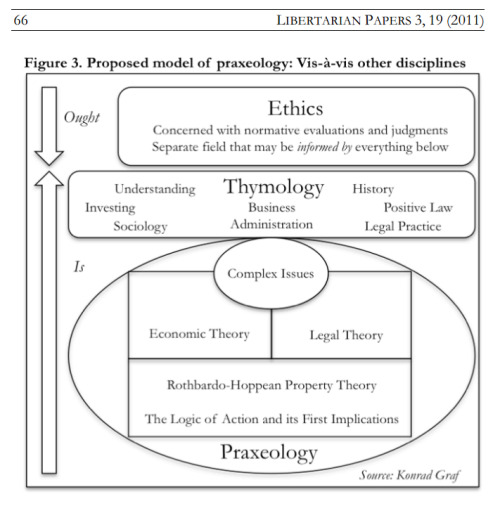
- Deductive legal theory, when properly applied in a given context, objectively and descriptively defines the parameters of what justice is in relation to questions of property rights, contracts, torts, and other legal matters. This yields a deeper-than-expected foundation for the traditional libertarian insistence on not mixing law with morality and the corollary opposition to “legislating morality.” Legal theory is a discrete field that, like Mises’s conception of economic theory, can provide descriptive, categorical input for use in “ought” considerations, even as legal theory and ethics remain distinct in foundations, scope, and method.
- Massive rush job. If anything needs expanding/elaboration/isn’t clear/you don’t think actually address it, let us know.
And this is, once again, where argumentation ethics falls on its face just like all other “Real Ethics”. Just because I use my body to argue doesn’t mean that I am extending rights on to anyone else, all it means is that I believe that I should be able to speak and argue at the time and place that I did when facing the exact conditions I did. This is not prescriptive upon the actions of anyone else or even of myself under different conditions.
See above, “no deviation from this ethic can be argumentatively justified”. sure, you claim the rights for yourself and dont extend them to anyone else, like any tyrant. Got it. Now can you justify this decision? Or do you concede that it cannot be argumentatively justified?
“See above, “no deviation from this ethic can be argumentatively justified”. sure, you claim the rights for yourself and dont extend them to anyone else, like any tyrant. Got it. Now can you justify this decision? Or do you concede that it cannot be argumentatively justified?”
What is ‘argumentatively justified’ is entirely subjective. I could argue that because I am especially good looking that I should have rights, or that because I am in need that it’s acceptable for me to violate your rights. Both of these are argumentatively justifiable exactly because ought is subjective and at any rate brining in argumentation ethics into the equation didn’t get you anywhere.
If you fire a gun to stop me from stealing your things then have you given the okay on everyone firing guns at people? No. There were specific conditions which you experienced which you believed gave you the justification for firing at me, not a general law.
thats a non sequitur, youre trying to turn a subjective value (your good looks) into an intersubjective proposition. Does not follow, objectively.
thats a non sequitur, no one has any reason to accept your proposition.
if they are justifiable then go right ahead and justify them. Making propositions is not the same as justifying them. You must appeal to premises. Whwn you make a proposition the only premises you have affirmed are those necessary for argumentation, i.e. self-ownership. We arent discussing “ought” here, just facts.
what I have done is made it impossible for me to object to another person’s use of firearms to prevent theft, because I am estopped from objecting.
and I have demonstrated a preference for my use of deadly force against a thief over my loss of property to theft. Now if I were to object to someone else’s performance of same, it would be incoherent, and therefore an invalid argument. Hence I have affirmed the use of deadly force against criminal aggressors.
“thats a non sequitur, youre trying to turn a subjective value (your good looks) into an intersubjective proposition. Does not follow, objectively.”
Nor does my asserting through argumentation that I have rights. I have rights, I consist of matter, therefore does all matter have rights? The causal factors are subjective since rights have no objective existence to point to.
“When you make a proposition the only premises you have affirmed are those necessary for argumentation, i.e. self-ownership. We arent discussing “ought” here, just facts.”
Then you have proven that I own myself. This is not an objective justification for rights.
“and I have demonstrated a preference for my use of deadly force against a thief over my loss of property to theft. Now if I were to object to someone else’s performance of same, it would be incoherent, and therefore an invalid argument. Hence I have affirmed the use of deadly force against criminal aggressors.”
That’s one way of looking at it. You have also demonstrated your preference to do what you desire. Therefore by this same logic you cannot object to others doing what they desire, no matter what it is.
rights are a social construct. This construct (rights) is a necessary prequisite for the act of argumentation, for all parties involved. Thats your objective premise.
so you agree that self-ownsership is presupposed by the act of arguing?
the act wasnt justified through argument by appealing to my desires. It was justified by appealing to property rights. In any event desires are not objectively verifiable, only preferences are. I never accepted the premise you attempted to foist upon me, and so I can very well object without estopping myself.
“rights are a social construct. This construct (rights) is a necessary prequisite for the act of argumentation, for all parties involved. Thats your objective premise.”
But that means nothing for actual prescription, there is no reason why I should respect your “right”?
“so you agree that self-ownsership is presupposed by the act of arguing?”
Define self-ownership. It can be shown that the mental being that constitutes “me” from an ontological aspect controls “my body”, but nothing more. In this case might makes right must be respected.
“the act wasnt justified through argument by appealing to my desires. It was justified by appealing to property rights. In any event desires are not objectively verifiable, only preferences are. I never accepted the premise you attempted to foist upon me, and so I can very well object without estopping myself.”
How so? You might have justified it that way with your words, but your actions are ultimately indistinguishable from just acting in your self-interest (if you adhere to praxeology).
Edit
So why is it a non-sequitur to appeal to my massive good looks but not to self-ownership as a reason to take or not to take something?
argumentation ethics is about what is justifiable, not what “ought” to be respected. If you dont respect my rights and you arent willing to be persuaded to do so by argument, then youre simply a criminal. This isnt about which magic words will prevent all crimes forever. Its about what acts can be justified and what acts cannot.
you want me to define self-ownership after you affirmed it? Ok, ownership is a social relation that constitutes an agreement between parties wherein the disposition of a thing at issue is the sole determination of the person whose property it is, hereinafter referred to as the “owner.” “self-ownership” is the rightful posession and control of the corpus by the consciousness. I dont think that “might makes right” is coherent as a normative statement. As a description it is a truism as long as you agree with me that “unused might” is irrelevant or nonexistent.
because it was justified through argument, i.e. words. If you propose to justify actions by appealing to one’s own self-interest then you cant possibly make any coherent prohibitive declarations, including asserting that I may not interfere with another’s actions.
your opinion of your own attractiveness could help you to justify spending your own money on a helmet with face shield, in order to protect your values. It prevents you from coherently denying your own attractiveness. Your affirmation of self-ownership through argument prevents you from coherently denying the self-ownership of another arguer, because of estoppel. Ownership was acquired through homestead so you cant coherently object to homestead principles. If you didnt eat, drink, or breath you could (try to) claim that only bodies can be owned. But if you sustain your life with these things, you also affirm the homestead means of acquisitions. This prevents you from coherently claiming someone else’s property over their objections. Estoppel. You could claim special priveleges for yourself but you would have to argue from first principles, of which there are none that assert special priveleges.
Would you agree with this definition of “Justify”?
- Show or prove to be right or reasonable: the person appointed has fully justified our confidence
be a good reason for: the situation was grave enough to justify further investigation
If so then what is justifiable is subjective and will vary. For instance I can justify something with my good looks and others might think that it’s an appropriate justification. YOU may not think that it is, but others might. Similarly I might not think that the fact you control your body is a justification for respecting your rights but you might. You can say that I’m “simply criminal” but this is using your judgment and your definition of criminality. The law that exists today states quite explicitly that if I’m the government and if I’m acting in accordance with certain procedures that I can violate your rights as much as I want and if you resist then YOU will be the criminal, not I.
“Ok, ownership is a social relation that constitutes an agreement between parties wherein the disposition of a thing at issue is the sole determination of the person whose property it is, hereinafter referred to as the “owner.” “self-ownership” is the rightful posession and control of the corpus by the consciousness.”
Sorry I’m not trying to be an ass but then can you define property and ownership? It would seem that the whole definition hinges upon those two words.
As for might makes right, the fact is that you will always control yourself, so the fact that you do control something means then that we are saying you should (or if you would prefer it is “justifiable” that you own something) then if I just seize everything from you then I become the rightful owner.
“because it was justified through argument, i.e. words. If you propose to justify actions by appealing to one’s own self-interest then you cant possibly make any coherent prohibitive declarations, including asserting that I may not interfere with another’s actions.”
But that argument was in turn based upon your own desires, which may then be considered the ultimate source of the argument itself.
You seem to think that something can be universally “justifiable” while still including words like “rightful” and “justifiable” which are based upon opinion
And my attractiveness is a fact, not an opinion, BTW. Ask SkepticalMetal about it some time, he just loves when I talk like this.
in this context I am using it to refer to logic, in this context its an objective statement.
given:
A) all bovines are cloven-hoofed
B) all cows are bovines
would you agree that the following is a justifiable proposition?
C) all cows have cloven hoofs
Thats the sense in which I am using “justified”. If you think logic is a matter of opinion then we dont have much to discuss here. If you agree with me that logical justification is objectively ascertainable, then we can move on to putting AE in the form of a syllogism.
I’m pretty sure that the quote you responded to includes a definition of ownership. Here:
“property” is (a) scarce good(s) that are (is) recognized as being the exclusive purview of a specific person or persons.
I’m not sure what you mean here. If you assert that “might makes right” then you should never have any need of appealing to the rightness of anything. Thats one of the implications of AE, people who actually believe that might makes right dont try to convince others of this fact, they use their might to appropriate what they want. Your decision to engage in discourse affirms some things, one of which is that on some level you want me to consent to something. Lions dont attempt to persuade gazelle to become prey. If you assert that “might makes right” then you have no need of any appeal to rightness.
I havent justified anything by appealing to my desires. one could just as easily consider solar energy to be the ultimate source of the argument, thats where the calories I used to formulate it came from.
it all depends on whether laws of thought (logic) are objective or not.
-
But there is no objective way to actually determine rights. You’re trying to apply objective language to a subjective matter. You can show that I have ownership over my own body but this means nothing in terms of a broad application of rights.
-
You are appealing to might makes right through argumentation ethics. You are stating that because I own and control myself that therefore I should control myself and I should have rights. There is no reason for this.
-
As for the ultimate reason thing, why it is that my being attractive means that I should have rights while you do not is ultimately irrelevant, I just have to have some reason. This is not displayed through argumentation that I think that all humans should have rights or even do have rights, merely that I do.
-
If you are justifying in terms of logical necessity, then argumentation is, once again, nonsense because nothing is logically implied by argumentation beyond very specific things under specific circumstances.
well if I have misspoken then I apologize. All I mean to say is that only libertarian “rights” can be justified through argument without contradiction. Humans are still free to ignore those “rights,” it isnt even necessary to discuss them. However, no other ethical system can be justified through reason.
no, it goes like this: by proposing anything, I affirm self-ownership. I cannot therefore propose anything contrary to self-ownership without inhabiting a performative contradiction. Theres no “should” involved. Just is. Arguing for communism is a performative contradiction. Its not a valid argument. This only means something to people who care about valid arguments. By engaging in argument, you implicitly affirm intersubjectively valid arguments. Therefore one cannot argue for communism coherently.
if you didnt hope to persuade me of your reasons, you would not attempt to persuade me. Your conclusion does not follow from your premises (rights arent part of being good looking, however affirmation of self-ownership is part of the act of argumentation).
I suggest you reconsider. Some things are necessarily implicit in the act of discourse. The (belief in) existence of intersubjective meaning is a necessary prerequisite for argument. The existence of invalid arguments is also implied, because if every argument were valid we could simply make propositions that we liked without attempting to justify them. Argumentation even implies that we have something in common (language) otherwise we would be unintelligible to each other.