I agree with what Chomsky has to say about, “Support our troops”:
“[…] the point of public relations slogans like “Support Our Troops” is that they don’t mean anything […] that’s the whole point of good propaganda. You want to create a slogan that nobody is going to be against and I suppose everybody will be for, because nobody knows what it means, because it doesn’t mean anything. But its crucial value is that it diverts your attention from a question that does mean something, do you support our policy? And that’s the one you’re not allowed to talk about.”
I think here you have distinguished between what one might call “physical courage” and what one might call “moral courage.”
Physical courage is something more immediate and tangible than moral courage. It’s acting in the face of fear. Now I don’t have incident reports sitting right here in front of me so I don’t really know what the causes for death were for every single man or woman killed in action. I don’t know if every single one of them died while acting in spite of their fears. But I can imagine myself in a situation like Afghanistan or Iraq and I can only imagine that I would be afraid for my life most of the time. It would take great courage for me to just to live there. So I’m willing to bet those men and women killed in action were facing their fears on a daily basis. I admire them for that.
As for moral courage it’s impossible for me to know whether or not every single man and woman lost in battle believed that their cause was just and right. I don’t really think it’s my place though to pass judgment on the morality of a war or the soldiers who served in it. I feel like the armed forces fight to protect me and my wonderfully luxurious lifestyle and the country I love so really I feel like it’s not my place to question their actions from a moral standpoint. So basically it’s good enough for me.
Perhaps one man’s hero is another man’s villain. Maybe it’s all about perspective. Valuing actions requires context and careful evaluation of the facts.
Courage is just one synonym for heroism anyways. In my mind it’s a much broader concept than mere courage that involves many different qualities that I admire.
It’s hard to explain exactly what it is about Chris Hayes that just rubs me the wrong way or exactly why I found his comments so disgusting but he does rub me the wrong way and I do find him disgusting. Perhaps it’s just in my nature to find weak looking men like him repulsive. Perhaps it’s his astounding presumption because the guy has never served but thinks it’s his place to comment on the service of others. Maybe it’s because in reading his “apology” I don’t get the feeling that he’s sorry or that he understands why people found his comments so offensive. Whatever it is I can’t stand the guy and I can’t find it in me to entertain his viewpoint even for a second.
…So basically, it’s exactly like I said. As long as someone physically does something that you are scared to do, that basically makes them a “hero” in your eyes. Or at least goes a long way to putting them there.
I find it interesting you would make it a point to say how you can’t know whether the dead soldier believed that their cause was just and right. In my view, I don’t think it really makes a difference. Again, someone could very easily walk up to an infant and slam it on the ground, and very well think it was the just, right, and moral thing to do. In my view, that doesn’t make it so. But then again, I’m not a moral relativist, as you apparently are. Someone could easily walk up and blow your head off in a crowded area. And it seems that you’re saying that as long as they were personally facing fear when they did it, and held a personal belief that it was moral, then the person is a hero.
I guess it’s just a good thing that most people don’t think and believe like you do.
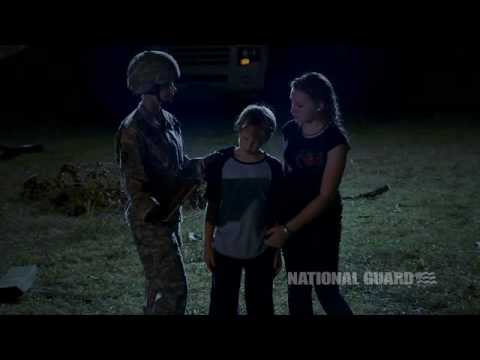
I found this 2009 NG ad the creepiest I’ve seen yet:
I was relieved to hear people laughing at the commercial after it ran. Of course, the soundtrack is a cheap knockoff of Orff’s O Fortuna, one of the most recognizable tunes ever written, thanks to Hollywood:
It was written in Germany slightly before Hitler’s rise to power which makes it extra-creepy and this is probably part of the NG’s decision to make a knockoff rather than use the original - but it’s obvious they wanted to use the original.
I clicked to watch the first video on the youtube site before reading the rest of your post. I actually noticed that right away, and then came back to see you mentioned it.
Also, maybe I’m sexist, but I kind of get an urge to laugh everytime I see a female in combat gear.
@JJ: Well, they’re coming for our daughters next. I saw on CNN the other day that some feminist pressure group is trying to get the Pentagon to change its policy on women in combat, saying it unfarily deprives them of experience and promotions. They actually have a point, as did gays living under DADT. Note that it’s the government which is dead last among employers to acknowledge basic human rights.
In any case, this would be of no note except that Congress has been batting around the idea of registering women for selective service. Now, once your society has reached the point where you are drafting women into combat roles, you are less than a generation from complete collapse. The reason has nothing to do with morality or good and evil and everything to do with the fact that your women are the only vehicle for sustaining your population. Males are fairly expendable as far as Nature is concerned, one man can do the honors for many women as well as he can for one woman, but the reverse is not the case. But culling the females through a draft and combat duty is literally social suicide.
I literally cringe every time I walk past a television showing cable news nowadays. It’s non-stop bad news for individual liberty and prosperity, 24x7.
How did DADT deprive military personnel of experience and promotions?
Human rights? I’m not sure what you’re talking about. How is it a “basic human right” to be employed in whatever position you want to be employed in? Lee Doren is like 5’6" and wants to be a linebacker for the Buffalo Bills. Is it is basic human right to have that job/experience/promotion?
Well I think physical courage is one part of the recipe. I think it’s important to note that I feel particularly fond of the American military because they’re part of my national defense. I might not be so fond of an invading army though undoubtedly back home they’d be heroes to some of their people.
I could not determine, just by examining that action alone, whether or not it was the right or wrong thing to do. I can imagine that it would probably be widely viewed as wrong but maybe that’s just because most people’s moral circle seems to encompass most infants. Those same people might not care as much about some random Arab though.
I’d say they acted with some form of physical courage, I don’t know if they’d be considered a hero. They might be a hero to themselves or to whomever wanted me dead but a villain to me. Perspective is key.
I’m not sure that my natural moral intuitions are fundamentally any different from anyone else’s. In fact, if I am to believe Pinker, they’re probably quite common.
@JJ: I worded that poorly - the feminists have a point; gay rights activists also had a point about DADT being discriminatory (different point, but they had one).
By referencing “human rights”, I’m criticizing them on their own grounds. It’s the statists who have been pushing the multi-cultural, egalitarian agenda onto the private sector for decades. But they themselves (the military is a branch of the government) are dead last to implement the very policies they’ve been shoving down everyone else’s throats. It’s like the story (not sure if it’s true) that Capitol Hill was exempted from compliance to ADA regulations because Congress determined it would be “too costly”. Go figure.
You need to read Why Beautiful People Have More Daughters. In the Introduction they talk about the Naturalistic and “Moralistic” fallacy - the naturalistic fallacy is the assumption that because something is natural that, tehrefore, it is moral and the moralistic fallacy is the reverse - believing that just because something is moral that therefore it is natural (or immoral and unnatural).
EP is a value-free science. It tells us nothing about the worthiness of our natural moral inclinations, it only tells us why some of them are what they are. Because we can think and we can alter our own moral perceptions through psychological self-training, it is not the case that we are at the mercy of our innate intuitions. This is where I think ethics gets really complicated and fuzzy because there is a “back-and-forth” between social norms as they exist “out there” and our own internalization and subjective criticism of those social norms.
I think there is a strong analogy between the nature of morality and language. A word (e.g. “bike”) is what it is and means what it means in an objective sense. Nevertheless, your participation in that meaning depends on your own internalization of the usage. Your style dictates how elevated your use of the language is.
Social norms are very similar in this regard. A social norm simply exists in some objective sense (e.g. “don’t steal”) - it is what it is. Your participation in that morality depends on your own internalization of it, that is, you must construct your own internal “image” of the social norms in order to be able to sense your own conformance or non-conformance to them. Others will make their own assessments independent of yours but your internal assessment constitutes your “moral sense”. Finally, your character or way of living will determine how refined your behavior is. None of this has anything to do with “thou shalt nots” or even outcomes/consequences except insomuch as the outcome is the action (foreseeable consequences) and, therefore, inseparable from it.
I really doubt you’d find many people who could witness someone walking up to an infant (even an Arab infant) and slamming it on the ground…and not have a problem with it.
I’ve actually ordered it already. Should be here soon. I also want to read Expanding the Circle by Peter Singer, I’m interested to learn more about “moral circles.”
Right and I wasn’t saying that my moral intuitions are necessarily correct I was just saying that they might not actually be uncommon. As Pinker points out in Blank Slate, in-group out-group thinking is something we come by naturally.
EDITED: I didn’t mean to imply an Arab infant. I meant like a grown man. But you’re probably right. I really have no data on this so I don’t know for sure but I’ll buy it. Either way that natural moral instinct that tells people “hurting infants is wrong” comes from somewhere in the brain. But so does the moral instinct that says “killing enemy combatants” or “fighting for one’s country” is right. So a person could hold the values “hurting infants is wrong” and also “killing enemy combatants is right” at the same time. Some people’s moral circles may encompass both infants and enemy combatants but mine is far narrower.
And you’re right about the ADA thing. I can’t believe I can’t find the program where (I believe) Stossel mentions it, but it’s just like you said. Here it says: “Congress remains exempt, although it must abide by certain internal requirements”…so in other words, they don’t have to abide by the rules they set for everyone else…just the rules they set for themselves.
In fact, hilarious/sad as it may be, there is actually a government webpage listing the laws that actually do apply to Congress. No, you didn’t read that wrong. The number of laws that don’t apply to Congress is so large, they just made a page listing the ones that do apply.
I still think that it is heroic to kill communists hahaha
those vietnam vets are heroes to me. And unless I get drafted and sent to north korea I dont think I will get into a shooting war with communists so I will just anger all of my fellow war on terror vets by recognizing the saltiness of the vietnam vets. I am like a troll general. Troll assassin. The ayatollah of trollatollyah
I find the Messianic narrative underpinning war death to be cynical in the extreme - they died “that we might be free.” Sounds an awful lot like Jesus, doesn’t it?:
I know that all of you are concerned with actual people stuff, and dont care about the details of military equipment. But I invited a few of my buddies here, and on the off chance that someone reads this thread and wants to get technical, in a technical sense it wasnt a “sniper” rifle. It was a sam-r, which is basically a sniper rifle with fetal alcohol syndrome. I was just trying to be brief and descriptive, I dont want anyone to think I was a sniper. And, again, I know you guys dont care, but some vets do care about minor things like this. Sorry for the necropost.
Heroes are likelier to be found among the people fighting the American troops. Unlike the Americans, OPFOR people are facing an enemy that has all the advantages in equipment, training, airsupport, supplies, medical facilities… They are doing something that you could not ask of anyone to be doing as it is so hazardous, jet they do it anyway. Another thing is fighting off the occupation is honorable (and a libertarian act) while lending your services to an occupation as American troops do is dishonorable.
Obviously getting killed requires no special heroism, it requires performing no action that is as per the pathetic military lingo “beyond the call of duty”. Also even such actions beyond what the military feels it can ask for as are performed are performed in the context of and for the benefit of maintaining an occupation. So we can not call American occupying troops who do something that would be heroic if done by an OPFOR fighter “heroes”. They are “heroes for the occupation”, but that is not a positive adjective. You wouldn’t call an SS trooper who exposed himself to great danger in order to get a chance to kill 50 Jews more than he would have otherwise a “hero”, would you now? In what way is an American soldier who exposes himself to added danger in order to kill more people fighting the occupation of their nation different?
Heroes such as exist among occupying troops are those who go against the occupation. During the Bengal Famine of 1943 many British troops defied orders by the military not to pass their food onto starving Indians — in as much as they faced severe and likely consequences for doing so (though most did not) they may be thought of as “heroes”, ie “heroes for their fellow man”.
That’s idiotic. So as long as you fear doing something, but do it anyway you are a hero, regardless of what danger doing this action actually puts you in. So if I really fear pouring myself some juice, but do it anyways I am big a hero.
So actually a huge coward who fears doing anything at all, even completely safe and routine stuff, is the biggest hero as long as he remains functional despite.
It’s clear to me you need to get off your Oprah touchy-feely shit. It’s making you dumb.