But huge tracts of math dont need numbers at all. Look at the list in an earlier post. And the ones that do need constants are usually studied using variables for constants, like v=ax+by +cz, where a, b and c are assumed to be constants.
Which is a bit of a subtle point. How can a letter of the alphabet be a constant? After all you are studying many equations at once, letting a, b, and c vary over the whole range of numbers. So they are not constants like pi or euler’s number is a constant.
I’m under the influence of a few beers, and it’s been a while since I gave these things any thought. Not sure how relevant it is anyway.
At any rate, the time has come to let the cat out of the bag:
I think Esuric was echoing Rothbard or someone like that whose writings I have seen in passing. Here is a link that turned up when I searched.
Their point is that TO APPLY a mathematical theory to a real world situation, one needs constants to work with. [In other words,one has to be able to replace the a, b and c with 3, 7 and 4 for example]. I suspect that’s what Esuric meant as well.
But math itself can get along fine in many areas without constants.
Going into it a bit more, math does not “need” the rock solid constants such as pi to get going. It starts out with nothing almost, the very abstarct axioms of set theory which dont mention numbers at all, and takes it from there. Pi and Euler’s number and such like make their appearance on the stage of Math as EXISTENCE THEOREMS.
They are RESULTS of studying math from scratch. They are not needed for math. Had math discovered, for example, that the ratio of the diameter to the circumference of a circle depends on the size of the circle and is not the constant number pi, math would not have come to an end. It would contnue on, happily studying the conclusions of that revelation.
I definitely agree, to actually apply mathematics in your field of study one needs to have established what the constants in your equations are, and in the same sense established there are constant relations. This is the same in physics and other areas where mathematics is applied, one may use shorthand notation for constants but ultimately they are defined as some number according to a certain scale or metric.
Indeed, going a little more abstract again, even with an equation like v=ax+by+cz , even if we consider the constants unknown and variable, the equation has still had to be specified by constants to the extent that the powers of the variables have been set to 1, and hence the expression is linear as opposed to nonlinear. Hence, to get some kind of determination you still can’t have absolutely no constants…
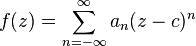
Indeed, good point again, what you’ve written is basically the definition of a power series which can be extended to describe functions f(z) with complex domains and negative powers.
This is just the general definition of a power/laurent series however, and could be used to describe any analytic function. Of course any theorems that apply generally in complex analysis would apply to these too, though again just having this definition doesn’t aid any application. That’s got me thinking, do economists make any use of complex analysis?
(note:- I can’t seem to attach Latex images from texify on this forum, so I had to copy that image from wikipedia too)
Linearity in variables or linearity in parameters is introduced in like, chapter 2 of my econometrics book.
And I think regression analysis pretty much assumes the kind of constancy you are talking about for the models to be valid. As an example, in time series, it is assumed that variances don’t change over time, which they probably do. If variances change over time, then you have heteroscedasticity, There are also ways to try to correct for this.
Don’t think that these issues are just being ignored, there is a whole discipline out there that tries to deal with them. How successful or not I do not know, since I’m still a noob at econometrics.
Ah, yes, I meant 1[:$]. Thinking about it again, beyond simply being able to establish the constants, one needs to show that the same uniform relationship between the variables holds in multiple repeated experiments in which other variables are controlled for. I confess I’m probably even more ignorant of econometrics not being an economics undergraduate, but I think it’s strange to assume a constancy in the nature of the relation between economic variables, since for example:
Looking at certain price charts I may find a linear dependence on demand for a set of goods, but in another set I may find a completely different dependence. Even though other variables could be accounted for in the different cases(I guess this is the entire aim of econometrics), it puzzles me as to how this could be achieved with unambiguous success. Regardless of that point, many of the factors affecting the formation of economic data are entirely qualitative and difficult or impossible to express in numbers(like ideology), that it seems strange how econmetrics could be seen as the “magic bullet”, to allow economics to assume the form of a natural science.
Well, any individual explanatory variable can be given its own functional form, linear, logarithimic, quadratic, whatever.
Also, qualitative information can be expressed using dummy variables. For example, gender can assume a 1 or 0. Whether they have a degree can assume a 1 or 0, whether they graduated with a first, second, third class. All of these things could technically be accounted for, assuming sufficient and accurate data. Of course, there are lots of problems too.