Hey guys, I was reading up on general business cycle theory and the Great Depression (notably the 1937 downturn). While Keynesian say that the downturn was caused by decreases in deficit spending, Austrians say that the main cause was the increase in real wages with the pro union legislation in 1936. I don’t quite understand the whole Austrians Unemployment theory and the increases in real wages stuff. Aren’t increases in real wages a good thing? What makes them bad in these cases? Do Austrians say that high unemployment is always caused by wage disequilibrium?
It would be a great help if someone could explain this to me. Thanks.
Austrians argue that unemployment is caused by wages being kept above equilibrium levels. Just like in any market, really. So if the government instituted a minimum wage, then unemployment would be higher than it otherwise would have been.
Rothbard in AGD says that the economists back then were idiots. They thought that the US was a prosperous country becuase its workers were paid high wages, and not that high wages were a result of high productivity and capital accumulation. Therefore the only thing the government could do to retain prosperity was to stop wages from falling.
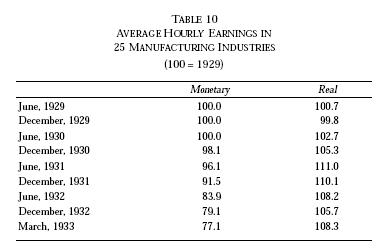
I’m not quite sure on the specifics of the 1937-38 recession but here is a chart showing real wages between 1929-33:
Murray N. Rothbard, in America’s Great Depression, offers an answer to your question. However, I do agree that the basic response “increase in real wages” is misleading. Murray N. Rothbard writes, “The maintenance of wage rates in the face of steadily declining prices (wholesale prices fell by 10 per cent in 1930, by 15 per cent in 1931), meant that the real wage rates of the employed were sharply increasing, thereby greatly aggravating the unemployment problem as time went on.” Rothbard isn’t necessarily blaming an increase in the purchasing power of the worker, more than he is suggesting that the maintanance of wage rates, with a decrease in the aggregate price level, is what ultimately aggravated unemployment. Maintanance of wages was a result of the underconsumption theory, which assumed that if wage rates were maintained than the workers would consume more. Rothbard, in the book, points out that the biggest hits were in the industrial-goods sector, not in the consumer-good sector. This means that even if it stimulated the purchase of consumer-goods, it wouldn’t necessarily deal with the depression, because it ignored the fact that the largest losses for the economy was not in that area. In effect, maintanance of wage rates acted as a sorts of price floor for labor, where businesses simply fired workers they couldn’t afford, as opposed to reducing wage rates and employing more people.
In other words, it’s a more flexible version of the minimum wage (flexible only in the sense that even with business’ agreement with wage rate maintanance, by late 1931 wage rates were falling in the face of increasing losses).
So how is this different then if an economy produces more and increases the supply of goods, leading to a decrease in the price level, which leads to an increase in the real wage rate (implying that wages have been kept the same)? I guess thats my big question.
So if keeping wages up in a recession is bad, then how has unemployment been ended in recessions after WWII since businesses don’t cut wages as much (I may be wrong on that).
The difference is that the wage rate is sustainable, because production has increased. Furthermore, if production increases then it’s perfectly acceptable to believe that the aggregate wage rate will also increase (there is competition for labor). During the Great Depression, production decreased as a result of a collective malinvestment. A decrease in productivity should be met with a decrease in the average wage rate, otherwise it’s not profitable for industry to continue (the industry takes losses and is forced to close; or, the industry will hire a smaller labor force—either method will result in unemployment).
A good explanation on the return to prosperity after the Second World War is offered by Robert Higg’s Depression, War and Cold War; I have not read the book, but the chapters relevant to the question are just reprinted articles he wrote for The Independent Review (specifically, “Why the Great Depression Lasted So Long and Why Prosperity Resumed after the War”). Some key passages:
“I shall argue that the economy remained in the depression as late as 1940 because private investment had never recovered sufficiently after its collapse during the Great Contraction… I shall argue further that the insufficiency of private investment from 1935 through 1940 reflected a pervasive uncertainty among investors about the security of their property rights in their capital and its prospective return.” (p. 563)
In regards to the post-war recovery:
“In 1945 the death of Roosevelt and the succession of Harry S. Truman and his administration completed the shift from a political regime investors perceived as full of uncertainty to one in which they felt much more confident about the security of their private property rights.”
And so, ultimately his hypothesis suggests that investment led to greater production, which led to more employment. In the book New Deal or Raw Deal?, author Burton Folsom Jr., who uses Higgs as a source, gives a concice overview (bolding mine):
“During World War II, Roosevelt softened his rhetoric against businessmen, whome he needed to wage the war… During the war, in fact, Roosevelt had switched from attacking rich people to letting big corporations monopolize war contracts. Under Truman, businessmen were even more optimistic. They expanded production, and the U.S. economy was thus able to absorb the returning soldiers and those who had previously worked to make war equipment.” (p. 247)
It’s important to realize, however, that expanded wartime production during the Second World War did not increase employment. Robert Higgs clarifies this in the priorly cited book; the chapter in the book is a re-print of the article “Wartime Prosperity? A Reassessment of the U.S. Economy in the 1940s”, published in The Journal of Economic History. It shows that the civilian labor force did not increase dramatically (by ~2 million), while decreased unemployment was largely attributed to conscription. Economics in One Lesson, by Henry Hazlitt, shows why government spending cannot create a net increase in jobs, only a net loss:
"This is what is immediately seen. But if we have trained ourselves to look beyond immediate to secondary consequences, and beyond those who are directly benefited by a government project to others who are indirectly affected, a different picture presents itself. It is true that a particular group of birdgeworkers may receive more employment than otherwise. But the bridge has to be paid for our of taxes. For every dollar that is spent on the bridge a dollar will be taken away from taxpayers. If the bridge costs $1,000,000 the taxpayers will lose $1,000,000. They will have that much taken away from them which they would otherwise have spent on things they needed most.
Therefore for every public job created by the bridge project a private job has been destroyed somewhere else. We can see the men employed on the bridge. We can watch them work. The employment argument of the government spenders becomes vivid, and probably for most people convicing. But there are other things that we do not see, because, alas, they have never been permitted to come into existence. They are the jobs destroyed by the $1,000,000 taken from the taxpayers… there has been a diversion of jobs…"
The concept is the same for the military-industrial complex.
I actually stumbled across this Lee Ohonian paper today. The abstract and conclusion summarises it perfectly:
This paper proposes such a theory, based on President Hoover’s program that offered industrial firms protection from unions in return for paying high wages. Firms deeply feared unions at this time, reflecting a growing union wage premium and a sea change in economic policy, including policies advanced and supported by Hoover, that significantly fostered unionization and enhanced their bargaining power. Consequently, there was an incentive for firms to follow Hoover’s program of paying moderately higher real wages to avoid even higher wages and lower profits that would come from unionization.
I conclude that the Depression is the consequence of government programs and policies, including those of Hoover, that increased labor’s ability to raise wages above their competitive levels.
If anyone knows of any papers, Austrian or otherwise, dealing with the '37-'38 contraction give me a shout!
One last question-in the face of stagflation, with rising prices (which would reduce real wages), what would the cause for unemployment be? Decreasing Demand from business and decreases in productivity?
And if real wages are supposed to increase in a recession (decrease in prices brings about an increase in real wages, is this supposed to be offset by the decreases in wages from business? If the wage suspensions stopped in late 1931 under Hoover, what was the cause of the increasing unemployment? Steadily decreasing prices? If someone could explain these things to me that would be great. Thanks.
A number of things could cause unemployment during stagflation, including:
Capital consumption (which happens in pretty much every highly inflationary environment), which lowers the productivity of workers, and hence the wage at which the market for labor will clear
Wage increases demanded by unions and enforced through violent strikes
Adjustment to the malinvestments that have already taken place - by the time stagflation is underway, it is pretty clear that there is a cluster of investment errors (which were caused by the expansion of the money supply in the preceding boom, as Austrian Business Cycle Theory teaches), and as these businesses go out of business, their employees are thrown out of work
Other government interventions in the markets - for example price controls, which cause shortages, and some marginal businesses to go under, along with their employees
There’s more, but you get the idea.
Real wages don’t necessarily increase during a recession, for a couple of reasons.
By definition, there have been malinvestments during the boom phase of the business cycle, and there is also over-consumption spurred by the wealth effect (consumers think they’re richer because their stocks and houses have gone up in value, so they spend more money). Both destroy capital. Real wages depend on capital investment and accumulation to increase the productivity of labor, that’s how they go up.
But there is more happening than just that, so whether real wages increase during a recession depends on many things.
“If the wage suspensions stopped in late 1931 under Hoover, what was the cause of the increasing unemployment?”
I don’t understand your question. But wages were propped up by Hoover and then Roosevelt for many years, and that is a major cause of unemployment during the 30s.
Thanks for the reply. What I meant is that businesses in late 1931 finally started to lower wages, yet the unemployment still increased. Is this because real wages still increased due to the extreme decline of prices?
This isn’t a uniquely Austrian argument. Neoclassicals (most of whom are Keynesians, monetarists, and new classicals in the macro world) argue this as well. If I am able to pay my workers $100 an hour and I hire 10 workers, I pay them, on average, $10 each. Now, if governments or unions mandate that I raise the wage to $20 and hour, I can no longer hire 10 workers. I only have $100 an hour to pay workers but I have to pay 10 workers $20/hour. The obvious solution for me is to cut down on the amount of workers I have, leaving only the best and most skilled who are able to earn me more in profits than what I pay them. This means that the low-skilled and unksilled workers who need on the job experience get canned for the benefit of politicians, union bosses, and skilled workers.
In a free market, however, real wage increases are a good thing. Real wage increases occur when people save more, providing more money which entreprenuers can borrow and thus buy machinery and factories, thereby lowering prices, increasing demand, thus increasing profits. This increase in profits allows the entrepreneurs to slowly bid up wages since they have more money with which to pay workers.
There other issues other than business’ slow lowering of wages. In 1932, Hoover increased taxes and continued to spend on public works (which took money from the private sector), and began to increase welfare programs. Furthermore, the amount at which wages were lowered was not what it would have been had businesses been allowed to flexibly respond to losses; wage decreases were slow. Then, FDR instituted the minimum wage as a price floor for labor, and intervened in other ways, which continued to make it hard for businesses to recover and increase employment.