What say you of Food Inc.

Just finished watching Food Inc.

I must say, unlike the dribble that is Michael Moore, this one is really well researched and backed. What I admired about it is that they stated a very blunt “just the facts mam” approach, in how they demonstrated how in many ways, the companies are giving phony food to the American Market. However, the film doesnt hide the fact that these companies are backed by the government in many ways.

Mind you the film does not present it in neither a pro-market fashion, nor pro-intervention fashion. Just raw facts, (actually, their solution to the problem can be harmonized in free market fashion, start teaching the consumer to value healthy food, which will give corporations, small and large a clue on actually producing low priced healthy food).

What say you people? :slight_smile:

I must say that it is a rare achievement of documentary filmmakers if this is so.

Normally, there is clearly an agenda, as was the case with the rather strange move Shock Doctrine.

I haven’t yet watched it in full, though I will be soon as I plan on writing a term paper using this documentary as a source. Good to know it is recommended though.

I really enjoyed this documentary myself, and also found that the solutions to the problems presented could be solved by the free market. However i have talked to people since i saw it, and they have somehow got the impression that the film presents the need for more government regulation of the american food industry.

It was however a while ago since i had seen the picture and could only remember a few bits, i fought back with the little i could, suggesting that the farmer outside in the open was COMPLAINING about government intervention. I didn’t go into Monsanto or anything else, but these stupid people are getting on my nerves, the guy just didn’t get it. They’re soloution to everything is more governement, In fact my best friend is deep advocate of food industry regulation, i think im going to crack up in a minute just thinking about it, so ill leave it here.

Actualy does anyone have any suggestions when it comes to debating people regarding the regulation of Food and Agriculture ?

Yes, we always need more regulators, like this guy! [:P]

Lol

I thought there was plenty of good information about government subsidized agro-conglomerates making people unhealthy, and treating plants and animals in truly ghastly ways, IMO. Of course, there was a few eye-rolling moments when the author keeps imploring for more regulation, but if you ignore that stuff, it’s a fairly enlightening film overall. And it confirms my belief that Monsanto is possibly the sickest business in history, like, “worse than the trans-Atlantic slave trade” bad.

If you liked this film, I would also suggest “The Corporation” for some good info about how the state endorses its pet industries while they commit tremendous atrocities.

Great documentary…I am afraid of eating ever since I watched it.

I think this problem is one related to corporatism.

I haven’t seen the documentary yet, but I find the following is a good strategy for of arguing against government regulations in general…

Start by saying you are firmly in favour of regulations… Most people don’t have the time or expertise to do research on whether any particular drug is safe to use, so they need an expert whose opinion they can trust. The question is: should the regulation be carried out by free market firms or by a government monopoly?

Then make the usual free market vs monopoly argument… Who is more likely to make good decisions? A bureaucracy, if it makes a bad decision or is covertly acting in the interests of the drug companies, endures. But a firm providing regulation will go bankrupt if it makes bad decisions or is corrupt, leaving only those firms that make the best decisions.

Regulation is about making decisions based on risk. A drug regulator may overestimate people’s propensity for risk, and endorse drugs that most people would consider too risky. Or it may underestimate people’s propensity for risk, and reject drugs that people would be willing to risk using.

Different individuals have different propensities for risk. A government regulator must make a ‘one-size-fits-all’ decision about whether to endorse any given drug. But the government has no real way of measuring or calculating how much risk people are willing to take, because of a lack of vital profit-and-loss signals.

Furthermore, when the government chooses not to endorse a drug, it uses violence to prevent that drug being sold, so individuals with a higher propensity for risk than the government regulator, or individuals who suspect incompetence or corruption of the government regulator, are deprived of a drug they would be perfectly willing to take.

With a free market, different regulatory firms will compete for business. Consumers demand regulation of drugs. They are willing to pay more for a drug that has been approved by their preferred regulator, so drug companies will be keen to demonstrate to the regulators that their products have been thoroughly tested and are safe to use. Free market regulators provide information on how risky a certain drug is, but it leaves it up to the consumer whether the risk is worth taking or not.

What I need are some examples of:

  • Free market regulators (The best I can come up with are websites like moneysavingexpert.com, and certificates like Microsoft Office Specialist. Does anyone know of an organization which endorses certain types of firms/professionals (like the General Medical Council) but you don’t have to be endorsed by in order to work?)
  • Drugs which provide great benefits but which the FDA does not allow (Hemp/Cannabis. Any more?)
  • Drugs which are very risky but are endorsed by the FDA (Water fluoridation. Aspartame. AZT. Any more?)

I’m sick of primitivist crackpots calling everything poisonous. There is no evidence that GMO is bad for you in any way.

Eat what you want, but I prefer to reason the other way around - if a food is made in a lab, I’d prefer to see evidence that it isn’t bad for you before I eat it. It isn’t necessary, and I have yet to find any processed food product that actually tastes good enough that I’d be “denying myself something pleasurable” by not eating it. I know, I know, there are studies, funded by the government-subsidized firms, that find it’s safe. Yet there are plenty of foods available that have been eaten for thousands of years. I’ll stick with those, maybe in a few decades I’ll have more confidence in the newer stuff.

And I’m sick of government subsidized agro-conglomerates building terminator genes into their seeds, preventing seeds from germinating unless bought new from the company every year (tainting non-terminator strains via pollination, by the way). I’m also sick of said company suing said farmer for copyright infringement when their patented genes are found in one of his fields because the genes in question blew onto his farm via pollen.

Post quoted to emphasize excellence.

In fact, there’s evidence that it isn’t dangerous. It’s been around for 10,000 years and it’s called selective breeding.

I have less trouble with GMO’s and much more trouble with chemicals.

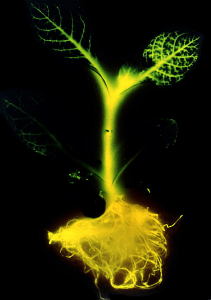
Oh yeah? How long do you think it would take to breed this?

Better question: what do I preheat the oven to? :wink:

You don’t eat it, you smoke it. Like tobacco needed to have a worse image. Well, at least I can find my smokes in the dark!

¡Sweet Jelly Belly Zeus!

Just one day goes by, and already 15 responses, guess more people are awares of the movie than I thought, I am pleased. :slight_smile:

Gonna be postin my replies. :slight_smile:

Thanks Trulib, nice answer. I think next time i make an argument about regulation, i will agree that regulation itself is a good thing but question the regulator.

Well, I was certainly suprised by that when I watched it.

Ash Lawson

I really enjoyed this documentary myself, and also found that the solutions to the problems presented could be solved by the free market. However i have talked to people since i saw it, and they have somehow got the impression that the film presents the need for more government regulation of the american food industry.

Oh definately! I mean, look at the farmer that is prospering and thriving growing foods the old fashioned way! There’s your free market solution right there! Mmhhh, I don’t know, I didn’t really get that impression either. At best, you may be refferring to those ladies that are lobbying in Congress (They will outright fail by my reckoning, they are wasting their time there).

Actualy does anyone have any suggestions when it comes to debating people regarding the regulation of Food and Agriculture ?

Demonstrate, for starters, how patents are screwing over the innovation of creating new soyseeds that may help the general populace in the long run.

Jackson Larose

I thought there was plenty of good information about government subsidized agro-conglomerates making people unhealthy, and treating plants and animals in truly ghastly ways, IMO. Of course, there was a few eye-rolling moments when the author keeps imploring for more regulation, but if you ignore that stuff, it’s a fairly enlightening film overall. And it confirms my belief that Monsanto is possibly the sickest business in history, like, “worse than the trans-Atlantic slave trade” bad.

True true on the eye rolling moments, thankfully, they are few and not too loud either. And it is enlightening, because regardless of it’s ideological posture, it holds true in presenting the facts correctly.

Truelib

I haven’t seen the documentary yet, but I find the following is a good strategy for of arguing against government regulations in general…

Indeed, but always remember that the film is knot acknowledging an explicit free market solution and we must not twist it’s arm to it, but we can use the facts it presents over to a free market solution.

JAlanKatz

Eat what you want, but I prefer to reason the other way around - if a food is made in a lab, I’d prefer to see evidence that it isn’t bad for you before I eat it. It isn’t necessary, and I have yet to find any processed food product that actually tastes good enough that I’d be “denying myself something pleasurable” by not eating it. I know, I know, there are studies, funded by the government-subsidized firms, that find it’s safe. Yet there are plenty of foods available that have been eaten for thousands of years. I’ll stick with those, maybe in a few decades I’ll have more confidence in the newer stuff.

Well, you could always move to a Third World Nation (like mine! Guatemala will welcome yah! :wink: ). This problem is non-existant in the less developed nations, it be particularity of the U.S., who knows how it is with Europe, Australia, and Canada, and Japan. Good food and in season is always found where I am from, yum yum! ^^

.