De Jasay is one of my favorites. Got a link/reference handy?
AJ: “Ultimately the Argumentation Ethics proponent will admit that it only purports to show that “there can be no other objective ethics than the NAP,” which of course devolves into a non-statement if there are no objective ethics.”
Wrong. A norm of “no ethics” is still a norm.
"Even without any actual claimed justification, we can describe the teleological “ought” action choice with regard to the NAP as a choice between following a justifiable norm and an alternative set of unjustifiable norms. That there is only one choice at this level among justifiable norms provides a reasonably solid prima facie case for following that one, and there are additional justifications and reasons to respect the NAP in action as noted above.
What about following no property norm at all?
To begin with, this is a self-contradictory “norm of following no norm.” It is a proposed norm, and thus fails as impossible merely by being stated. Hoppe also makes clear that every alternative to the NAP implies some property norm. The difference among possible property norms is the specific criteria for who shall be deemed to justifiably control what. All variants of statism claim that “the people” own certain resources described as “public” via the state, but since this is impossible, it masks the fact that specific people actually control these various resources, only in a less just, less efficient and more arbitrary way than under the NAP, a way dominated by “political” skills rather than skills in employing scarce resources so as to better satisfy demand Hoppe 2010, Chapter 3).
In sum, this interpretation of the Hoppean APoA alters what “ought” ethics faces in the realm of property theory. Instead of facing a thorny question of which property norms are justified, ethics itself is faced only with he question of whether a person should follow the only justifiable norms with regard to property. The APoA establishes that there is no justifiable alternative to the NAP and therefore little choice to be made with regard to it except, as Ayn Rand would say, the choice to either acknowledge it or to mentally evade it." ~ (Action-Based Jurisprudence: Praxeological Legal Theory in Relation to Economic Theory, Ethics, and Legal Practice http://libertarianpapers.org/articles/2011/lp-3-1… pg 26.
Furthermore, the charachterization of the ‘a priori of argumentation’ as being based on ethics is completely ignorant / misguided.
"Praxeology has delimited a sphere of possibility for the category of justification with regard to property norms. With no recourse to “oughts,” praxeology arrives at a somewhat surprising conclusion: there is only one set of norms at the level of property theory that are compatible with the requirements of justification itself-and these are the NAP-based norms.
Praxeology has thus done most of the work when it comes to property theory, leaving ethics itself, understood as an “ought” discipline, with a simple yea-or-nay task-to respect the NAP or not to in action. Only one additional step is required to conclude that the sole property norm that CAN be justified, also IS justified based on additional criteria. Among them, Hoppe argues that the NAP is universalizable, prevents conflicts, can in theory be applied without contradiction from the beginning of mankind onward, and promotes wealth, peace, social harmony, well-being, and character development.
It is important in this context to separate justification as such from any particular act of either following or not following a justified norm. Action implies ends aimed at and requires a choice of ends. Ethics is concerned with choosing ends-some rather than others. Yet justifiability, and possibly also justification itself, can exist independently from any particular action or choice. As Hoppe writes, “There is and remains a difference between establishing a truth claim and instilling a desire to act upon the truth-with ‘ought’ or without it” (2006, 408)." ~ (Action-Based Jurisprudence: Praxeological Legal Theory in Relation to Economic Theory, Ethics, and Legal Practice http://libertarianpapers.org/articles/2011/lp-3-1… pg 24.
"It’s an argument intended for people who already believe in objective ethics. Since “objective ethics” is an incoherent notion (because “objective value” is), Argumentation Ethics would at best be a tool for convincing people who already buy into the objective ethics nonsense. Unfortunately, it fails even at that, due to equivocation.
Hence Argumentation Ethics is fatally flawed twice over."
LOL, you’re still linking to that tripe and think it is worthy? Hilarious. In particular see the Universalizability video 4.28+.. nice language breakdowns .
"Let me start by asking what is wrong with the position taken by Mises and so many others that the choice between values is ultimately arbitrary? First, it should be noted that such a position assumes that at least the question of whether or not value judgments or normative statements can be justified is itself a cognitive problem. If this were not assumed, Mises could not even say what he evidently says and claims to be the case. His position simply could not exist as an arguable intellectual position.
At first glance this does not seem to take one very far. Indeed, it still seems to be a far cry from this insight to the actual proof that normative statements can be justified and that it is only the libertarian ethic which can be defended. This impression is wrong, however, and there is already much more won here than might be suspected. The argument shows us that any truth claim, the claim connected with any proposition that it is true, objective or valid (all terms used synonymously here), is and must be raised and settled in the course of an argumentation. Since it cannot be disputed that this is so (one cannot communicate and argue that one cannot communicate and argue), and since it must be assumed that everyone knows what it means to claim something to be true (one cannot deny this statement without claiming its negation to be true), this very fact has been aptly called “the a priori of communication and argumentation.”
Arguing never consists of just free-floating propositions claiming to be true. Rather, argumentation is always an activity, too. However, given that truth claims are raised and settled in argumentation and that argumentation, aside from whatever it is that is said in its course, is a practical affair, it follows that intersubjectively meaningful norms must exist-precisely those which make some action an argumentation-which have a special cognitive status in that they are the practical preconditions of objectivity and truth."
The Economics and Ethics of Private Property p.314-15 ~ Hoppe
In other words, total gibberish. You cannot talk about anything other than your perceptions. The only way to claim you can is to equivocate on the word “perception,” just like Hoppe equivocates on the word “control” and Rothbard and Rand equivocate on the word “life.”
Not sure I understand your point AJ, are you saying only metaphysics is legitimate but physics is not ?
Actually, the issue is whether it is an objective norm.
Hilarious? No one has ever addressed that equivocation, and your copypasta does not even mention it. That “tripe” isn’t going away just because people try to heap on more text to evade it. Hoppe was caught in a bald equivocation, revealing how he floundered into his argument by making a basic error.
http://www.dejasay.org/bib_journals_detail.asp?id=21
A process of unravelling the logical implications of a system of permissions uncovers the breeding ground of the presumption of unfreedom. By an identical process, a system of prohibitions invites the presumption of freedom. The oldest and most important prohibitions originated as conventions and date back to the birth of societies. They have since been supplemented, and often superseded, by statutory rules. Of the few trillion acts feasible for humans to perform, they single out a few billion that must not be done. Digby and Jacqueline have occasions to dispute over the residual. Jacqueline proposes to perform some act that is not explicitly prohibited by a rule, and Digby objects. There are indefinitely many potential objections. No matter how many Jacqueline manages to falsify, there will always be indefinitely many left. Therefore the burden of proof cannot be placed on her. However, if an objection is valid, it can be shown to be valid. Digby’s case, in other words, is verifiable, and hence it is he who must assume the burden of proof. Until and unless he can discharge it, Jacqueline enjoys the presumption of liberty.
Nir, there is a sort of confidence game going on here. Not to pick on RothbardsDisciple because many people make similar claims, but in the definition he gave, the communication process looks like this:
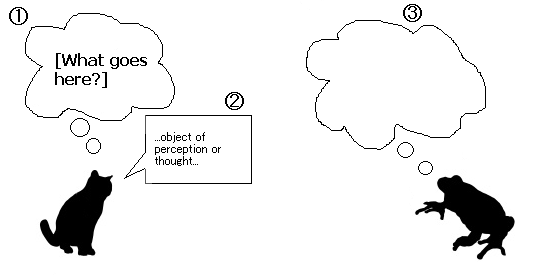
Whenever someone says that they are talking about something outside their experience, they are admitting that that thing was never in their mind. But this raises the fundamental question of what the person is even trying to accomplish by speaking. Are they trying to get a something that is in their mind into your mind? Nope, because they just admitted that the thing they are “talking about” is not in their mind.
Naturally one has to wonder where that thing or object is. Do they purport to merely be relaying a communication from some other people who did experience that thing or object? If so, how did that person do it? It’s just a big confidence game. All we have are our experiences. To speak of something that is literally “beyond experience,” in the strict sense, is to speak nonsense; those words can’t point to anything.
I think you are being uncharitable…
I can’t say I’ve come away from reading anyones post thinking they are referring to things that they never think of…
rather perhaps you are referring to them putting the focus on the target of an idea rather than the idea itself, what Kan’t would call the thing in itself.
Consider this apple on this table, obviously I have the idea of an apple on the table and so do you (maybe!) ,… Im not asking you to think about my idea of it, which might include information like that I am the one thinking about it, rather I wish you to consider (spawn an idea) of the apple on the table. its the apple on the table I want to tell you about, not so much your idea of the apple I want to tell you about or that Im one of the people thinking about it…
Sure, draw me a picture of an apple, take a photo, point with your finger, or just describe what you see enough that I don’t mistake it for something else.
Yet if we go back to the little graphic of the cat and frog above, what is in the cat’s mind is an image of an apple, and then that appears in the frog’s mind. Good, they have communicated successfully.
However, what ends up in the frog’s mind is not “something beyond experience called the apple itself,” but an image of the apple (and perhaps other sensory impressions). Or more clearly, to any one person the “apple itself” just is those sensory impressions (round, red, hard, fits in hand, smells apple-like, can be cut, etc.). The reason we can communicate about apples is that other people also apparently experience those same sets of sensory impressions, so we can name them and use those names consistently so that everyone experiences the same thing when someone says “apple.”
AJ, is there any difference between an idea of an apple on a table with this colour, smell ,taste, + lots of other predicates,
and a similarly complex idea but combined with notion that this apple on table idea refers to a particular something out there in the world which others might stumble across for themselves as it is not imaginary ?
I.e. does such a notion makes sense?
No you have it exactly right, because the key thing I neglected to mention is the matter of “they might stumble across [the apple] themselves.” In other words, when I say, “There’s an apple over there,” I’m not simply picturing an apple over there; otherwise it would be no different than daydreaming. I am picturing an apple over there and and feeling something that lets me know it could affect my actions.
I’m not sure what form this “feeling something” takes - whether it is a slight bodily sensation that distinguishes between “real” and “imagined” or if it is a movie I see of me tripping on the apple, etc. - but it has to be there.
However, all this still respects the communication process. I believe that I could trip if I walk forward (because “there’s an apple over there”), and if you are similarly positioned you will interpret those words in a similar way, of course depending on why it’s important to your action. In other words, if you are bound to a wheelchair you won’t worry about tripping on the apple, but you might want to eat it, or any other number of possible actions that involve the apple.
This still all stays within the realm of perception, never beyond it.
I thought your position was that in theory there could be a satisfactory argument (proof) of objective ethics, but that AE is not it. But here you are making the stronger statement that objective ethics is an incoherent nation, i.e. that ethics is a subjective discipline like aesthetics.
My question is how could you be certain that ethics is subjective? Are you certain that value is subjective, or is it that we have just not seen any kind of proof that value is objective?
@Nir
Another objection to what I’m saying might be: “What if you imagined the other side of the apple, the part that is hidden from view? What if the part you can see is red and the hidden part is green? That would be beyond your senses, yet you are saying the notion of the other side of the apple is nonsense?”
Actually when you imagine the other side of the apple, you are sensing something. You’re not sensing with your eyes, not sensing in the meaning of “detecting something out there,” but you are experiencing a sensation (an image of a green patch on the other side of the apple). In short, you are imagining something, which may or may not be “there” - that is, may or may not be a reliable guidepost for your actions.
No you’re right, strictly speaking I can only await a coherent definition of “objective ethics.” Both those words have a lot of definitions, and anyone could of course conceivably come up with a new one that allows the term to make sense.
Why do I say that value is subjective? Because value requires a valuer. To me, the noun value is derived from the verb value. I make this case in detail here. An excerpt:
The reason I find all value to be fundamentally subjective is that subjectivity is inherent in my interpretation of the word value itself. Why should you care how I interpret the word value? Because you just might interpret it in the same way. Stop me where we differ:
-
It seems to me that the noun value is just a nominalization of the verb to value. Just as we can’t have exploitation without an exploiter, I don’t see what it would even mean for there to be value without some entity doing the valuing. (Could be man, God, or anyone.)
-
Since I reject methodological collectivism (in both economics and philosophy in general), the entity doing the valuing has to be an individual, not a group. (Could still be God, any individual person, etc.)
-
Therefore the only way I see to interpret the noun value is to refer to some individual entity valuing something (the act of individual valuation).
-
The act of individual valuation of something is exactly what I mean by the term subjective valuation, A.K.A., subjective value. Hence, the only way I can see to interpret the noun value is as (automatically) “subjective value.” All value is subjective because all acts of valuation are subjective (that is, done by an individual, even if it is God doing the valuing).
All that said, I think it would be much clearer if we never used the word value as a noun, but instead substituted a word like valuing or valuation. That way, the connection to the verb “to value” would not be lost, and then - I think - anyone who adheres to methodological individualism would automatically understand the word valuation to refer to a subjective phenomenon (something an individual does).
Thing to remember when discussing ethics is that ‘value’ in ethics, is rather different from ‘value’ in economics, it is in fact a metaphor that plays off of the meaning from economics.
In economics value is a subjective phenomen and is used in the mental construct whereby we posit a value scale for an agent so that we might have a teleological understanding of the agents actions. ‘value’ is said to be demonstrated when an agent demonstrates doing one thing over another thereby demonstrating that ex-ante they ‘valued’ this over that
In ethics, ‘values’ are propositions with weight attached to them. Someone that says ‘being honest is a core value of mine’ is not using value in the economic sense, but rather using is metaphorically to motivate the idea that he puts weight, or importance on such dictums/rules/norms/behaviours. This is quite different, and I wan’t people to be aware of this confusion where the terminology is quite common in two spheres but quite different.
To Nir and Graham Wright,
There is a graphic elaboration on what I’ve just been saying here (drag with mouse, zoom with mousewheel). It’s very rough and a work-in-progress, but it should be of some help if what I’m saying sounds bizarre. It doesn’t cover morality specifically, though, yet.
I could perhaps agree that these valuations (the economic and ethical) are of a different nature. The thing I have a problem with is the nominalization (that is, to make into a noun) of the word “value.” As long as value is used as a verb, it should be clear that only individuals can value.
And maybe this is a key out of this debate: we can drop the objective/subjective line of debate and instead just look at individualist vs. collectivist analysis. What I am saying, I suppose, is that valuation is something individuals do, not groups. It is in that sense necessarily subjective - but to avoid the confusion that the terms objective and subjective bring, I can simply say that individuals value certain dictums/rules/norms/behaviors. Perhaps that would lay the debate to rest?
Does this mean that when a mathematician or logician does their thang, they are not saying things that are real about the world ?
I tend to assume that people are only interested in what mathematicians and logicians come up with because they enlighten us about the world, and help us cope with it…I tend to think that they are real enough.
(For colour I would add that there is a Feynman quote about mathematics being natures language…)
Logic and math tell us things about statements, or about information, which can be useful in making decisions that involve the real world. “2+2=4” doesn’t tell us anything about the world all by itself. It just says that if you have the information “two apples are in my left hand” and “two apples are in my right hand,” you can convert that into the information: “I have four apples in my hands.”
Don’t we know that the world is one in which 2+2=4 and not where 2+2!=4 ?
or in otherwords, logic and math tell us things about statements or about information, that hold true in what world ?
I’m groping at something like Goedel taught us that we live in a world in which its not possible for any non-trivial axiomatic systems to be both consistent and complete…that was in doubt before he proved it…logicians entertained the notion that it may have been possible for some axiomatic systems to be consistent and complete, they were unsure, but then…they got some more facts about the world. Through what sense?