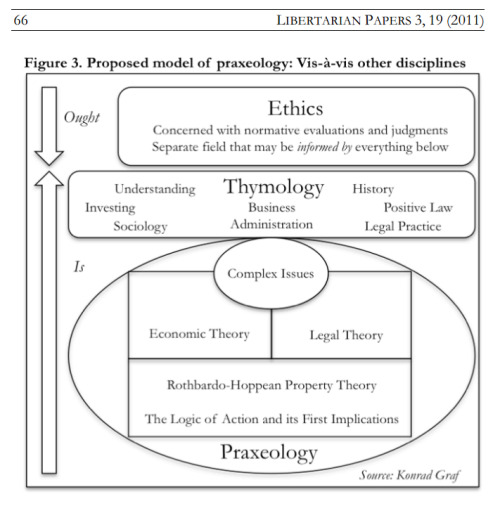
Re: "I’ve recently changed my opnion on natural law, from “no way, this is stupid” to “this can make a whole lot of sense when treated properly.” One of the things that I think turns a lot of people off though, is the meta-ethical stances of people like Rand and Rothbard which seems to say something along the lines of “this is true in all cases for all people no matter what.”…
Eh? They are dealing with political philosophy. Stuff that is universalizable. It’s meta-normative, they’re not saying what you OUGHT to do or SHOULD do, it’s what you have a RIGHT to do. That’s it.
Properly framed, it’s not ‘ethics’ at all.. it’s action based jurisprudence.[1] The natural law argument is axiomatic-deductive in that it shows the praxeolgical absurdity of all other ethics. The a priori of argumentation and communication as per Hoppe (which Rothbard also agreed to), establishes praxeology within the ‘legal sphere’ (i.e what Rothbard’s TEOL was all about) and other Austro-Libertarian scholars have put forward, but just from a more evolved foundation - although there need not be any contradiction.
"Nevertheless, by coming out with a genuinely new theory (amazing in itself, considering the long history of political philosophy) Hoppe is in danger of offending all the intellectual vested interests of the libertarian camp. Utilitarians, who should be happy that value-freedom was preserved, will be appalled to find that Hoppean rights are even more absolutist and “dogmatic” than natural rights. Natural rightsers, while happy at the “dogmatism,” will be unwilling to accept an ethics not grounded in the broad nature of things. Randians will be particularly upset because the Hoppean system is grounded (as was the Misesian) on the Satanic Immanuel Kant and his “synthetic a priori.”
Randians might be mollified, however, to learn that Hoppe is influenced by a group of German Kantians (headed by mathematician Paul Lorenzen) who interpret Kant as a deeply realistic Aristotelian, in contrast to the idealist interpretation common in the United States.
As a natural rightser, I don’t see any real contradiction here, or why one cannot hold to both the natural-rights and the Hoppean-rights ethic at the same time. Both rights ethics, after all, are grounded, like the realist version of Kantianism, in the nature of reality."
— Murray N. Rothbard, Beyond Is and Ought
[1]
“Deductive legal theory, when properly applied in a given context, objectively and descriptively defines the parameters of what justice is in relation to questions of property rights, contracts, torts, and other legal matters. This yields a deeper-than-expected foundation for the traditional libertarian insistence on not mixing law with morality and the corollary opposition to “legislating morality.” Legal theory is a discrete field that, like Mises’s conception of economic theory, can provide descriptive, categorical input for use in “ought” considerations, even as legal theory and ethics remain distinct in foundations, scope, and method.”