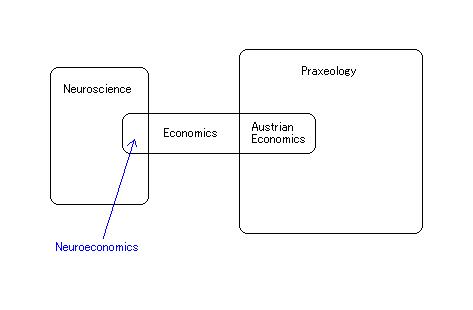
The classic mistake in trying to scientifically model other people (e.g., economics, linguistics, neuroscience) is to mix up the two methods (one being modeling other people on yourself, and the other being modeling them strictly as 3D objects).
Mises tried to avoid that error. He referred to “praxeology” as “the science of human action” (not simply movement or behavior!), and he called “economics” a branch of praxeology. He simply tried to say, “Look, I’m over here doing this, and you’re over there doing that. I think that what I’m doing is more useful at this point in history, but maybe some day that will change.”
So yeah, I wouldn’t want to call that type of prediction “economics”. Calling them both “economics” would probably lead down a long path to making it much harder to keep the two methods separate from each other.
This is the first time I have heard of the intentional stance and I like it. It very closely mirrors how I go about analyzing objects. You use the most appropriate method available but don’t presume that anything is special.
When I look at a human I am interested in predicting their actions (the only thing I ever care about with regards to other humans) I usually take the intentional stance and this usually meets my needs. However, I do find it useful to sometimes dig a bit deeper and take the design stance so I can better understand how the human works and therefore predict their behavior. This is where cognitive psychology, sociology and anthropology come into play in my opinion. On very seldom occassions I will dig even deeper for the answer which requires the physical stance (neurobiology).
It does seem that this is quite similar to what others are saying in this thread but I definately like the wording here better since it acknowledges that humans are not special while still explaining why we treat them differently in some cases than other objects we interact with.
I don’t think you can predict events with a different framework than the framework you use to explain them. The neurobiological processes in the men whose actions lead to one drop in an interest rate will be hugely different from the neurobiological processes in the men whose actions lead to another drop in an interest rate, even if the two interest rate rises have largely the same economic causes, because the particular emotional states and reasonings that lead different men to pursue basically the same economic actions (saving more, expanding the money supply, etc) will be hugely different from case to case. Only the teleological reasonings of entrepreneurs and other forecasters (which can actually understand the notion of economic causes) can even begin to predict teleological events.
I disagree with the assertion that cognitive neurscience/psychology does not provide a benefit to macroscopic human prediction. Understanding how humans work individually can give us a better understanding of how they “tend” to work which leads to statistically more accurate assumptions.
While I will not claim that the dictator game applies directly to real economics (you can’t model an economy in a lab), I will suggest that it gives incite into human behavior which can be beneficial when applied to economic predictions. In the case of the dictator game it shows us that framing effects how humans react. If they believe that a figure of authority has suggested a particular action is not the “most mean” action they will react differently than if such a suggestion is not provided.
This means that when a president (someone many people think of as a figure of authority) suggests that “things could be worse” economists can take that into consideration when attempting to predict market performance.
It seems to me, just from experience, that we can predict events without even explaining them at all. Predicting from neurobiological processes seems far fetched to me, but simply by statistics I can predict how someone will act. I don’t need to know why or how a rock falls when I let go of it, to predict that it will fall with high accuracy. I also don’t need to know why or how a store clerk will decide to sell me a candy bar in order to accurately predict that he will.
An analogy for my above post is that of particle physics. When we are looking to understand how to most effectively build a bridge we generally don’t care about the interactions between quarks, atoms or molecules. However, by having a strong understand of particle physics we are better able to understand the more abstract concepts surrounding various materials, friction, erosion, etc. which all combine to allow us to build more effective bridges.
Also, particle physicists discover things that are used by chemists who are then able to discover things used by bridge builders. So even if there is not a direct link between two disciplines it does not mean that they do not indirectly effect each other. Neurscientists may discover things that allow psychologists to discover things which economists can use to better predict human action.
As Danny Sanchez has pointed out, the notion of “human action” presumes the notion of “intentionality”.
Just because the teleological perspective is a lower-resolution view of reality does not make it useless. When astrophysicists model the behavior of galactic clusters, do they necessarily model every atom in every star in every galaxy under analysis?
“Illuminating” in what way(s), exactly? Do you mean such approaches can provide insight into the underlying mechanisms behind human action? For example, my understanding is that goal-seeking behavior in humans is correlated with relatively high levels of dopamine in the brain, whereas satiation behavior is correlated with relatively high levels of serotonin in the brain. While I personally find such information to be very interesting and insightful, I don’t see how it renders concepts like “means”, “ends”, and “utility” as useless or invalid. Just because a solid object is actually composed of untold numbers of separate atoms doesn’t mean we should abandon the concept of “solid object”!
To bring back in the original topic of this thread, here is a footnote I’m adding to my paper, in which I present my case against the action axiom more fully:
Many followers of Mises have characterized praxeology as deductions from an “action axiom”. And some say that this “action axiom” is “humans act” or “action is purposeful behavior”. It is important to note that Mises never used the term “action axiom”. Mises used “human” basically as a synonym for “actor”. So saying “humans act” is tantamount to saying “acting beings are acting beings”. Furthermore, “purposeful behavior” means nothing more and nothing less than “action”. Therefore saying “action is purposeful behavior” is tantamount to saying “action is action”. Thus both “axioms” are pleonastic, and nothing useful can be deduced from them. Praxeology is the unbundling of the implications of a conception, not of a proposition. Praxeology stems from the conception we think of when we hear the single term “action” (or any of its translations or synonyms), not from the proposition “action is purposeful behavior”. When Mises wrote “action is purposeful behavior”, he introduced “purposeful behavior” as a clarifying substitute for “action”, just in case readers are thinking of another meaning of the word “action”, not as the second half of non-pleonastic proposition from which to derive theorems. Mises derived praxeology from the a priori category of action, not the “action axiom”. The propositions immediately implied by the category of action might be considered axioms (e.g., “Action always involves the passing of time.”), because they are actually propositions, and thus can be used for edifying deductions. But terms (“action”) and pleonasms (“action is action”) cannot be so used.
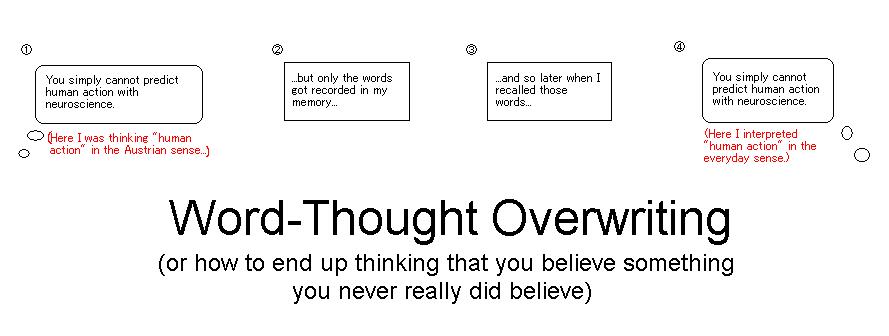
It seems there is a word-thought overwrite to watch out for, in that someone who doesn’t want to label “human action not analyzed teleologically” as “human action,” will say to themselves, “You can’t predict human action [Austrian sense] with neuroscience.” But later, or immediately, they might turn around - remembering the words - and say to themselves, “You can’t predict human action [casual sense of “any body movement a human will make”] with neuroscience.” That is, they store the words interpreting them in one sense, but when they go to recall the words they are interpreted in a different sense.
But since you trust your past judgment about what you were certain of before, and since you are totally sure that those words represented your thought, you seemingly have no choice but to believe them. Yet if you didn’t notice the different interpretations between when you recorded the words into memory and when you recalled them, you end up believing that you believed something different. And whatever you believe you believe, you, well, tend to believe. And viola, you ended up thinking you are quite certain of some well-reasoned judgment that, in fact, is different from the real conclusion you actually came to and were certain of.
(By the way, this is just an example. I’m not saying anyone is doing this specific one. It’s an extremely important concept in general because it is the actual mechanism by which most of the semantic dust gets created that we can see in almost any debate, so I am taking this opportunity to introduce it.)
While I definitely agree with you about economics (and praxeology in general) presupposing teleology, I think that at least some teleological phenomena are embodied in patterns and processes found within the brain. For example, I think preferences and purposes are embodied in this way. One could say that they’re emergent on intra-individually. Costs and proceeds, on the other hand, seem to be emergent inter-individually.
Ah, apparently I misunderstood you up above. It seemed to me that you were saying that preferences and purposes (at least) are not caused by brain patterns and processes. Certainly I agree that our minds intuitively grasp teleology in a fundamentally different way from causality.
I think teleological concepts could be explained in terms of causality alone, but those explanations would be incredibly complex. It would be like trying to explain how an airplane flies solely in terms of individual atoms.
That’s what happens when you record a definition (“human action” used in the AE sense) in the form of an assertion (“you can’t predict human action with neuroscience”).
This. I think what you describe above is due to people being used to ascribing certain meanings to certain words or phrases. So it can be very difficult for them to use wildly different meanings instead. “Action” in a physical sense vs. “action” in an economic sense seems to be a good example of this phenomenon.
It’s pretty obvious when even the anti-teleologist is talking about neuroeconomics that all parties are talking about human action in the “economic” sense..
But not every human action is analyzed teleologically. I can analyze someone throwing his fist in the air as being elated - an experience I can model after the example of my own - or I can analyze it as something that that person is simply “doing” (simply a way that their body is moving for no reason I can fathom). My point is that even if I see a “human action” as nothing more than a movement of an bunch of atoms, and even if I think nothing of teleology, I will still have cause to call that human action (but not in an Austrian sense).